Tokenized Cash: From Crypto Concept to Bank Reality
— By Whatsertrade in Analysis
Explore how BMO, CME, and Google Cloud are turning tokenized cash into an institutional finance solution.
For years, tokenization was treated as a crypto narrative. It sounded promising, but for many institutions it still felt distant, experimental, or disconnected from real financial operations. That perception is now starting to change.
The latest signal is hard to ignore. BMO is set to become the first bank to offer CME’s tokenized cash solution on Google Cloud Universal Ledger, with the goal of enabling 24/7 movement for margin, collateral, and settlement. That may sound technical at first glance, but the bigger message is simple. Tokenized cash is no longer just a concept for crypto founders and blockchain analysts. It is becoming part of the infrastructure conversation inside traditional finance.
That shift matters because it moves the story away from speculation and closer to utility. Instead of asking whether tokenization is interesting, institutions are beginning to ask how it can improve capital efficiency, settlement speed, and operational flexibility.
Why Tokenized Cash Matters
Tokenized cash is one of the most important ideas in the next phase of digital finance because it addresses a real problem. Traditional financial systems are still constrained by business hours, settlement windows, fragmented ledgers, and legacy processes that create friction in moving capital.
In practice, that means institutions often face delays when transferring funds for margin requirements, posting collateral, or completing settlement across different systems. Even in highly sophisticated markets, money does not always move with the same speed as information.
That is where tokenized cash becomes powerful. By representing cash on digital rails, institutions can potentially move value around the clock, streamline back-end processes, and reduce the friction that comes with waiting for conventional banking windows to reopen.
This is why the BMO, CME, and Google Cloud story is much bigger than a single product announcement. It points to a structural change in how financial institutions may handle cash movement in the future.
From Concept to Product
One reason this development stands out is because it changes the frame entirely.
Crypto has long promoted the idea of 24/7 financial rails. Stablecoins, tokenized assets, and blockchain settlement all pushed that vision forward. But when a major bank begins offering a tokenized cash solution tied to core institutional functions like collateral and margin, the market is no longer talking about theory. It is talking about implementation.
That's the important transition.
Tokenized cash becomes more credible when it is positioned as a banking product rather than just a crypto experiment. It becomes easier for institutions to understand because the use case is concrete. Faster settlement, better liquidity management, more flexible collateral movement, and reduced operational bottlenecks.
These are not niche crypto talking points. These are real priorities for banks, clearing systems, exchanges, and large financial firms.
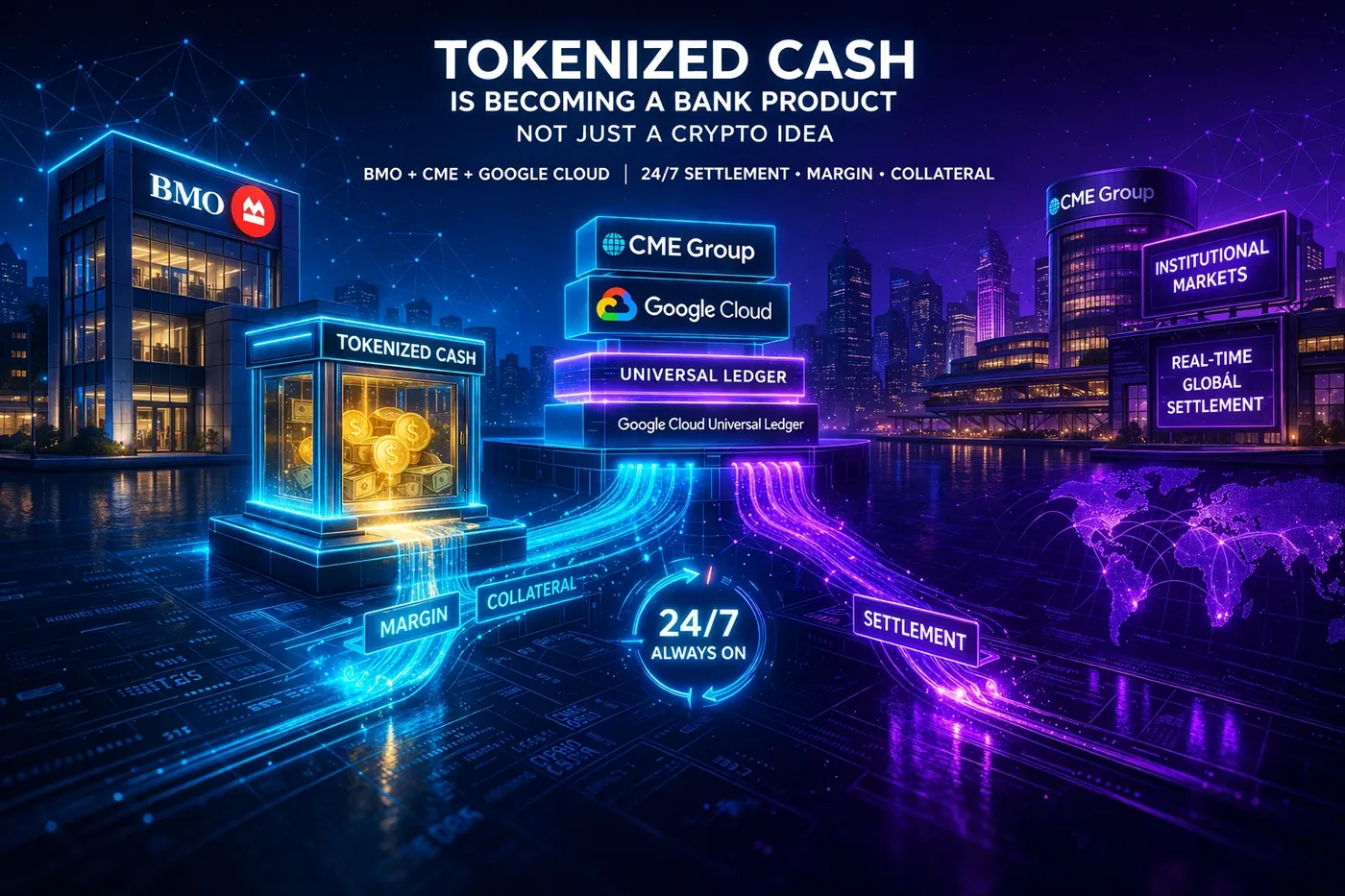
Power Trio: BMO, CME, and Google Cloud
Each name in this story adds weight to the narrative.
BMO brings the banking layer. CME brings the market infrastructure angle. Google Cloud brings the technology backbone. Together, they create a much more institution-friendly version of tokenization than the market often associates with crypto-native experimentation.
That matters because institutional adoption usually does not happen when one company builds a great product in isolation. It happens when trusted players from finance and technology align around a practical use case.
In this case, the use case is highly relevant. Margin, collateral, and settlement are some of the most important plumbing functions in modern financial markets. They are not flashy, but they are essential. If tokenized cash can improve those workflows, then it has a realistic path into the financial mainstream.
This is why the story deserves more attention than a typical market headline. It is not about short-term price action. It is about the infrastructure layer being rebuilt in a more programmable and always-on format.
The Persistence of 24/7:
One of the biggest strengths of tokenized cash is the promise of 24/7 movement.
Traditional finance still operates with many time-based constraints. Markets may trade at one pace, but the underlying movement of funds often happens at another. That mismatch creates inefficiency, especially in global markets where institutions need flexibility across time zones and operational windows.
A tokenized cash solution changes that conversation. It introduces the possibility of moving value continuously, rather than only when legacy systems permit it. That can be especially meaningful in environments where margin calls, collateral transfers, and settlement requirements need to be handled quickly.
This is one reason the tokenized cash narrative fits so well with the broader digital asset space. Crypto normalized the idea that markets do not sleep. Now institutional finance is increasingly exploring infrastructure that reflects the same reality.
Beyond Assets: Tokenization's Reach
Another reason this story is important is that it shows tokenization is not limited to stocks, bonds, or real-world assets.
A lot of the public conversation around tokenization has focused on tokenized securities or tokenized treasuries. Those themes are still important, but tokenized cash may end up being even more foundational. Before a financial system can fully operate on digital rails, it needs a digital version of cash that can move efficiently within that environment.
That's what makes this development so strategic.
It suggests the industry is moving closer to a world where tokenized assets and tokenized cash can operate together inside a more integrated system. In that model, cash is not just sitting on the sidelines as a traditional settlement tool. It becomes part of the same digital infrastructure as the assets it supports.
If that happens at scale, tokenization stops being a product category and starts becoming a financial architecture.
A Crypto-Inspired Shift
Even though this is clearly an institutional story, it still matters for crypto.
For one, it validates a core thesis that crypto markets have pushed for years, which is that digital rails can improve financial efficiency. It also strengthens the broader case for programmable finance, onchain settlement, and always-on capital movement.
More importantly, it shows that the ideas born in crypto are increasingly influencing how traditional institutions think about infrastructure. That does not mean banks are becoming crypto-native. It means they are borrowing some of the most useful concepts from the digital asset world and adapting them for institutional use.
That's a meaningful shift.
The next wave of adoption may not look like retail traders rushing into a new token. It may look like banks, exchanges, clearing firms, and large financial institutions upgrading how value moves behind the scenes.
And that kind of shift can be even more important over the long term.
Realigning Financial Infrastructure
The BMO, CME, and Google Cloud move is not just another tokenization headline. It is a sign that tokenized cash is becoming part of the real institutional roadmap.
That's what makes this story stand out.
It connects banking, market infrastructure, cloud technology, and digital asset logic in one place. It also pushes the tokenization narrative beyond hype and closer to practical financial operations. Margin, collateral, and settlement may not grab attention like meme coins or price rallies, but they are where serious infrastructure gets built.
If tokenized cash begins to scale, the market may look back on moments like this as part of the transition from crypto idea to bank product.
And that may be where the next major chapter of digital finance really begins.
FAQ
What is tokenized cash?
Tokenized cash is a digital representation of cash designed to move on modern financial rails, potentially allowing faster and more flexible settlement, collateral transfers, and liquidity management.
Why is tokenized cash important for institutions?
It can help institutions improve capital movement, reduce operational friction, and support 24/7 workflows for margin, collateral, and settlement.
Why does the BMO, CME, and Google Cloud story matter?
Because it shows tokenized cash is being positioned as real institutional infrastructure rather than just a crypto narrative.
Is tokenized cash the same as a stablecoin?
Not exactly. Both involve digital representations of value, but tokenized cash in institutional finance is typically framed around banking, settlement, and regulated market infrastructure rather than retail crypto usage.
Wall Street's Crypto Push: Tokenized Stocks & Staking US Regulators Open Door for Tokenized Securities Nasdaq, NYSE Owner Race to Put $126 Trillion Equity Market on Blockchain Why AI Agents Will Make Stablecoins the Default Payment Layer of the Internet