10 Best Stablecoins 2026: Safety, Yields & Use Cases
— By Whatsertrade in Tutorials

Explore 2026's stablecoins, including USDT, USDC, and DAI. Discover their distinct advantages and use cases for traders, DeFi users, and institutions.
Best Stablecoins in 2026: Pros, Cons, and Which One Makes Sense for You
Stablecoins have become one of the most important sectors in crypto. They are no longer just a safe parking place during volatility. Today, they are the foundation of trading, DeFi, payments, remittances, tokenized finance, and onchain liquidity.
But not all stablecoins are built the same way.
Some prioritize liquidity. Others focus on transparency, regulation, decentralization, or yield. That is why comparing stablecoins in 2026 is not just about asking which one is biggest. The real question is which stablecoin is best for each type of user.
For traders, deep liquidity matters most. For institutions, compliance and reserve quality are critical. For DeFi users, censorship resistance and composability often come first. And for yield hunters, synthetic models are becoming more attractive.
In this guide, we compare the top stablecoins in 2026, including USDT, USDC, USDS, DAI, USDe, PYUSD, and RLUSD, and break down their pros, cons, and ideal use cases.
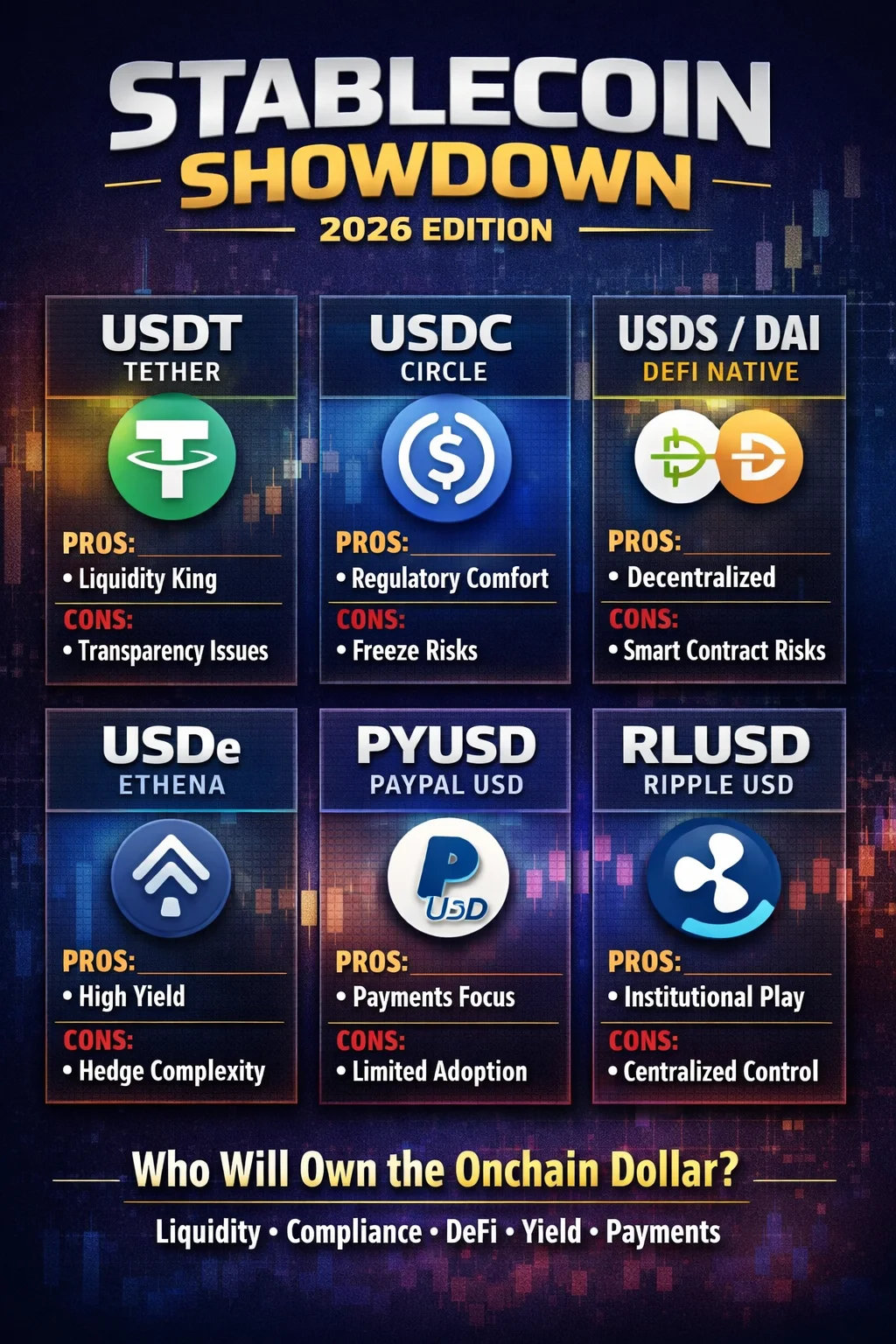
Stablecoin Comparison Table 2026
Here is a side-by-side comparison of the top 7 stablecoins in 2026.
Quick Decision Guide
Video: How Do Stablecoins Work?

Why Stablecoins Matter More Than Ever
The stablecoin market has evolved from a simple crypto niche into the dollar layer of the digital asset economy. Stablecoins now serve several key functions:
- Trading pairs on centralized and decentralized exchanges
- Collateral in lending and borrowing protocols
- Settlement assets for onchain payments
- Bridges between traditional finance and blockchain
- Yield strategies across DeFi ecosystems
This growth has also made the stablecoin debate much more sophisticated. The market is no longer choosing between only centralized and decentralized options. It is now comparing reserve-backed dollars, overcollateralized crypto dollars, synthetic dollars, and payment-focused stablecoins.
That shift is what makes 2026 such an interesting year for stablecoin analysis.

USDT: The King of Liquidity
USDT remains the dominant name in stablecoins because of one simple advantage: liquidity.
It is the default dollar pair across much of the crypto market and still plays a central role in trading activity worldwide. For many users, especially active traders, USDT is the most practical stablecoin because it is listed almost everywhere and supported across multiple chains and exchanges.
Pros of USDT
USDT has unmatched liquidity in many markets. It is widely accepted across centralized exchanges, decentralized platforms, and offshore trading environments. For traders who need fast execution and deep order books, it often remains the most convenient option.
It also benefits from strong network effects. Because so many platforms support it, its utility reinforces itself.
Cons of USDT
The main criticism of USDT has always been transparency. Even though confidence around Tether has improved over time, the project still faces more scrutiny than some competitors when it comes to reserves, disclosures, and overall structure.
It is also a centralized stablecoin, which means freeze risk and compliance intervention remain part of the equation.
Best for
USDT is best for traders, high-volume market participants, and users who prioritize liquidity above all else.

USDC: The Transparency and Compliance Favorite
USDC has built its reputation around regulatory alignment, reserve clarity, and institutional trust. In many ways, it is the stablecoin that appeals most to users who want a cleaner compliance narrative and more comfort around how reserves are managed.
Pros of USDC
USDC is often viewed as one of the strongest options for transparency. It has positioned itself as a more regulation-friendly stablecoin and tends to be favored by institutions, fintech platforms, and users who value lower perceived reserve risk.
It also has strong integration across major DeFi protocols and onchain ecosystems, making it useful far beyond centralized exchanges.
Cons of USDC
Its biggest weakness is the same thing that many users see as a strength: regulation. Because USDC is closely tied to a compliant corporate structure, it carries a higher perception of censorship risk for crypto-native users who want minimal reliance on centralized control.
That can make it less attractive for those who prefer the ideological side of decentralization.
Best for
USDC is best for institutions, conservative crypto users, DeFi participants who want a reserve-backed dollar, and anyone who values transparency and regulatory comfort.

USDS and DAI: The DeFi Native Stablecoin Model
USDS and DAI represent a different philosophy. Rather than focusing mainly on corporate issuance and reserve management, they come from the DeFi world and reflect a more protocol-driven approach to digital dollars.
DAI has long been one of the best known decentralized stablecoins, while USDS is part of the broader evolution of that ecosystem.
Pros of USDS and DAI
Their biggest advantage is crypto-native design. These stablecoins are deeply integrated into DeFi and are often more aligned with the values of onchain finance, governance, and permissionless access.
They are also highly relevant in lending, borrowing, collateral, and treasury strategies across DeFi.
Cons of USDS and DAI
The downside is complexity. These systems are harder for mainstream users to understand than a simple reserve-backed stablecoin. Their architecture, collateral mechanics, governance, and protocol dependencies can feel less intuitive.
They also carry smart contract and ecosystem risk, which makes them less straightforward for beginners.
Best for
USDS and DAI are best for DeFi users, governance-focused investors, and crypto-native participants who want deeper alignment with decentralized finance.

USDe: The Yield-Oriented Synthetic Dollar
USDe stands out because it does not try to be a traditional fiat-backed stablecoin. Instead, it represents the rise of the synthetic dollar model in crypto.
This makes it one of the most interesting stablecoins in the market, but also one of the most misunderstood.
Pros of USDe
Its biggest appeal is that it is designed to be capital efficient and deeply embedded in crypto-native market structure. It offers a different vision of the onchain dollar, one that is not simply backed by cash and treasuries, but structured through hedging and derivatives-based mechanisms.
For users seeking yield and exposure to advanced DeFi strategies, USDe has become a major talking point.
Cons of USDe
USDe is not the same risk category as USDC or PYUSD. Its model introduces more moving parts, including hedge execution, counterparty exposure, operational complexity, and market structure dependency.
That does not automatically make it bad, but it does mean users should understand that synthetic stability is not the same as reserve-backed stability.
Best for
USDe is best for experienced DeFi users, yield seekers, and crypto-native investors comfortable with a more complex stablecoin design.

PYUSD: The Payments Angle
PYUSD brings something different to the table. Instead of focusing first on crypto trading or DeFi composability, it leans into payments, fintech distribution, and user familiarity.
That gives it a very different long-term opportunity.
Pros of PYUSD
The biggest strength of PYUSD is distribution. PayPal already has a massive consumer and merchant network, which means PYUSD can benefit from real-world payment rails rather than relying only on crypto adoption.
It also gives mainstream users a more familiar entry point into digital dollars.
Cons of PYUSD
PYUSD still does not have the same level of crypto-native dominance as USDT or USDC. It is more closely associated with payments than with aggressive trading or deep DeFi integration.
That means its relevance in the crypto market depends on whether payment adoption grows fast enough to justify its positioning.
Best for
PYUSD is best for payments, retail adoption, fintech integration, and users who want a more mainstream stablecoin experience.

RLUSD: The Institutional Payments Contender
RLUSD is one of the clearest examples of where the market may be heading next: enterprise-grade stablecoins built for settlement, compliance, and cross-border finance.
It fits into the growing narrative that stablecoins are becoming tools not just for crypto traders, but for corporations and financial infrastructure providers.
Pros of RLUSD
Its main strength is institutional positioning. RLUSD is built around the idea that stablecoins can serve as efficient settlement assets for regulated business use cases, especially in payments and financial infrastructure.
That makes it attractive for enterprises exploring blockchain without wanting the unpredictability of less structured crypto products.
Cons of RLUSD
The challenge is scale and network effect. Institutional narrative alone is not enough. A stablecoin also needs broad usage, liquidity, and ecosystem support. Competing with USDT and USDC on that front is difficult.
RLUSD also shares the same centralization concerns that apply to most corporate-issued stablecoins.
Best for
RLUSD is best for enterprise payments, institutional crypto infrastructure, and users who believe the next growth wave in stablecoins will come from regulated finance.
Which Stablecoin Is Best in 2026?
There is no single winner, because each stablecoin solves a different problem.
If you want the most liquid dollar in crypto, USDT still leads.
If you want transparency and regulatory comfort, USDC stands out.
If you want DeFi-native exposure, USDS and DAI make the most sense.
If you want a synthetic yield-oriented model, USDe is the most interesting option.
If you want payment distribution, PYUSD has a strong angle.
If you want enterprise and institutional positioning, RLUSD is one to watch.
That is the real story of the stablecoin market in 2026.
The competition is no longer only about holding a one dollar peg. It is about who can own the future of digital dollars across trading, DeFi, payments, and tokenized finance.
Final Take
The stablecoin wars are entering a new phase.
For years, the conversation was mostly about trust, reserves, and whether a token could hold its peg. Those questions still matter. But now the market is bigger, more mature, and more segmented.
Today, stablecoins are competing across five major dimensions: liquidity, transparency, decentralization, yield, and distribution.
That means the best stablecoin is no longer the same for everyone. It depends on what you need from your onchain dollar.
And that is exactly why stablecoins remain one of the most important sectors to watch in crypto right now.
FAQ: Stablecoins in 2026
What is the safest stablecoin in 2026?
That depends on how you define safety. Some users prioritize reserve transparency and regulation, while others focus on decentralization or reduced censorship risk.
What is the most popular stablecoin?
USDT remains the most widely used stablecoin in much of the crypto trading market.
What is the best stablecoin for DeFi?
USDS, DAI, USDC, and USDe are all relevant in DeFi, but each serves a different purpose depending on whether you want collateral, liquidity, or yield.
What is the difference between fiat-backed and synthetic stablecoins?
Fiat-backed stablecoins are typically backed by cash, treasuries, or cash equivalents. Synthetic stablecoins use other mechanisms, such as collateral structures or hedging strategies, to maintain price stability.
Are stablecoins good for long-term holding?
They can be useful for preserving dollar value inside crypto, but each stablecoin carries different risks related to reserves, governance, centralization, or protocol design.
Stablecoin Yield Compromise Euro Stablecoins Tokenized Stocks & Staking Tokenized Assets in DeFi Stablecoins as Payment LayerConvert Stablecoins and Crypto to USD
Need to check the current value of your crypto holdings? Use our free live converter tools to convert any cryptocurrency to USD in real-time:
- BTC to USD Converter - Live Bitcoin price calculator
- ETH to USD Converter - Live Ethereum price calculator
- SOL to USD Converter - Live Solana price calculator
- BNB to USD Converter - Live BNB price calculator
- XRP to USD Converter - Live Ripple price calculator
- DOGE to USD Converter - Live Dogecoin price calculator
Learn More About Crypto Wallets
Before buying stablecoins, you need a secure wallet to store them. Check our complete guide:
- How to Use Phantom Wallet - Step-by-step tutorial for Solana''s most popular wallet
Related Guides
- TRON vs Solana: Speed, Fees and Use Cases Compared (2026)
- Looping Strategies: How to Leverage Stablecoin Yields Safely
- Where to Stake ETH: Top 2026 Platforms for High Yields
- What is Polygon zkEVM? Architecture and Use Cases (2026)
- What Does XRP Do? Real Use Cases & Utility Explained (2026)
Frequently Asked Questions
What is a stablecoin?
A stablecoin is a cryptocurrency designed to hold a steady value, usually pegged to a fiat currency like the US dollar. It aims to combine crypto's flexibility with reduced price volatility.
What is the difference between USDT, USDC, and DAI?
USDT and USDC are centralized stablecoins backed by reserves held by their issuers, while DAI is a decentralized stablecoin backed by crypto collateral managed by a protocol. They differ in how their pegs are maintained and who controls the reserves.
Are stablecoins safe?
Stablecoins reduce price volatility but carry their own risks, including reserve quality, issuer trust, regulatory action, and the possibility of losing the peg. No stablecoin is completely risk-free.
What does it mean when a stablecoin depegs?
A depeg occurs when a stablecoin trades away from its intended value, such as a dollar-pegged coin slipping below one dollar. Depegs can result from loss of confidence, reserve issues, or extreme market stress.