Nasdaq, NYSE Owner Race to Put $126 Trillion Equity Market on Blockchain
— By Whatsertrade in News
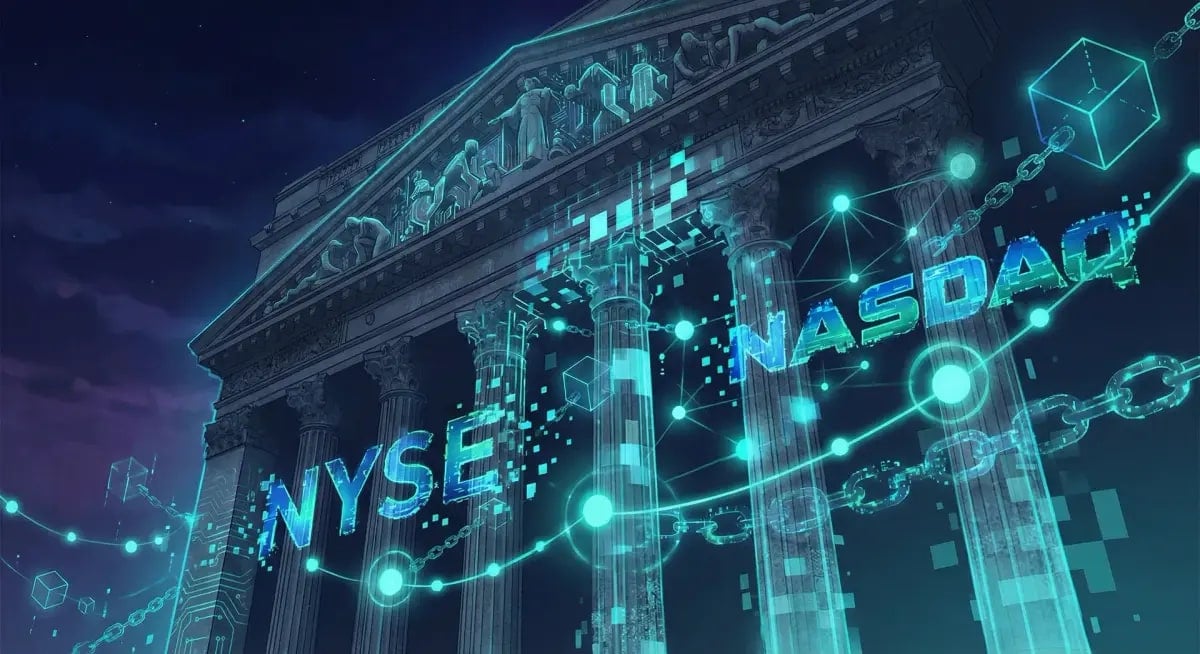
Nasdaq partners with Kraken and NYSE owner ICE invests in OKX at $25B valuation as Wall Street races to tokenize the $126 trillion global equity market on blockchain.
Wall Street's Biggest Exchanges Are Going Onchain
In a move that signals the definitive convergence of traditional finance and crypto, the two most powerful exchange operators in the world are racing to bring the entire $126 trillion global equity market onto blockchain rails.
Over the past week, Nasdaq partnered with Kraken's parent company Payward to develop a framework for tokenized stocks, while Intercontinental Exchange (ICE), the parent company of the New York Stock Exchange, made a strategic investment in crypto exchange OKX at a staggering $25 billion valuation.
The Everything Exchange Is Coming
For decades, stocks, bonds, and funds have traded on separate, siloed systems with rigid trading hours. Blockchain technology promises something radically different: a unified, always-on marketplace where every financial asset can settle as tokens, 24 hours a day, 7 days a week.
Antoine Scalia, founder and CEO of crypto compliance platform Cryptio, calls this the everything exchange -- a marketplace where all asset classes trade on the same infrastructure.
Nasdaq + Kraken: Tokenized Stocks by 2027
Nasdaq is developing a framework that would allow publicly listed companies to issue blockchain-based versions of their shares while preserving traditional ownership rights and governance structures. To distribute those tokenized stocks globally, the exchange is working with Kraken.
The offering could go live as soon as the first half of 2027, making it one of the most ambitious tokenization projects ever attempted by a legacy exchange.
ICE + OKX: A $25 Billion Bet
Meanwhile, ICE revealed a strategic investment in OKX at a $25 billion valuation. The deal includes plans to launch new tokenized stocks and crypto futures, allowing the NYSE's parent company to tap into OKX's massive 120 million user base.
This is not a small experiment. This is the owner of the New York Stock Exchange placing a multi-billion dollar bet that the future of trading runs on blockchain.
Why This Changes Everything
The biggest advantage of putting traditional equities on blockchains is continuous price discovery. Unlike traditional stock markets, which operate on fixed hours, blockchain-based assets never sleep. This could unlock more capital, improve liquidity, and reduce the kind of overnight volatility gaps that have plagued markets for decades.
The numbers support the trend: tokenized equity markets have tripled since mid-2025, according to RWA.xyz data. A joint report by Boston Consulting Group and Ripple forecasts that tokenized assets could grow 53% annually, reaching $18.9 trillion by 2033.
The Frenemy Dynamic
What makes this particularly fascinating is the relationship between traditional and crypto-native exchanges. They need each other: traditional exchanges want access to crypto traders, while crypto platforms want the credibility and distribution that established financial infrastructure provides.
The SEC Green Light
This entire movement was accelerated by a January 2026 SEC Staff Statement on Tokenized Securities, which clarified that tokenized equities carry the same legal weight as their traditional counterparts. That gave Wall Street the legal cover it needed to enter the tokenized equity market with confidence.
What This Means for Crypto Traders
For crypto natives, this is validation on a massive scale. The institutions that once dismissed blockchain as a fad are now rebuilding their entire infrastructure around it. The $126 trillion equity market moving onchain means more liquidity, more trading pairs, and a future where the line between crypto and stocks simply disappears.
The race for the everything exchange has begun. And both Wall Street and crypto are running.