Token Analysis: First 48 Hours Checklist (2026 Sniper Guide)
— By Whatsertrade in Tutorials
Master the first 48 hours of any token launch with this checkpoint framework. Tools, position sizing, smart money tracking, and exit triggers per phase.
Token Analysis: The First 48 Hours Checklist (2026 Sniper Guide)
The first 48 hours of a token launch are the most violent, most profitable, and most dangerous window in all of crypto. More than 92% of all pump-and-dump events on Pump.fun complete inside this window. The vast majority of legitimate 100x runners also print their highest risk-adjusted returns during the same period. If you cannot read what is happening in those 48 hours, you will either rug yourself out of generational trades or hand your wallet over to a snipe bot before lunch.
This guide is a time-boxed, checkpoint-based framework for analyzing a brand new token from the moment its liquidity pool is created (T+0) through the second-day dump survival test (T+48). At every checkpoint you get a checklist, the exact tools to use, a position sizing rule, and the exit triggers that should make you flip from buyer to seller in seconds.
It is written for the trader who is on DEXTools, GMGN.ai, Photon, or Bullx right now, scanning a brand new contract, and trying to decide whether to ape, scale in, or block. By the end of this article you will have a repeatable system you can apply to every launch instead of relying on gut feel and Telegram screenshots.
Why the First 48 Hours Decide Everything
A token's first 48 hours compress what would normally take months in traditional markets into two days of raw discovery. Bots snipe the launch candle, early buyers test the contract, social momentum builds or dies, the developer either rug-pulls or commits, and a real holder base either forms or evaporates. By the end of hour 48, the token has effectively given you every signal you need about whether it can survive the next week.
The reason this window is so decisive is structural. Liquidity is at its thinnest, which means every buy and sell has outsized price impact. Holder count is at its lowest, which means a single whale can dictate the chart. Information is asymmetric, which means whoever reads the on-chain data first wins. And smart contract risk is at its highest, which means features like mint authority, freeze authority, or hidden taxes can wipe out a position in one block.
- 92% of Pump.fun launches die before hour 24
- 70% of rug pulls execute inside the first 6 hours
- 85% of all-time-high prices for failed memecoins print before hour 12
- 3% of new launches survive past hour 48 with growing holders
- Less than 1% ever return to retest their 48-hour high after a dump
The takeaway is simple: if you do not have a framework for the first 48 hours, you are gambling. With a framework, you are still taking risk, but you are reading the same data professional snipers read, at the same time they read it.
The 48-Hour Timeline at a Glance
Before diving into each checkpoint, here is the full timeline. Treat it as the skeleton you will hang every other section on.
Each checkpoint has a different question to answer, a different toolset, and a different position sizing rule. You do not need to act at every checkpoint, but you need to read every checkpoint.
Pre-Launch (T-1h): Screening Before the Pool Exists
The best trades start before the liquidity pool is even created. This is where you have the most asymmetric advantage because most of the market is not paying attention yet. If a launch is announced on Twitter, Telegram, or a launchpad calendar, you have a real window to do the homework that 99% of buyers will skip.
Your goal at T-1h is to answer three questions: Has this developer launched before? Does the social presence look authentic or astroturfed? Is there an audit, and what does it actually say? Each question maps to a specific tool.
Developer Wallet History
Open the deployer wallet address on Solscan, Etherscan, or BaseScan depending on the chain. Look at the previous tokens this wallet has deployed. If the wallet has launched seven previous tokens that all went to zero within 24 hours, you are looking at a serial rugger. If the wallet has one or two prior launches that still have active holders and liquidity, that is a positive signal. Use Bubblemaps or a similar cluster tool to check whether the deployer wallet is connected to known rugger clusters.
This step alone filters out a huge percentage of garbage. Many traders skip it because it takes five minutes. Five minutes that save five-figure losses are the best time investment in crypto. For the deep version of this workflow, our burner wallet guide shows how to use isolated wallets while you do this research.
Social Presence Audit
Real projects have organic followers, conversational replies, and members with history. Fake projects have follower counts that jumped from 0 to 20,000 in two days, comment sections full of identical emoji responses, and Telegram groups where every member joined in the last 48 hours. Tools like TweetScout or HypeAuditor can quantify follower quality. If the social presence smells like a content farm, it almost always is.
Audit Status
Not every token needs a formal audit, but the absence of one is data. If a project claims to be a serious DeFi protocol, expect an audit from a recognized firm. If it is a memecoin, you should at least see a contract scan from RugCheck, TokenSniffer, or De.Fi showing no obvious red flags like mint authority still enabled, freeze authority enabled, or honeypot patterns.
T+0: The Launch Candle
The instant the liquidity pool is created and the first trade clears, you have less than a minute to make three decisions: enter immediately, wait for snipers to exit, or block the token entirely. Whichever you choose, you must answer these questions in the first sixty seconds.
Minimum healthy LP for a memecoin is 5 SOL or roughly $1,000. Anything less and one whale moves the chart 80%. Anything over 20 SOL suggests the dev is serious.
If the deployer wallet holds more than 5% of supply at launch, you are pre-rugged. Healthy launches show dev wallet at 0% or 1% maximum after the initial buy.
Some launches use anti-bot blocks for the first 60 seconds. This is bullish: it gives humans a chance to enter before snipers extract value.
Use DEXTools or DEX Screener to view the pool the moment it appears. Use RugCheck for Solana or Honeypot.is for EVM to verify the contract is sellable and that mint and freeze authorities are revoked. If the contract has mint authority enabled, the developer can print infinite supply at any moment. Block immediately.
T+15 Minutes: The Sniper Flush
Fifteen minutes after launch, the first wave of sniper bots that bought in block one or block two will start dumping. This is the most violent and most informative period of the entire 48 hours. How the price reacts to the sniper dump tells you whether there is real demand behind the token or just bot-on-bot trading.
Open GMGN.ai or Photon and filter the trade history by wallet age. Sniper bots are wallets less than 24 hours old that bought in the first three blocks. If those wallets are selling at T+15m and the price holds or recovers, you have organic demand. If those wallets sell and the chart collapses to zero, the launch was bot trading without real buyers.
The healthy buy/sell ratio at T+15m sits between 60/40 and 70/30 in favor of buys. Above 80/20, you are looking at coordinated pumping that will reverse. Below 50/50, the snipers have already won and you are buying their bags.
T+1 Hour: The First Real Deep Dive
One hour in, the noise has thinned and you can do actual analysis. This is where you separate the launches worth tracking from the launches worth deleting. At T+1h you are answering five questions in this order.
Use Bubblemaps to visualize wallet clusters. If three wallets that share funding history collectively hold 30% of supply, those are the same person and you are one click away from a rug. If holders are scattered without obvious cluster relationships, the distribution is organic.
Verify the LP lock by checking where the LP tokens went. If they went to a known locker contract like UNCX, Team.Finance, or Mudra Locker, the lock is real. If they went to a random wallet, the dev can pull liquidity any second. If they went to a burn address (zero address), the LP is permanently locked, which is the strongest signal.
T+4 Hours: The Holder Retention Test
Four hours in, the early flippers have already taken profit. The question now is who stayed. Holder retention rate measures how many wallets that bought in the first hour are still holding at hour four. Healthy retention is 60% or higher. Below 40%, the early buyers have lost faith and you are buying their exit.
You can calculate retention by comparing the unique buyer count from T+1h with the active holder count at T+4h. GMGN.ai shows this directly. DEXTools shows holder count over time, which you can use to estimate retention.
Average position size is the second metric. Healthy launches show position sizes between $50 and $500 for the bulk of holders. A token where the average position is $5 is a dust airdrop pump. A token where the average position is $5,000 is whale-dominated and will dump when one whale exits. The middle band is where you find sustainable price action.
Supply distribution stability is the third check. If the top 10 holders at T+4h are the same wallets as the top 10 at T+1h, distribution is stable. If the top 10 list has rotated completely, there is heavy whale movement and the chart will reflect it.
T+12 Hours: Volume and Trending Check
By hour 12, you should be able to tell whether volume is sustaining or fading. Healthy launches show declining but consistent volume, typically 20% to 40% of the launch hour volume. Failed launches show volume collapse to under 5% of launch hour.
Trending presence on aggregators is the second signal. If the token is showing up in the trending tab on DEXTools, DEX Screener, Birdeye, or GMGN, organic discovery is happening. If it is not trending, you have to ask why. Either the marketing is weak or the volume is too thin to register. Both are warning signs unless you are extremely early.
- DEXTools Hot Pairs: Real-time trending by volume and momentum, the industry standard.
- DEX Screener Trending: Cross-chain trending, useful for spotting EVM and Solana side by side.
- Birdeye Trending: Solana-focused, often shows momentum 30 minutes ahead of DEXTools.
- GMGN.ai Trending: Solana sniper-grade trending with smart money filters.
- Photon Trending: Solana trading terminal with built-in momentum scoring.
T+24 Hours: Community and Smart Money
One full day after launch, the community either exists or it does not. Real communities have active Telegram chats with members posting unprompted commentary, Twitter spaces with actual humans, and meme creation from holders that the developer did not commission. Fake communities have 5,000 Telegram members and 12 messages in the last hour, most of them from admins.
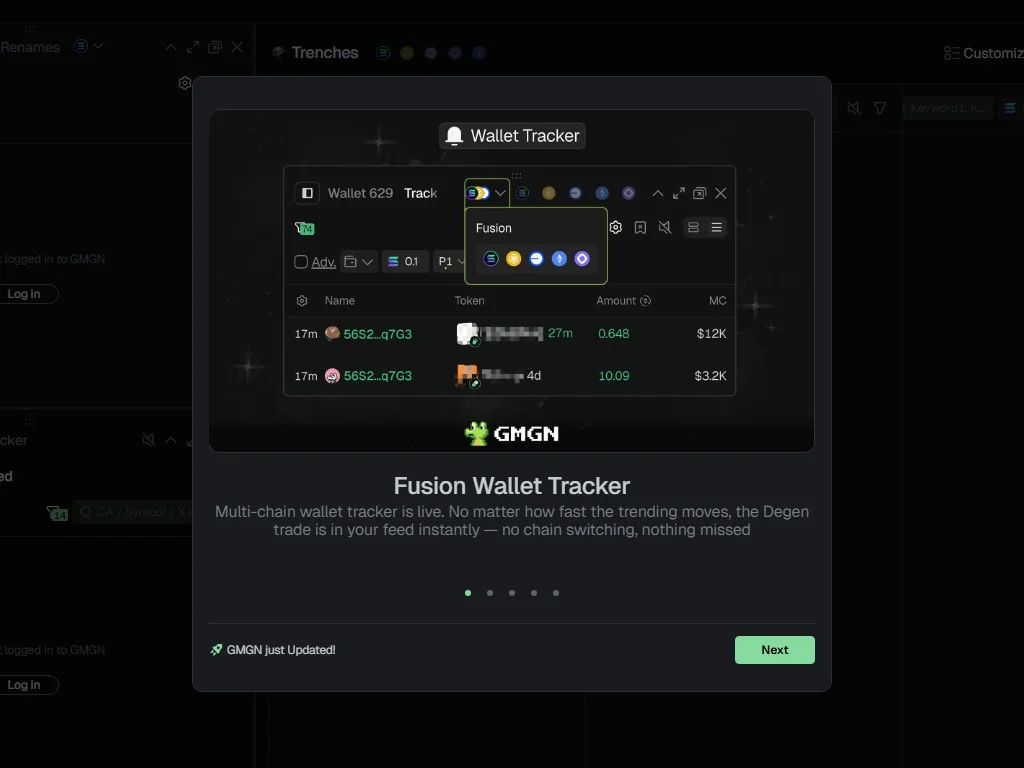
Smart money entries are the second signal and the most powerful one. Smart money wallets are addresses with a history of profitable early entries. Tools like Nansen, Cielo Finance, and Arkham label these wallets. If three or more known smart money wallets bought your token in the past 12 hours, you have institutional-quality conviction behind the play.
Smart Money Tracking Workflow
On Solana, open Cielo and paste the token contract. Filter trades by labeled smart money wallets. You can see exactly which wallets entered, at what price, and how much they bought. On EVM chains, Nansen does the same with stronger labeling but a higher price tag. Arkham Intelligence is free and offers similar functionality with their own labeling system.
The threshold to take a position based on smart money: three or more independent smart money wallets buying within a 6-hour window, none of which sold within the next 12 hours. That is your green light to scale in. If smart money buys and immediately sells, you are not following smart money, you are following bait.
T+48 Hours: The Second-Day Dump Survival Test
Almost every legitimate launch has a second-day dump. It happens between hour 24 and hour 36 as early profit-takers exit and bots rotate. The token's behavior during and after this dump is the final test of the 48-hour framework.
A healthy survivor shows a dump of 30% to 50% from the local high, followed by a base that holds for at least 4 hours, followed by recovery. The recovery does not need to retest the high, but it needs to print higher lows on the 1-hour chart. Holder count during the dump should increase, not decrease. This is counter-intuitive but critical: real communities buy the dip, paper hands sell it.
If the token dumps 80% and never recovers, the launch was a bot game and you should move on. If it dumps and recovers with holder growth, you have a survivor candidate worth swing trading or holding.
Developer Posture at T+48h
The developer's behavior in the first 48 hours tells you everything about whether they intend to build. Healthy developer posture includes responding to community questions in Telegram, posting roadmap updates without overpromising, locking team tokens with vesting visible on-chain, and not selling their personal allocation. Toxic developer posture includes radio silence after launch, deleting Telegram messages, dumping team tokens immediately, or constantly hyping price.
The Full Tool Stack per Checkpoint
Below is the exact toolkit you should have open at each checkpoint. Bookmark these. The traders who win the first 48 hours are the ones who can open six tabs in twelve seconds and know exactly what to look for in each.
Position Sizing Matrix per Checkpoint
The single biggest mistake new traders make in the first 48 hours is sizing every entry the same. Risk is not uniform across the timeline. Sizing should scale with conviction, which grows as more checkpoints pass green. Below is a position sizing matrix that maps checkpoint phase to allocation as a percentage of your dedicated launch sniping bankroll.
This sizing assumes you have a dedicated bankroll for launch sniping that is separate from your long-term holdings. Never use rent money. The 92% failure rate of new launches is real, and you will eat losses. The framework is designed to keep individual losses small enough that one survivor at 30x pays for forty wipeouts.
Exit Triggers per Phase
Sizing in is only half the trade. Exits are where most traders lose. The exit triggers below are phase-specific and should be treated as automatic. If a trigger fires, exit. Do not negotiate with the chart.
LP removed, mint authority enabled mid-launch, dev wallet selling, sell tax suddenly above 50%, contract pause function triggered. Sell instantly.
Volume drops more than 80% from peak, holder count flatlines for over 2 hours, top wallet concentration jumps above 35%, smart money exiting.
Scale out 25% at 2x, 25% at 5x, 25% at 10x, hold 25% as moonbag. Re-enter survivors after T+48h dump if holders kept growing.
For mechanical exits on EVM chains, consider preset limit orders via aggregators. Our slippage configuration guide covers the settings you need to actually get your exit filled when the chart cracks.
Case Study: BRETT, A T+48h Survivor
BRETT launched on Base in early 2024 with no team allocation, fair launch mechanics, and a community that built around the Matt Furie character rather than developer hype. In the first 48 hours, BRETT did everything our framework looks for: LP burned at T+0, dev wallet at zero percent, holder count growing through every dump, smart money wallets entering around hour 18, and a 40% dump at hour 30 that held its low and recovered with higher holder count.
Traders who applied the T+24h smart money check spotted BRETT at sub $5 million market cap. The token went on to peak above $1.7 billion in market cap, returning 300x to T+24h entries. The signal was not on Twitter, it was on the on-chain dashboards.
Another illustrative survivor is DEGEN, also on Base. DEGEN passed the T+1h holder distribution check with the top 10 wallets controlling under 20% combined. Its T+12h volume sustain ratio was textbook at 35% of launch hour volume, and its T+48h dump recovery printed a clear higher low while holder count grew from 4,800 to 7,200 through the dump. Both BRETT and DEGEN are reminders that the highest returns come from tokens that pass every checkpoint, not from the loudest Telegram calls.
Case Study: A Typical Pump.fun Rug
Contrast that with the average Pump.fun launch. Bot snipes the launch, price spikes 50x in five minutes, dev sells their stealth allocation routed through three intermediary wallets, LP is pulled at minute eight, and the contract goes to zero before T+15m. Holder count peaks at 80 wallets, most of which are bot addresses funded from the same source. The token never had a community, never had organic volume, and never had a chance.
The framework filters this trade out at T+0: dev allocation above 5%, LP unlocked, mint authority enabled. If you applied the checklist, you skipped this rug. If you aped from a Telegram call, you became the exit liquidity.
Common Mistakes That Wipe Bankrolls

Even with a framework, traders bleed when they ignore their own rules. The patterns below show up in every wiped bankroll. Recognize them in your own behavior and you will save more capital than the framework itself does.
Aping based on Telegram calls. By the time a token is being shouted in a public Telegram, the call channel has already accumulated and is using your buy as exit liquidity. Always verify the on-chain checkpoints yourself.
Sizing T+0 entries like T+24h conviction trades. The launch candle is maximum uncertainty. If you put 8% of your bankroll on a 60-second-old launch, you are gambling. Phase-appropriate sizing is non-negotiable.
Skipping the contract scan. Mint authority enabled, freeze authority enabled, owner-only transfer functions, and trading pause functions are deal breakers. RugCheck and Honeypot.is take 10 seconds to run. Run them.
Ignoring smart money exits. If three smart money wallets bought at hour 8 and all three sold at hour 20, that is your signal to exit, not your signal to hold. Smart money exits inform smart trader exits.
Chasing the dump. A token that dumped 70% in hour 6 is not a discount. It is a corpse. Reentry is reserved for survivors that completed the T+48h dump recovery test. For more on reading rejection candles and chart structure, our liquidation zones guide covers the price levels where bounces actually trigger.
Chain-Specific Notes: Solana vs Base vs Ethereum
Although the framework is chain-agnostic, the practical realities of each chain change which checkpoints matter most. On Solana, where Pump.fun graduations and meteora pools dominate, the T+0 and T+15m checkpoints carry the most weight because launches are so cheap that thousands happen per day and the median lifespan is measured in minutes. Sniper warfare is also more intense, so the T+15m sniper flush check is non-negotiable.
On Base, launches are slower, fees are higher than Solana but a fraction of Ethereum mainnet, and the median launch quality is noticeably higher. The T+1h and T+12h checkpoints are where Base launches reveal themselves, because there is more time for organic discovery before the chart resolves one way or another. On Ethereum mainnet, launches are rare enough that you can often do extended pre-launch research that simply is not possible on Solana memecoin volume.
Layer 2 ecosystems like Arbitrum and Optimism behave similarly to Base, with the added complexity of bridging dynamics. Watch for tokens whose early liquidity comes disproportionately from bridged stablecoins, which can indicate prepared insider positioning rather than organic discovery.
Integrating With Your Broader Trading Workflow
The 48-hour framework does not replace your broader analysis. It complements it. If you also use techniques like VWAP for entry timing or backtesting historical setups, those tools layer on top of the checkpoint system. The framework identifies which tokens deserve attention. Your technical analysis decides exactly where in the chart to enter.
Wallet security matters too. New tokens often interact with contracts that request token approvals you do not need to grant. Read our Permit2 permissions guide and our wallet security tips before connecting to any brand new dApp. Address poisoning is also active in memecoin trading, so be aware of poisoning scam patterns when copying contract addresses from screenshots.
Fake volume is another concern, especially on small caps. Our fake volume detection guide covers exactly how to spot wash trading patterns that the 48-hour framework treats as volume signal but should be discounted.
Building Your Personal Checklist
Print this article. Tape the checkpoint grid to your monitor. Open all the bookmarked tools before you start a session. The traders who win the first 48 hours are not the smartest or the fastest. They are the ones who execute the same checklist on every launch without skipping steps because they are excited or tired.
Start small. Apply the framework to ten new launches without taking any positions. Just observe and grade your predictions against actual outcomes. After ten launches you will have calibrated which checkpoints carry the most signal in your specific chain and market environment. After fifty launches you will have intuition that supplements the checklist.
The 48-hour window is the most concentrated profit and risk window in any market that exists today. Treat it with the discipline that level of opportunity demands.
Frequently Asked Questions
Q Why do the first 48 hours matter so much for token analysis?
The first 48 hours compress months of normal market discovery into two days. Liquidity is at its thinnest, the holder base is forming, the developer either commits or rugs, and smart money makes its earliest decisions. Roughly 92% of new launches die inside this window, and the survivors print most of their risk-adjusted upside during it. If you can read the on-chain signals quickly, you can filter rugs and identify the small percentage of tokens worth scaling into.
Q What is the most important checkpoint in the 48-hour framework?
The T+1h deep dive is the highest-signal checkpoint. By that point the sniper bots have flushed, you can see real unique buyer counts, you can verify whether the LP is locked, and you can map wallet clusters with Bubblemaps. Decisions made at T+1h with the full checklist tend to outperform aping at T+0 because you trade some upside for dramatically reduced rug risk.
Q Which tools should I have open before a launch?
At minimum: DEXTools or DEX Screener for the chart, GMGN.ai or Photon for sniper-grade trade data on Solana, Bubblemaps for cluster visualization, RugCheck or Honeypot.is for contract safety, Solscan or Etherscan for wallet and deployer history, and Cielo or Nansen for smart money tracking. Bookmark them, and pin them as a browser group so you can open all of them in two clicks.
Q How much should I risk per launch?
Risk scales with checkpoint phase. At T+0 to T+15m, never put more than 1% of your launch-sniping bankroll on a single token. From T+1h to T+4h you can scale to 2% to 4% if checkpoints pass. From T+12h to T+24h, with smart money confirmation, you can size up to 5% to 8% on highest-conviction setups. Never use long-term holdings or rent money. Bankroll size should assume an 80% to 90% loss rate, with survivors paying for it.
Q How do I know if smart money is buying a token?
Use Cielo Finance for Solana or Nansen for EVM chains. Both label wallets that have a profitable trading history. Paste the token contract into the tool and filter trades by labeled smart money. The signal is meaningful when three or more independent smart money wallets buy within a 6-hour window and hold for at least 12 hours afterward. Arkham Intelligence offers a free alternative with its own labeling system.
Q What are the biggest red flags in the first hour?
Mint authority still enabled, freeze authority still enabled, dev wallet holding more than 5% of supply, top 10 holders controlling more than 30% combined, LP tokens sent to a random wallet instead of a locker or burn address, and visible wallet clusters showing connected funding from the deployer. Any one of these is a deal breaker. Multiple stacked together is a guaranteed rug.
Q What is the second-day dump and why does it matter?
The second-day dump happens between hour 24 and hour 36 as early profit-takers exit. A healthy token dumps 30% to 50% from its local high, bases for at least 4 hours, then recovers with holder count growing through the dump. This filter is the final test of the 48-hour framework. Surviving tokens have demonstrated real demand. Tokens that dump and never recover were always bot-on-bot trading.
Q Can I use this framework on every chain?
Yes, with tool substitutions. On Solana, GMGN.ai, Photon, Cielo, Birdeye, and Solscan are the core stack. On EVM chains like Ethereum and Base, DEXTools, Honeypot.is, Etherscan, and Nansen play the same roles. The checkpoint logic and position sizing matrix are chain-agnostic. The specific tools change, but the questions you answer at each checkpoint do not.
Q How long does it take to do a full T+1h analysis?
With bookmarked tools and a memorized checklist, a full T+1h analysis takes about 4 to 6 minutes. The first time you do it, expect 20 minutes. By your tenth launch the workflow becomes muscle memory. Speed matters because slow analysis means you enter after the runners have already moved 5x.
Q What is a healthy buy/sell ratio at T+15m?
A buy/sell ratio between 60/40 and 70/30 in favor of buys is healthy and sustainable. Above 80/20, you are looking at coordinated pumping that will reverse hard. Below 50/50, snipers have won and you are buying their exit. The 60/40 to 70/30 range typically corresponds to genuine human buyers entering as bots exit.
Q Should I always wait until T+1h to enter?
Not always. If pre-launch checks were impeccable (no dev allocation, audited, known team, LP burn confirmed), entering at T+0 with a small 0.5% to 1% position is reasonable. For most launches, however, waiting until T+1h gives you dramatically better data at the cost of some upside. The expected value math usually favors the wait.
Q How do I verify a LP lock is real?
Look up the LP token contract on the explorer and check the holder of the LP tokens. If the holder is a known locker like UNCX, Team.Finance, or Mudra Locker, click into that contract and verify the lock duration and beneficiary. If the LP went to the zero address, the LP is permanently burned, which is the strongest possible lock. If the LP is held by a random wallet, the dev can pull it any second and there is no lock.
Q What if the token I am tracking is not on DEXTools yet?
Brand new tokens take a few minutes to be indexed on aggregators. Use the chain explorer directly or use the trading terminal (Photon, GMGN, Bullx) which usually indexes faster than aggregators. Once DEXTools indexes the pair, the chart and trade history populate retroactively. For the first 5 to 10 minutes you may need to rely on the raw explorer data and the trading terminal.
Conclusion: Read the Window, Win the Window
The first 48 hours of a token launch are a brutal information war. Snipers, bots, market makers, smart money, and retail are all reading the same on-chain data and racing to act on it. The traders who profit consistently are not the ones with insider information. They are the ones with a repeatable framework that processes the available data faster and more accurately than the people on the other side of the trade.
The eight-checkpoint timeline (T-1h, T+0, T+15m, T+1h, T+4h, T+12h, T+24h, T+48h) is your map. The tool stack (DEXTools, GMGN, Photon, Bubblemaps, Cielo, Nansen, RugCheck, Solscan) is your kit. The position sizing matrix is your risk control. The exit triggers are your survival. Combine all four and you have a system that filters the 92% of launches that die and concentrates your exposure into the small percentage that survive.
Apply the checklist on every launch. Track your results. Refine the thresholds based on what your specific chain and market environment teach you. The framework is a starting point, not gospel. The traders who win the next cycle will be the ones who built and iterated on systems exactly like this one while everyone else was aping Telegram calls.
Ready to put this into practice? Open DEXTools right now, pick a pair that launched in the past 48 hours, and run the full checkpoint analysis as if you were live. Repeat with ten different tokens. By the end of the week, the framework will be muscle memory and your decision quality on the next live launch will be transformed.