Solana Aims for Enterprise Role in Stablecoin Era
— By Whatsertrade in Crypto

Solana transitions from speed-focused to enterprise payment backbone, eyeing stablecoins and tokenized finance.
Solana Is No Longer Selling Only Speed to Traders
For years, Solana has been framed as a chain built for speed, low fees, and crypto-native activity. That image helped it win attention from traders, developers, and speculators. But the next phase of Solana's story looks very different.
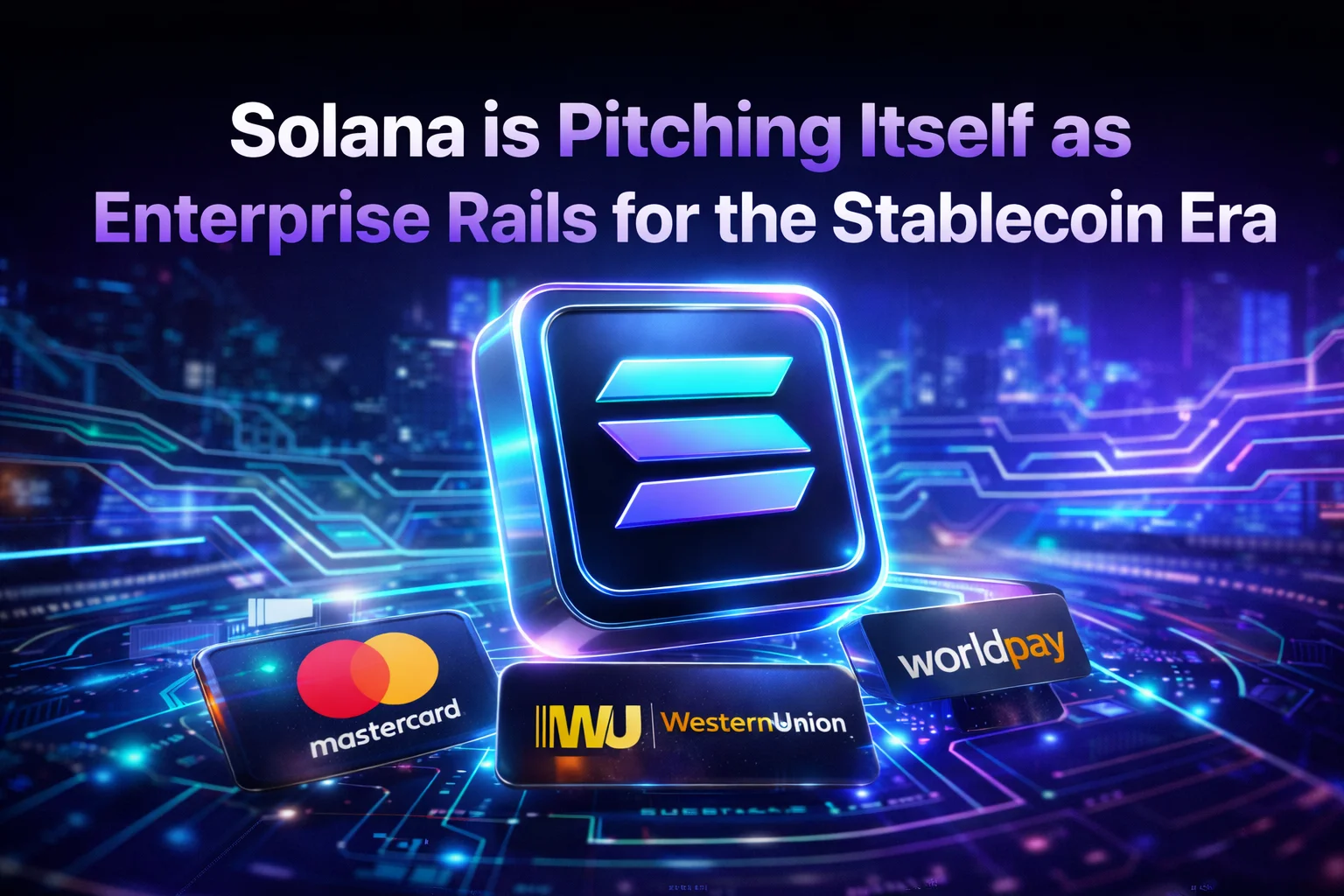
Now the pitch is becoming much more ambitious. Solana is not just trying to be a fast chain for retail activity. It is trying to become enterprise infrastructure for payments, stablecoins, tokenized assets, and financial applications built by major companies. That shift became much clearer after the Solana Foundation announced Solana Developer Platform, an API-based platform designed for enterprises and financial institutions. Early users named by the foundation include Mastercard, Western Union, and Worldpay.
This matters because it changes how the market should think about Solana. The conversation is no longer just about throughput or meme coin volume. It is about whether Solana can position itself as a serious layer for real financial activity, especially in a market where stablecoins, onchain settlement, and tokenized finance are becoming some of the strongest narratives in crypto.
The Real Message Behind Solana Developer Platform
The launch of Solana Developer Platform is not just a product release. It is a statement about where the network wants to compete next.
According to the Solana Foundation, the platform is built as a unified API layer that helps enterprises and institutions build and launch financial products on Solana more easily. It includes three core modules. The issuance module is designed for tokenized deposits, stablecoins, and tokenized real-world assets. The payments module supports fiat and stablecoin flows, including on-ramp and off-ramp functionality. The trading module is intended to support atomic swaps, vaults, and onchain foreign exchange, with issuance and payments live now and trading expected later in 2026.
That is a very different narrative from the old version of Solana. Instead of marketing only speed and cost efficiency, the network is packaging itself as a ready-made financial stack. The language matters. Enterprises do not want to hear only that a blockchain is fast. They want to know that it is scalable, compliant, easy to integrate, and built around practical business flows.
In other words, Solana is trying to reduce the friction that usually stops large companies from building onchain in the first place.
Why Mastercard and Western Union Matter
The names attached to this launch are what give the story real weight.
Mastercard is involved around stablecoin settlement, while Western Union is focused on cross-border payments. Worldpay is also part of the early group, with an emphasis on merchant payments and settlement. Those examples are important because they show Solana is aiming at use cases with real-world relevance, not just experimental pilots for crypto insiders.
That is exactly why this is such a strong article theme for DEXTools. It sits at the intersection of three narratives that are getting stronger at the same time: blockchain infrastructure, stablecoin adoption, and corporate entry into digital assets.
Stablecoins have become one of the most credible bridges between crypto and traditional finance. Payments have become one of the clearest enterprise use cases. And large companies are increasingly more interested in blockchain when the product can fit into existing systems instead of replacing them entirely. Solana's message is simple: you do not need to rebuild your company around crypto, you can plug into an API layer and start using onchain rails where they make sense.
Solana Wants to Be the Chain Companies Can Actually Use
There is another important detail in this launch. Solana Developer Platform is designed to abstract a lot of blockchain complexity away from enterprise users.
The foundation says the platform aggregates more than 20 infrastructure partners across categories such as node infrastructure, wallets, compliance, and payment ramps. It also says the platform is available in a sandbox on Solana devnet, which signals a clear enterprise onboarding path rather than a pure developer-only product.
That matters because corporate blockchain adoption rarely fails because of a lack of interest. More often, it fails because the operational burden is too high. Compliance requirements, custody, integration complexity, and internal risk controls make direct blockchain adoption difficult for traditional firms.
Solana's strategy here is to package the ecosystem into something that looks more familiar to a business customer. That makes the chain easier to sell, easier to test, and easier to justify inside a large organization.
This Is Bigger Than a Solana Story
The bigger takeaway is that crypto infrastructure is maturing into a business product category.
For a long time, the market treated blockchains mainly as assets to trade or ecosystems to speculate on. That phase is still alive, but it is no longer the whole story. The rise of stablecoin payments, tokenized deposits, onchain settlement, and regulated digital asset products is pushing public chains into a new arena.
Solana clearly wants to be one of the winners in that transition.
That does not mean success is guaranteed. Enterprise adoption always moves slower than crypto traders expect. Big brands appearing in an announcement does not automatically mean massive transaction volume will arrive tomorrow. But the strategic direction is hard to ignore. Solana is positioning itself where future institutional demand may actually grow.
Why This Fits the Stablecoin Era
The stablecoin angle is what makes this narrative especially powerful.
Stablecoins are increasingly becoming the most practical product in crypto. They are useful in trading, treasury management, remittances, settlement, and cross-border commerce. For institutions, they are one of the easiest digital asset categories to understand because the value proposition is simple. Faster movement of dollars, lower friction, programmable transfers, and 24 hour infrastructure.
By putting stablecoin settlement and payment flows at the center of its enterprise pitch, Solana is aligning itself with one of the most durable themes in the market. This is not just about token launches or onchain hype. It is about becoming infrastructure for the movement of value.
If that thesis plays out, then Solana is not only competing with other smart contract chains. It is competing to become part of the financial backend for the next generation of internet payments.
Final Take
Solana is selling a new version of itself.
Yes, it is still a chain used by traders. Yes, it still benefits from the speed and low-cost narrative that made it famous. But the bigger story now is whether Solana can evolve from a retail-heavy ecosystem into enterprise-grade financial infrastructure.
That is why the launch of Solana Developer Platform matters. It gives the market a cleaner way to understand where Solana wants to go next. Not just as a chain for speculation, but as a platform for stablecoins, payments, and corporate blockchain products.
If this strategy works, Solana may end up benefiting from one of the biggest shifts in crypto right now: the move from trading narratives to real financial rails.
FAQ
Why is Solana targeting enterprises now?
Because the biggest growth opportunities in crypto are increasingly tied to payments, stablecoins, tokenized assets, and financial infrastructure rather than only retail speculation.
What is Solana Developer Platform?
It is an API-based platform launched by the Solana Foundation to help enterprises and financial institutions build products on Solana more easily.
Why are Mastercard and Western Union important in this story?
They make the enterprise push feel more credible because they represent real-world payment and settlement use cases rather than purely crypto-native experimentation.
Is this bullish for Solana?
Potentially, yes. It strengthens the network's position in one of the most important narratives in crypto today, which is the growth of stablecoin and enterprise financial infrastructure.
Solana Beyond the Bull Run: Reimagining Its Future Solana Staking Explained: Validate Transactions with Solscan Solana Ecosystem Roundup: Jupiter, Meteora & DEX Trends 2026 Solana: 2026 Investment Insights & Risks Solana Institutional Momentum Grows Stronger in 2026Frequently Asked Questions
What are Solana's enterprise stablecoin rails?
Solana offers high throughput and low transaction fees, making it suitable for large-scale stablecoin operations. Its architecture supports fast settlement and efficient transfer of value for businesses.
How does Solana ensure the security of enterprise stablecoins?
Solana utilizes a Proof of History consensus mechanism combined with Proof of Stake to secure its network. This design aims to prevent double-spending and ensure transaction integrity for stablecoin issuers.
What advantages does Solana offer for businesses issuing stablecoins?
Businesses can leverage Solana's speed and cost-effectiveness for various stablecoin use cases, including remittances, payments, and trade finance. Its scalability allows for growth in transaction volume.
Are there existing enterprise stablecoin projects on Solana?
Several projects are exploring or have launched stablecoins on the Solana blockchain, targeting enterprise solutions. These initiatives aim to utilize Solana's infrastructure for real-world financial applications.
What regulatory considerations apply to enterprise stablecoins on Solana?
Issuers of enterprise stablecoins on Solana must comply with relevant financial regulations in their operating jurisdictions. Solana provides the technological rails, but regulatory compliance remains with the stablecoin issuer.