Solana Ecosystem Roundup: Jupiter, Meteora & DEX Trends 2026
— By AliceOnChain in News

Discover the 2026 Solana ecosystem roundup. We analyze Jupiter, Meteora, and Raydium's market dominance, plus the AI and RWA trends reshaping DEXTools charts.
Solana Ecosystem Roundup: Jupiter, Meteora, Raydium and New DEX Trends
The Solana ecosystem roundup for early 2026 shows a market that has reached full technical maturity. The focus has moved from simple scalability to advanced capital efficiency. As DEX volumes on the network now frequently surpass Ethereum, the chain has become the global hub for retail liquidity. For traders using DEXTools, this Solana ecosystem roundup explores the three pillars of liquidity: Jupiter, Meteora, and Raydium, and the trends redefining on-chain commerce.
The Triad of Liquidity: Jupiter, Meteora, and Raydium
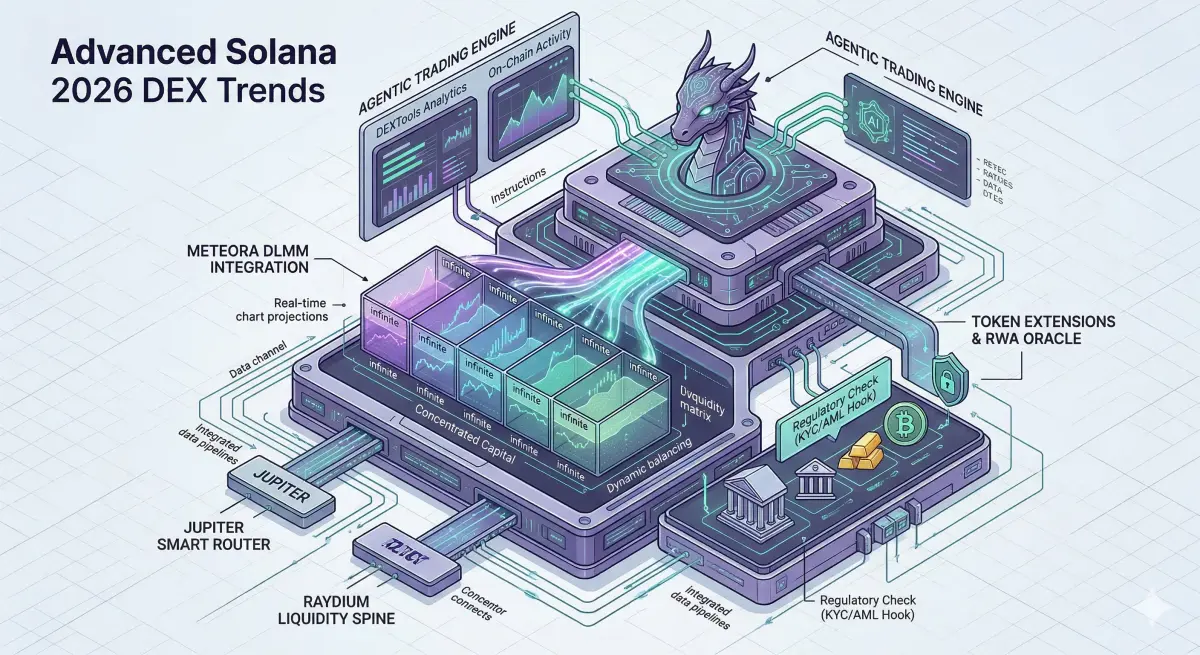
Jupiter has evolved far beyond being a simple DEX aggregator. In this Solana ecosystem roundup, we see it operating as the primary operating system for the network. Its dominance comes from advanced routing algorithms. These allow for near-zero slippage on high-volume trades. By using MEV-resistant execution, Jupiter captures most of the retail flow. When a new asset appears on DEXTools, Jupiter’s infrastructure ensures liquidity comes from every corner of the network. This provides a unified experience that hides the complexity of fragmented pools within the Solana ecosystem.
Meteora provides the essential yield infrastructure that keeps capital moving. The introduction of Dynamic Liquidity Market Maker (DLMM) technology has changed how providers approach the market. Unlike traditional AMMs, Meteora concentrates liquidity into specific price bins. This increases fee generation while reducing the capital needed for deep markets. Many protocols now use Meteora to launch tokens with sustainable liquidity. This Solana ecosystem roundup highlights how these dynamic bins prevent the sudden liquidity drains seen in earlier cycles.
Raydium remains the foundational backbone of the Solana network. As the most established liquidity layer, it continues to incubate new projects. In 2026, Raydium’s integration with Firedancer-optimized validators has lowered swap latency. This upgrade allows Raydium to compete with centralized exchanges in execution speed. Algorithmic traders rely on real-time data from DEXTools to execute trades on Raydium efficiently. The deep liquidity within Raydium ensures it stays a critical part of any Solana ecosystem roundup analysis.
The Surge of AI-Driven Agentic Trading
One of the most transformative trends in this Solana ecosystem roundup is the rise of agentic trading. Autonomous AI agents are now primary participants in the DEX space. These agents move beyond simple bots to manage entire liquidity vaults. They analyze real-time metrics-like those found on DEXTools-to rebalance positions instantly across the Solana ecosystem. This has created "Agent-Native" tokens, which are designed to be traded and governed by AI entities.
This trend has increased market intelligence. AI agents provide constant liquidity and stabilize the market during high volatility. Human traders now face a more efficient but complex environment. Understanding how agents interact with Jupiter’s routing is now a requirement. The convergence of AI and high-speed execution is a core theme in our Solana ecosystem roundup.
Institutional Real World Assets and Regulatory Maturity
A second major growth area is the migration of Real World Assets (RWAs) to the ledger. By mid-2026, the network is the preferred choice for tokenized assets. This includes everything from royalties to sovereign debt. "Token Extensions" have made this possible. These native features allow for built-in compliance, such as transfer hooks. Institutions can now issue assets directly on-chain while meeting regulatory rules.
The impact of RWAs on the Solana ecosystem roundup is massive. DEXTools "Hot Pairs" are no longer just speculative memes. They now include tokenized commodities and credit markets. This influx of "real value" boosts the Total Value Locked (TVL) across the network. It also creates a stable collateral base for DeFi lending. As institutional capital flows in, the demand for SOL reaches new heights, solidifying the case for the Solana ecosystem.
Examining the On-Chain Metrics of 2026
To understand this growth, we must look at the macro metrics. Total Value Locked has passed the $35 billion mark. This reflects deep trust in the network's stability after the Firedancer rollout. More importantly, the DEX-to-CEX volume ratio has reached 45%. This suggests users prefer the transparency of the Solana ecosystem over centralized entities.
With over 45 million active addresses, the network handles 160 million daily transactions. This is a functional economy, not just speculation. Users are paying for services and managing complex portfolios on-chain. The combination of retail trading and institutional liquidity creates a cycle of growth. This Solana ecosystem roundup concludes that the network continues to outpace all other Layer-1 solutions.
Best Token Scanner for Solana in 2026
How AI Agents Are Changing DeFi
2026 Crypto Market Trends and Growth Forecasts
--
Disclaimer: This article is for informational purposes only and does not constitute investment advice, financial advice, trading advice, or any other kind of advice. DEXTools does not recommend buying, selling, or holding any cryptocurrency or token. Users should conduct their own research and consult with a qualified financial advisor before making any investment decisions. Cryptocurrency investments are volatile and high-risk. DEXTools is not responsible for any losses incurred.