Spot a Real Crypto Breakout: Avoid Exit Liquidity
— By Whatsertrade in Analysis
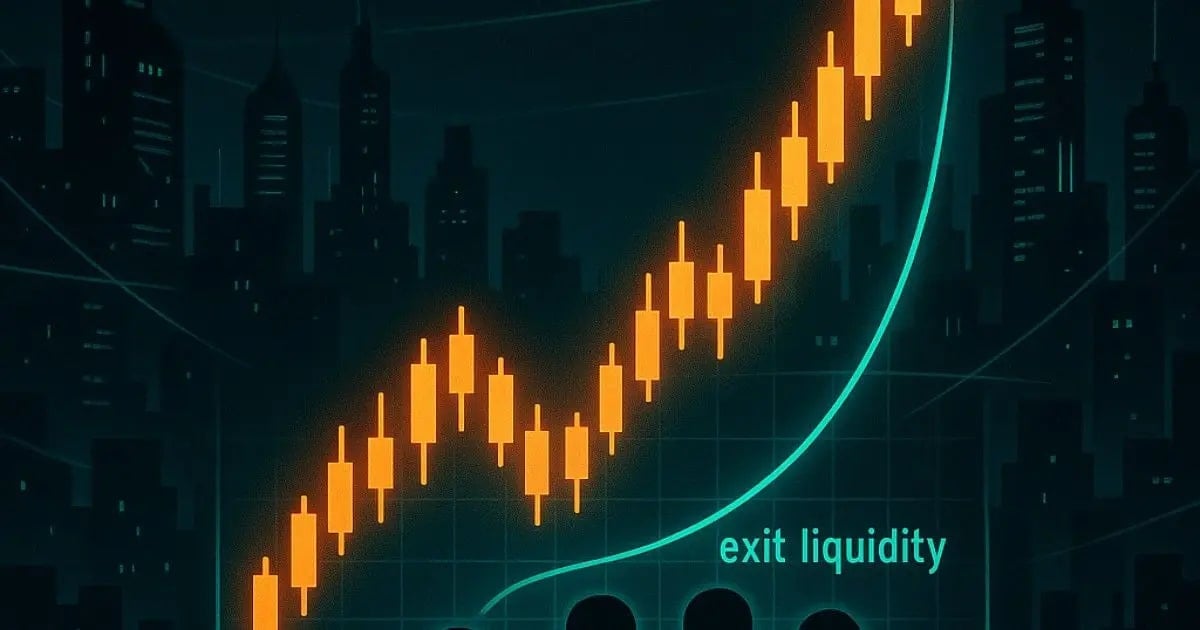
Learn to distinguish a real crypto breakout from exit liquidity traps. Avoid costly errors by understanding the signs of genuine market strength.
In crypto, not every breakout is a real opportunity.
Some moves are the start of a larger trend. Others are simply the final stage of a setup where early buyers sell into late enthusiasm. For traders, this is one of the most expensive mistakes in the market. A chart looks strong, volume spikes, social media turns bullish, and then the price collapses because the breakout was never real. It was exit liquidity.
If you want to avoid buying tops and improve your entries, you need to learn how to separate real strength from staged excitement.
This is how to tell the difference between a real breakout and exit liquidity.
What a real breakout means in crypto
A real breakout happens when price moves through an important level with enough strength, participation, and structure to support continuation.
That does not mean the token will go up forever. It means the move has a solid foundation. Buyers are showing real demand, market structure is improving, and the breakout is not depending only on emotion or late FOMO.
A strong breakout usually reflects growing conviction.
What exit liquidity means in crypto
Exit liquidity happens when early holders use late buyers as their way out.
This often appears after a token has already moved significantly. The story becomes exciting, the chart becomes obvious, and new traders rush in thinking they are early. In reality, they are buying from wallets that entered much lower and are ready to distribute into strength.
That is why exit liquidity can look bullish right before it fails.
The trap works because late demand creates the perfect opportunity for early participants to unload.
The biggest difference: what happened before the breakout
The easiest way to judge a breakout is to study what happened before it.
A real breakout usually has a base. Price consolidates, volume gradually improves, and the market starts showing controlled strength. The breakout is the result of earlier accumulation.
Exit liquidity usually looks different. The move into resistance is fast, emotional, and often too obvious. Instead of a healthy base, you often see a token that already ran hard and is now attracting late attention.
The more vertical the setup looks before the breakout, the more careful you should be.
Sign one: volume quality matters more than volume size
Many traders see big volume and assume the move is real. That is a mistake.
What matters is not just whether volume is high. What matters is whether volume is healthy.
In a real breakout, volume often builds before the move. You may see a gradual increase in participation, stronger consistency, and a cleaner relationship between price and demand. The breakout volume feels like confirmation.
In exit liquidity, volume often arrives all at once at the most obvious moment. The chart looks dramatic, the candles get larger, and attention floods in. That can feel bullish, but it may simply mean late buyers are being used as counterparties.
Big volume is not enough. You need good volume.
Sign two: price action should look controlled, not desperate
Real breakouts usually look stronger before they look exciting.
The best setups often show tighter consolidation, higher lows, and cleaner structure before price finally pushes through resistance. The move feels earned.
Exit liquidity often looks desperate. Price races upward, candles extend too fast, and the move feels driven more by urgency than by structure. Traders start chasing because they are afraid to miss out, not because the setup was well built.
If the chart feels like it is trying too hard to get your attention, that is often a warning.
Sign three: liquidity must support the move
Liquidity is one of the most overlooked filters in crypto trading.
A token with weak liquidity can still produce a dramatic breakout on the chart, but that does not make the move healthy. Thin markets are easier to manipulate, easier to push, and easier to dump.
A real breakout becomes much more credible when liquidity is strong enough to support continued participation.
Exit liquidity becomes more likely when a token is running on shallow liquidity, especially after an already aggressive move. In that kind of setup, early wallets do not need much late demand to create the illusion of momentum.
Before buying a breakout, ask yourself whether the market is deep enough to support real continuation.
Sign four: wallet behavior tells the real story
One of the best ways to judge a breakout is to watch who is active during the move.
In a real breakout, you often see broader participation. More wallets enter, activity expands, and the move feels increasingly distributed across the market.
In exit liquidity, the opposite often happens. The breakout attracts fresh retail buyers, but larger or earlier wallets begin selling into that strength. The chart still looks bullish at first, but the underlying behavior becomes weaker.
This is why wallet behavior matters so much. A strong chart can hide weak internals. A real breakout needs supportive flow, not just supportive headlines.
Sign five: social media timing is a major clue
Attention usually arrives late.
When a token is breaking out and social media is only beginning to notice, that can still be constructive. But when the entire timeline is screaming about a move that already looks extended, risk rises quickly.
Real breakouts often begin before mass attention peaks.
Exit liquidity often depends on mass attention arriving at exactly the right moment for early holders to sell.
The louder the market gets after a token has already moved hard, the more careful you should become.
Sign six: a real breakout can survive a retest
One of the cleanest signs of strength is how price behaves after the initial breakout.
A real breakout often survives a retest. Price may pull back, revisit the breakout area, and then find support. That kind of behavior shows buyers are still interested and the move has real structure behind it.
Exit liquidity often fails quickly after the first push. Once the initial excitement fades, there is not enough genuine demand underneath. The retest breaks down, momentum disappears, and late buyers are trapped.
A breakout that cannot handle pressure is often not a real breakout.
Common signs of exit liquidity
There are several warning signs traders should never ignore.
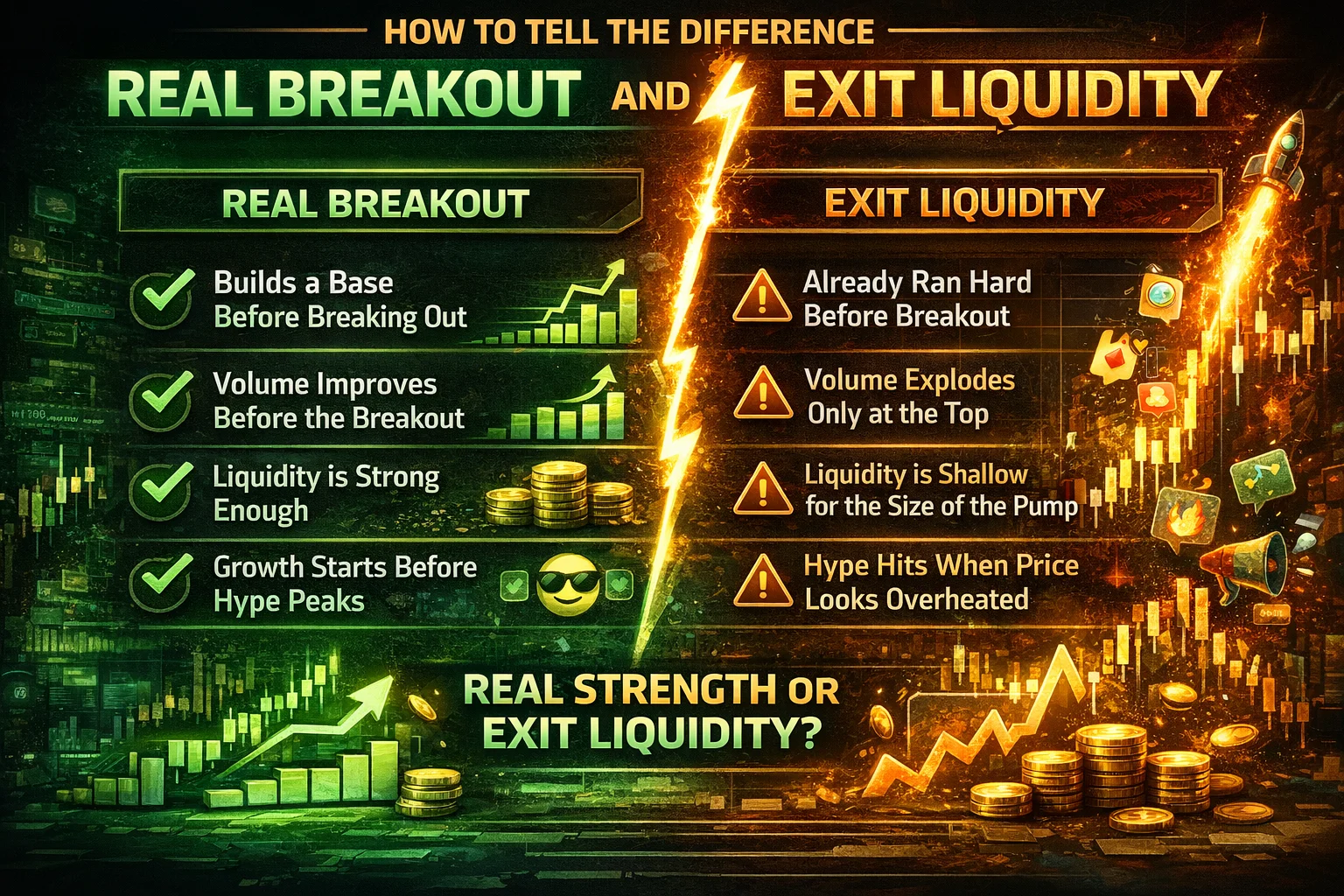
The token already ran hard before the breakout.
The move into resistance is too fast and too obvious.
Volume explodes only at the top of the move.
Liquidity is shallow relative to the size of the pump.
Social hype arrives all at once.
Early wallets appear to be distributing into strength.
The chart looks emotional instead of structured.
You do not need every red flag to avoid a trade. Sometimes two or three are enough.
Common signs of a real breakout
Real breakouts usually share a different set of traits.
Price builds a believable base before the move.
Volume improves before the breakout, not just during it.
Liquidity is strong enough to support continuation.
Participation broadens instead of narrowing.
The move is visible, but not yet completely overcrowded.
Retests hold better than expected.
The breakout feels supported, not forced.
That does not guarantee success, but it gives you a much stronger framework.
The mindset shift that saves traders money
Most traders ask the wrong question when they see a breakout.
They ask, “How high can this go?”
A better question is, “Who is this move really serving?”
If the breakout is serving new buyers and attracting fresh trend participation, it may be real. If the breakout is serving early holders who need late buyers to exit, it is probably exit liquidity.
That one mindset shift can save you a lot of money over time.
What to do before buying any breakout
Before entering, slow the process down.
Look at the chart structure.
Check whether the token already ran too far.
Study the volume pattern.
Review liquidity.
Watch wallet behavior.
Assess whether social attention is early or late.
Wait and see whether the breakout can survive pressure.
A good trade does not become bad because you spent five extra minutes checking the setup.
Final thoughts
Learning how to tell the difference between a real breakout and exit liquidity is one of the most valuable skills in crypto trading.
It helps you stop reacting to excitement and start reading structure. It trains you to look beyond candles and ask whether the move has real support from liquidity, participation, and positioning.
The market will always create charts that look tempting. Your edge comes from knowing which ones deserve your attention and which ones are designed to attract it for the wrong reasons.
The best traders do not just buy strength.
They understand what kind of strength they are buying.
How to Bridge Crypto Between Chains: Complete Cross-Chain Tutorial 2026 How to Use 1inch: Complete DEX Aggregator Swap Tutorial (2026) How to Use OKX Web3 Wallet: Complete Multi-Chain Wallet Tutorial (2026)