Ethereum Yield Evolution: Liquid Staking vs. Restaking

Explore the evolving strategies in Ethereum's yield ecosystem in 2026, comparing liquid staking with liquid restaking.
The Evolution of Ethereum Yield: Liquid Staking vs. Liquid Restaking in 2026
- As we navigate through March 2026, the Ethereum ecosystem has undergone a profound transformation. The simple act of securing the network through staking has evolved from a technical necessity into a complex, multi layered financial economy.
- For investors and decentralized finance enthusiasts, the choice between Liquid Staking and Liquid Restaking has become the central pillar of asset management strategy. While both concepts aim to maximize the utility of Ethereum (ETH), they represent different points on the risk and reward spectrum.
- Understanding the architectural differences and the systemic implications of these two methodologies is essential for any participant in the modern crypto economy.
The Foundation of the Yield Economy: Liquid Staking Tokens (LSTs)
- Liquid Staking remains the bedrock of the Ethereum proof of stake model. When Ethereum transitioned away from mining, the barrier to entry for staking was high, requiring 32 ETH and the technical overhead of maintaining a validator node. Liquid Staking protocols solved this by pooling user funds and issuing a receipt token, commonly known as a Liquid Staking Token (LST). These tokens represent the user's staked ETH plus the rewards accrued over time, all while remaining liquid and tradable in the open market.
- Protocols like Lido and Rocket Pool have become household names in this space. Lido, for instance, issues stETH, which has become one of the most integrated collateral assets in the decentralized finance landscape. Rocket Pool provides a more decentralized alternative with its rETH token, allowing smaller node operators to participate.
- In 2026, these LSTs are no longer just speculative assets; they are the primary form of "pristine collateral" used in lending markets, stablecoin minting, and yield farming. The primary appeal of LSTs is their simplicity and relatively low risk profile, as the yield is generated directly from Ethereum's protocol level inflation and transaction fees.
The Rise of the Yield Layer: Understanding Liquid Restaking (LRTs)
- If Liquid Staking was the first step in the evolution of ETH yield, Liquid Restaking is the giant leap that followed. This concept, popularized by the maturation of EigenLayer and similar coordination layers, allows users to take their already staked ETH (or their LSTs) and "re pledge" them to secure additional services. These services, known as Actively Validated Services (AVSs), can include data availability layers, decentralized oracle networks, or cross chain bridges.
- Liquid Restaking Tokens (LRTs) act as the receipt for this secondary level of staking. When a user deposits ETH or an LST into a protocol like Ether.fi or Renzo, they receive an LRT such as eETH or ezETH. This token captures not only the base Ethereum staking yield but also the additional rewards paid out by the AVSs that the restaking protocol supports. By 2026, Liquid Restaking has created a massive secondary market for security, where Ethereum's multi billion dollar security budget is effectively "rented out" to other protocols, creating a highly efficient capital environment.
Architectural Differences and the Yield Stack
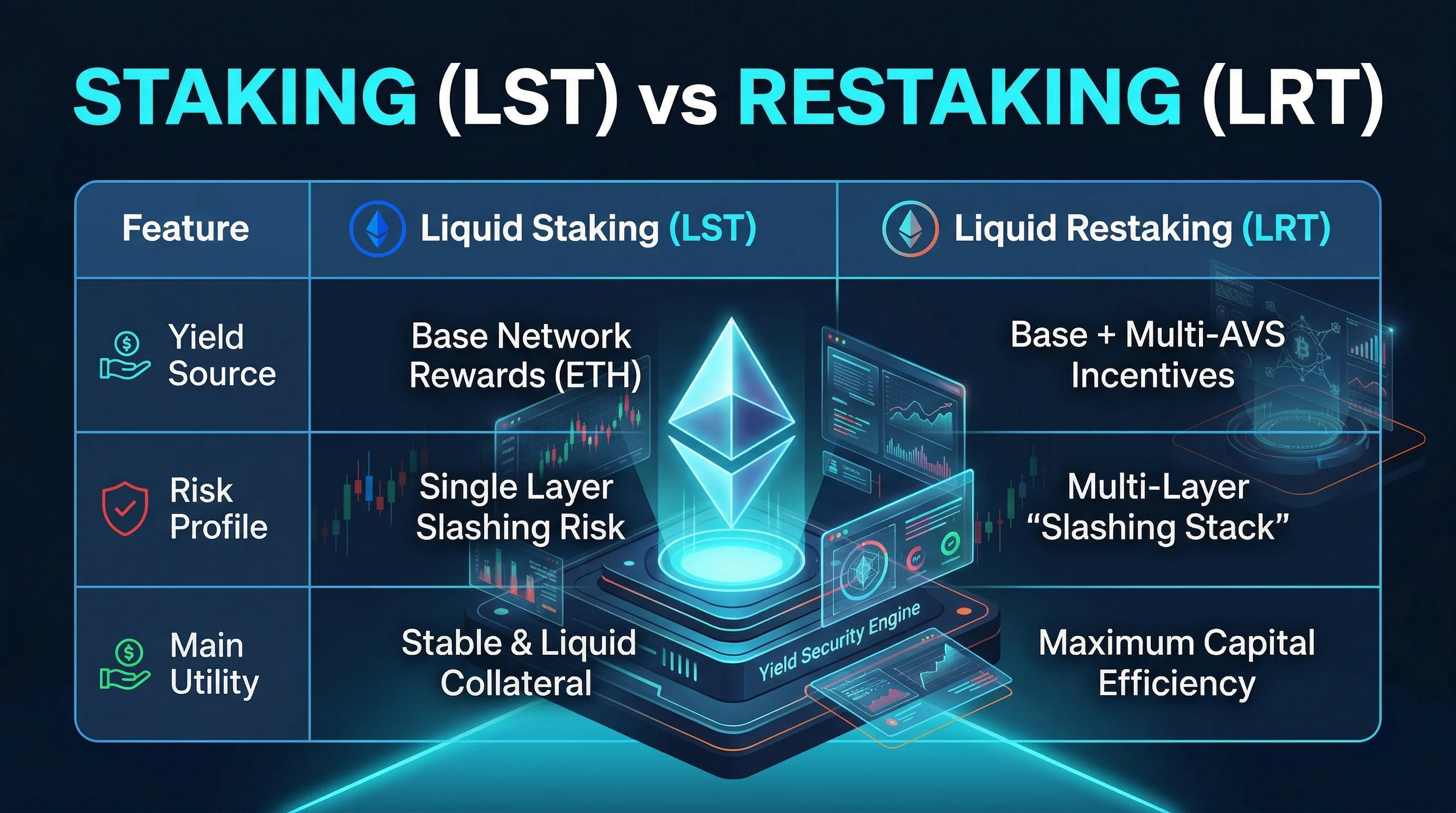
- The fundamental difference between LSTs and LRTs lies in the "Yield Stack." For a holder of an LST, the yield is singular and linear. It comes from the consensus layer of the Ethereum blockchain. For an LRT holder, the yield is modular and compounded. An LRT holder might be earning a base 3.5 percent from Ethereum staking, plus an additional 2 percent from a data availability AVS, and another 1 percent from a decentralized sequencer AVS.
- This compounding effect is what drove the massive migration of capital toward LRTs throughout 2025 and into 2026. However, this architectural complexity introduces a new set of variables. While an LST is only as risky as the Ethereum consensus mechanism and the protocol's smart contracts, an LRT is exposed to the slashing conditions of every single AVS it secures. In 2026, the industry uses sophisticated risk management dashboards to track these "slashing paths," ensuring that a failure in a small, experimental AVS does not lead to a catastrophic loss of the underlying ETH.
Comparative Examples in the 2026 Market
- To visualize these differences, let us look at two hypothetical investors. Investor A chooses to hold stETH from Lido. Their goal is long term wealth preservation with a steady, predictable return. They use their stETH as collateral on a lending platform to borrow stablecoins, maintaining a conservative health factor. This is the classic Liquid Staking play: reliable, highly liquid, and deeply integrated into the core DeFi stack.
- Investor B, seeking higher alpha, opts for an LRT like pufETH from Puffer Finance or an equivalent from Kelp DAO. By holding this LRT, Investor B is participating in the security of several emerging AVSs, such as EigenDA for scaling or various AI inference networks that require decentralized validation. While Investor B enjoys a significantly higher Annual Percentage Yield (APY), they must also monitor the health of the restaking protocol and the performance of the node operators who are managing their "restaked" assets. If a node operator fails to perform their duties on a specific AVS, Investor B could face a slashing penalty that exceeds the rewards they earned.
The Risk of Systemic Fragility and the "Lego" Problem
- The primary concern among researchers in 2026 is the potential for systemic risk. DeFi is often compared to Money Legos, where protocols are stacked on top of each other. Liquid Restaking takes this metaphor to its extreme. If a major LRT protocol were to experience a smart contract exploit or a massive slashing event across multiple AVSs, the contagion could spread through the entire ecosystem.
- Because LRTs are often used as collateral in the same way LSTs are, a de pegging event where an LRT loses its 1:1 value with ETH could trigger a wave of liquidations. We saw minor instances of this during the "restaking volatility" of late 2025, which led to the implementation of better circuit breakers and withdrawal buffers in most modern protocols. Despite these safeguards, the inherent complexity of restaking means that it will always carry a higher "tail risk" compared to the relatively straightforward nature of liquid staking.
Liquidity and Market Exit Strategies
- In the current market climate of March 2026, liquidity is king. One of the most critical points of comparison between LSTs and LRTs is the ease of exit. LSTs like stETH have massive liquidity pools on decentralized exchanges, allowing billion dollar trades with minimal slippage. This makes them suitable for institutional players who may need to exit positions quickly during market downturns.
- LRTs, while liquid, often face deeper challenges during periods of "Extreme Fear," such as the current market correction. Since the underlying ETH is locked across multiple AVSs with varying withdrawal periods, the "liquidity layer" of the LRT protocol must be carefully managed. During the current March 2026 correction, we have seen some LRTs trade at a 1 to 2 percent discount to their Net Asset Value (NAV), reflecting the market's demand for immediate liquidity over the long term yield of restaking. For an investor, choosing between an LST and an LRT often comes down to their required "time to liquidity."
Conclusion: Navigating the Future of Ethereum
- The choice between Liquid Staking and Liquid Restaking is not a matter of which is better, but rather which is more appropriate for a specific financial objective. Liquid Staking remains the gold standard for those who prioritize security, liquidity, and integration with the foundational layers of DeFi. It is the "savings account" of the Ethereum world, offering a base rate of return that is as close to "risk free" as one can find in the crypto space.
- Liquid Restaking, on the other hand, is the "growth fund" or the "venture security" arm of the ecosystem. It provides the fuel for the next generation of decentralized infrastructure by allowing ETH holders to opt into higher risk, higher reward scenarios. As we move further into 2026, the line between these two will continue to blur, but the fundamental trade off between complexity and security will remain. The successful investor is the one who balances their portfolio across both, leveraging the stability of LSTs while selectively capturing the alpha provided by the restaking revolution.
Disclaimer: This article is for informational purposes only and does not constitute investment advice, financial advice, trading advice, or any other kind of advice. DEXTools does not recommend buying, selling, or holding any cryptocurrency or token. Users should conduct their own research and consult with a qualified financial advisor before making any investment decisions. Cryptocurrency investments are volatile and high-risk. DEXTools is not responsible for any losses incurred.
Related Guides
- Native Staking vs Liquid Staking vs Restaking: Decision Tree
- Lido on Ethereum: stETH, wstETH and Dual Governance Explained (2026)
- Lido vs Rocket Pool: Ethereum Liquid Staking Compared (2026)
- What Is YieldNest (YND)? The MAX LRT Liquid Restaking Protocol Explained in 2026
- What Is Renzo (REZ)? ezETH Liquid Restaking on EigenLayer Guide 2026
- What Is Hyperbeat? Liquid Staking and Yield Vaults on Hyperl
Frequently Asked Questions
What is Liquid Staking in Ethereum?
Liquid Staking is a method that allows users to stake their Ethereum (ETH) through pooled funds, issuing Liquid Staking Tokens (LSTs) that represent their staked ETH and accrued rewards while remaining tradable.
How does Liquid Restaking differ from Liquid Staking?
Liquid Restaking allows users to take their staked ETH or LSTs and re-pledge them to secure additional services, earning compounded rewards from both Ethereum staking and the services provided by Actively Validated Services (AVSs).
What are Liquid Staking Tokens (LSTs)?
Liquid Staking Tokens (LSTs) are receipt tokens issued by Liquid Staking protocols that represent a user's staked ETH and the rewards earned, allowing for liquidity and tradability in the market.
What are the risks associated with Liquid Restaking?
Liquid Restaking introduces additional risks compared to Liquid Staking, as it exposes users to potential slashing penalties from the various Actively Validated Services (AVSs) they engage with.
What is the yield structure for LSTs and LRTs?
LST holders earn a singular yield from Ethereum's consensus layer, while LRT holders benefit from a modular, compounded yield that includes rewards from both Ethereum staking and additional AVS services.