What Is TON DNS and How Do .ton Domains Work? Guide (2026)
— By Tony Rabbit in Tutorials
Learn what TON DNS is, how .ton domains work as NFTs, how to buy and configure a TON domain, and why readable names help usability without replacing trust checks.
TON DNS is one of the cleanest examples of why TON is more than a payments story. At the surface level it looks simple: a human-readable name instead of a raw address. Underneath that, it is an on-chain naming system tied to smart contracts, sites, storage, and subdomain delegation. That combination makes it useful, but it also means beginners can misunderstand what they actually bought or what a domain does for them once they own it.
Quick answer: TON DNS lets users translate human-readable domain names such as example.ton into wallet addresses, TON Sites, storage references, and other records. A .ton domain is an NFT on TON, which means it can be transferred or sold, has to be renewed, and needs correct record setup before it becomes genuinely useful. Buying the domain is only step one. Configuring it properly is what makes it work.
- TON DNS is not only for wallets. It can resolve wallet records, site records, storage references, text records, and delegated subdomains.
- .ton domains are NFTs. They are transferable assets, not just names living in an off-chain database.
- Owning a name is different from configuring a name. A domain with no correct wallet or site record is just an idle asset.
- Domains must be renewed. Official TON docs note annual renewal with no grace period after expiry.
- Human-readable names reduce typing pain, not trust risk. You still need to verify the destination source before you send funds.
What TON DNS actually does
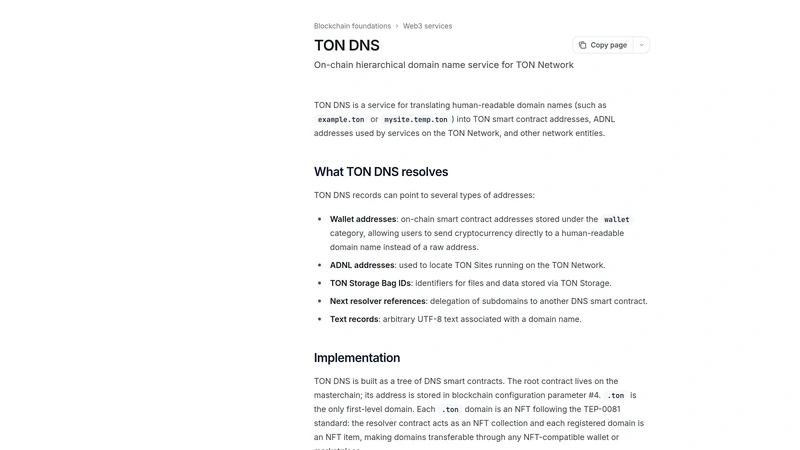
The official TON documentation describes TON DNS as an on-chain hierarchical domain name service for the TON Network. In practical terms, it translates readable names such as example.ton or delegated subdomains into useful network records. The wallet use case is the easiest to understand because users can send funds to a readable domain instead of copying a long raw address. But that is only part of the system.
Trade TON with Not.Trade, the fastest terminal on TON
Not.Trade is purpose built for TON traders: real-time on-chain charts for every jetton, insider safety scoring (Top 10 wallets, snipers, dev movement, bundlers, LP lock), MCAP-trigger limit orders, multi-wallet sniping, MEV protection and one-click swaps routed across STON.fi and DeDust. It runs natively inside Telegram and as a fast web terminal, with TON Connect non-custodial wallet support.
Read the full Not.Trade guide ->TON docs explain that DNS records can point to wallet addresses, ADNL addresses for TON Sites, TON Storage bag IDs, text records, or the next resolver that handles the rest of a subdomain tree. That matters because it turns TON DNS into infrastructure, not only branding. A domain can function as a wallet alias, a site entry point, a storage label, or a delegated namespace.
If you are coming from a simpler crypto naming system, the safest mindset is this: TON DNS is a naming layer attached to real on-chain records. It is not magic. It is a smart-contract-backed lookup system that still depends on the owner setting the right record for the right use case.
Why TON DNS matters for normal users
The obvious benefit is usability. A readable .ton name is easier to recognize, share, and remember than a raw wallet address. That alone reduces friction for payments, tips, community identity, and brand presence inside the TON ecosystem.
The more important benefit is ecosystem coherence. A domain can connect a wallet identity, a TON Site, and a broader project presence under one human-readable namespace. That makes TON feel more like an integrated network and less like a pile of unrelated apps. For creators, projects, and power users, this is usually the real appeal.
At the same time, human readability can create false comfort. A .ton domain may be easier to read than a raw address, but that does not mean every readable name is trustworthy. The same security logic covered in the crypto security guide still applies. Readable names reduce copy-paste pain. They do not eliminate scams, impersonation, or bad operator judgment.
How .ton domains work on TON
TON docs state that .ton is the only first-level domain and that each .ton domain is an NFT following the TEP-0081 standard. In other words, the resolver behaves like an NFT collection and each registered domain is an NFT item. This is the detail that changes the mental model. You are not just renting a label from a web2 registrar. You are holding a transferable on-chain asset that controls the records attached to that name.
The same documentation explains that TON DNS is built as a tree of smart contracts and that the .t.me namespace is implemented as a delegated sub-resolver on the same infrastructure. That layered design is why subdomain delegation and resolver logic matter. A name can be simple from the user side while still being technically rich under the surface.
For everyday users, the practical result is straightforward. A .ton domain can be used as a wallet-friendly identity, but only after the correct record is set. If the domain owner never configures the wallet record, sending funds to the domain will not serve the purpose the buyer expected.
How to buy a TON domain without getting confused
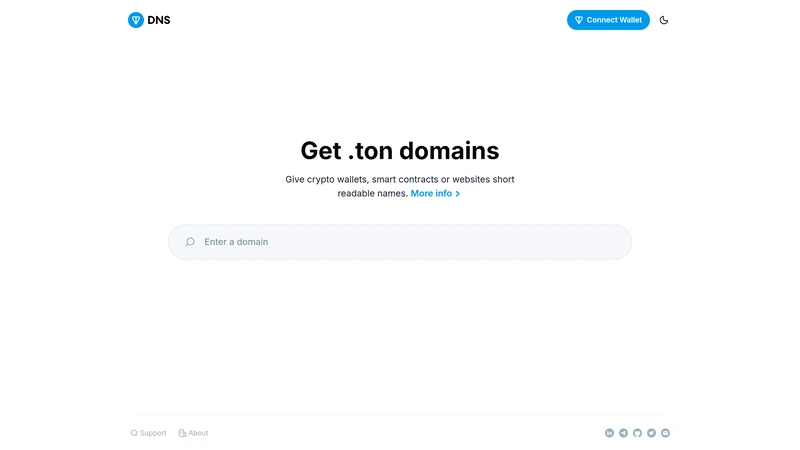
The practical search intent behind TON domains is usually simple: where do I get one and how do I avoid mistakes? The safest answer is to start from official or well-known TON domain interfaces, search the name you want, and understand whether you are looking at an available auction, a listed name, or an already-held NFT that would need to be bought from an existing owner.
Because .ton domains behave as NFTs, the acquisition path can look different from classic domain buying. A fresh name may go through an auction-style process, while a name already owned can be transferred or sold like any other NFT-compatible asset. Users should understand this before funding a wallet for a purchase, otherwise they may assume every desired name can simply be registered on demand.
- Search the exact name first. Confirm whether it is available, in auction, or already owned.
- Use a wallet you control. Tonkeeper or another TON wallet is usually the cleanest path for self-custody users.
- Confirm the purchase flow and final cost. Auction timing, listed pricing, and secondary-market logic can differ.
- Record the ownership result. A domain is an asset. Treat it like one after purchase.
- Do not stop at ownership. Set the relevant records after the domain lands in your wallet.
That final step is where beginners often stall. They think buying the name completed the job. In reality, they may still need to set a wallet record, a site record, or other configuration before the domain does anything useful.
How to use a .ton domain as a wallet-friendly address
Using a .ton domain for payments is the most mainstream TON DNS use case. Official docs identify the wallet category as the default wallet address record. Once that record points correctly to your wallet, the domain becomes a human-readable destination instead of a decorative NFT.
The benefit is obvious. Sharing a readable name is easier than sharing a long address, and recipients are less likely to make a typo while reading or copying it. But do not over-romanticize the safety aspect. A readable name can still be misread, spoofed in social contexts, or shared by a bad actor pretending to be someone else. It is friendlier, not automatically safer.
A good rule is to verify the domain source the same way you would verify an address source. If a seller, group admin, or support account sends you a .ton name in a rushed situation, treat it like any other payment destination. Human readability helps with usability. It does not replace source verification.
TON Sites, storage, and subdomains
TON DNS becomes more interesting once you move past wallets. Official documentation notes support for site records via ADNL addresses, storage references via TON Storage bag IDs, text records, and next-resolver delegation for subdomains. This is why the system matters for builders and ecosystem brands, not only for users sending coins.
A project could use a .ton domain as a wallet alias, a site label, and a namespace anchor at the same time. That multi-role potential is part of the TON ecosystem thesis because it ties identity, discoverability, and infrastructure together. It also explains why memorable names can carry more value than simple vanity.
For normal users, the key takeaway is not that you need to master every record type. It is that TON DNS has more depth than a vanity address tool. That helps you understand why desirable names can be scarce and why configuration quality matters after acquisition.
Renewal, expiry, and the mistake people discover too late
The TON docs are unusually clear on the domain lifecycle. Registered domains must be renewed annually by sending 0.015 TON to the domain contract. There is no grace period. Once a domain has gone more than one year without renewal, anyone can trigger release and the name can re-enter auction.
This is the operational detail many buyers ignore because it is boring. Unfortunately, boring rules are the ones that create the most preventable losses. If a domain matters to your identity, payments, or project branding, renewal discipline is not optional. A domain left unattended can become someone else's opportunity.
| Domain task | Why it matters |
|---|---|
| Track renewal date | There is no grace period after the annual renewal window passes. |
| Set the right records | Ownership without configuration creates a weak user experience. |
| Verify wallet source before sending | A readable name can still be used in social-engineering setups. |
| Store access like a real asset | The domain is an on-chain NFT and should be treated accordingly. |
How DEXTools fits the TON DNS conversation
DEXTools is not where you buy a .ton domain, but it still fits the evaluation layer around TON projects. If a project markets itself through a .ton domain, that can help with brand coherence, but it is not proof that the token or market around that project is healthy. A readable domain should be treated as one trust signal among many, not as a substitute for market verification.
That is especially relevant when a token launch leans hard on branding. A polished .ton name and a smooth TON-native landing flow can make a project look finished before the market fundamentals have earned that confidence. DEXTools is where you slow down and verify whether the token, liquidity, and activity deserve the same confidence the brand presentation is trying to claim.
So the practical workflow is simple: use TON DNS to make identity and payments cleaner, but use DEXTools to check whether the market side of a TON project actually holds up. Naming helps discovery. Market data helps judgment.
Where TON DNS differs from web2 domains and ENS-style expectations
A lot of confusion around TON DNS comes from users importing the wrong mental model. Some think a .ton domain should behave exactly like a web2 domain bought from a registrar. Others think it should work exactly like any other crypto naming system they have used before. In practice, TON DNS overlaps with both ideas but is not identical to either one.
A web2 domain usually feels like a subscription record controlled through registrar dashboards and DNS settings that live off-chain. A TON domain is an on-chain NFT-based asset that controls a naming record tree inside TON's own resolver architecture. That means ownership, transfer, and configuration live closer to the chain itself. It also means user mistakes feel more asset-like. Losing access to the wallet that controls the domain is not the same kind of support ticket as forgetting a web login.
At the same time, users coming from ENS-like systems should not assume every naming-system habit transfers perfectly. TON DNS has its own record categories, resolver delegation logic, and site or storage use cases. The broad idea is similar, but the specific tooling and lifecycle details still need to be learned on TON's own terms.
This matters for SEO intent too. Many searchers are not just asking "what is TON DNS?" They are asking whether a .ton domain is worth buying for identity, payments, or project branding. The right answer depends on whether they need practical utility or just vanity. If a user only wants a cool name but will never set records, never renew carefully, and never use it operationally, the asset may end up being more decorative than useful.
The TON DNS use cases that actually justify ownership
The strongest TON DNS use cases are the ones that reduce recurring friction. A trader or creator who receives TON payments repeatedly can benefit from a readable payment identity. A project team can use a .ton domain to make wallet sharing, site discovery, and brand consistency cleaner across the ecosystem. A builder working with TON Sites or storage references may value the infrastructure role more than the visual brand aspect.
There is also a practical signaling benefit when used well. A project that owns a relevant .ton domain and configures it properly can make its ecosystem footprint easier to verify and easier to navigate. That is not the same as saying the project is trustworthy by default. It just means the naming layer is being used responsibly rather than left as dead decoration.
- Payment identity: useful when you receive recurring TON payments and want a readable destination.
- Project namespace: useful when a team wants one naming layer for wallet, site, and broader TON presence.
- Community branding: useful when memorable names improve discoverability inside TON-native social flows.
- Infrastructure labeling: useful for builders who need more than a vanity label and actually use records.
The weak use case is speculative ownership with no operating plan. Some names will always attract collectors, but most users should buy a TON domain because they plan to use it, maintain it, and renew it, not because they assume every readable name becomes valuable automatically.
Final takeaway: TON DNS is worth understanding because it turns readable names into real on-chain infrastructure. A .ton domain can help with payments, sites, storage, and brand identity, but only if you treat it like an asset, configure the right records, and remember that a readable name is useful, not automatically trustworthy.
Disclaimer: This draft is for educational purposes only and does not constitute legal, financial, or technical implementation advice. Domain interfaces, auctions, and wallet support can evolve.
Related Guides
- TON Sites Explained: How .ton Decentralized Websites Work (2026)
- What Is Unstoppable Domains: Web3 Domains, Identity and Digital Ownership (2026)
- How to Buy and Use ENS Domains (.eth Names): Complete Guide (2026)
- What Is Proof of Work vs Proof of Stake: Complete Guide (2026)
- What Is Futures Trading in Crypto? How Leverage, Margin and Liquidation Work (2026)
Frequently Asked Questions
What is TON DNS in simple terms?
It is TON's on-chain naming system that lets readable domains resolve to wallet addresses, sites, storage references, and other records.
Is a .ton domain just a name, or is it an NFT?
Each .ton domain is an NFT item under TON's DNS design, which means it can be transferred or sold.
Can I use a .ton domain instead of sharing my wallet address?
Yes, if you set the correct wallet record so the domain points to the intended wallet.
Do TON domains need renewal?
Yes. TON documentation states that domains must be renewed annually and there is no grace period after expiry.
Does a .ton domain prove that a project is trustworthy?
No. It can improve identity and branding, but it does not replace market or security checks.