Tezos (XTZ) Explained: Self-Amending Blockchain
Tezos (XTZ) explained: how its proof-of-stake and on-chain governance work and why its self-amending design matters for smart contracts and upgrades.
Top results for what is Tezos focus on the basics: proof of stake, on-chain governance, self-amending upgrades, and where XTZ fits into the network.
This page answers what Tezos is and why its self-amending model matters. It is a chain explainer, not a generic proof-of-stake overview.
Tezos (XTZ) in 2026: A Technical Guide
As of May 7, 2026, Tezos (XTZ) continues to occupy a distinct niche in the blockchain ecosystem. Unlike many of its peers that rely on "hard forks" to implement major upgrades, Tezos was engineered with an on-chain governance mechanism that allows the protocol to amend itself. In the current 2026 market, where many older blockchains struggle with technical debt, Tezos has successfully integrated dozens of upgrades, including its recent move toward massive scalability via Smart Rollups, without disrupting the network's continuity.
While its market presence is stable, Tezos focuses primarily on institutional reliability, high-end digital art (NFTs), and formal verification, rather than chasing the high-volatility retail trends seen on other networks.
1. The Core Innovation: On-Chain Governance and Self-Amendment
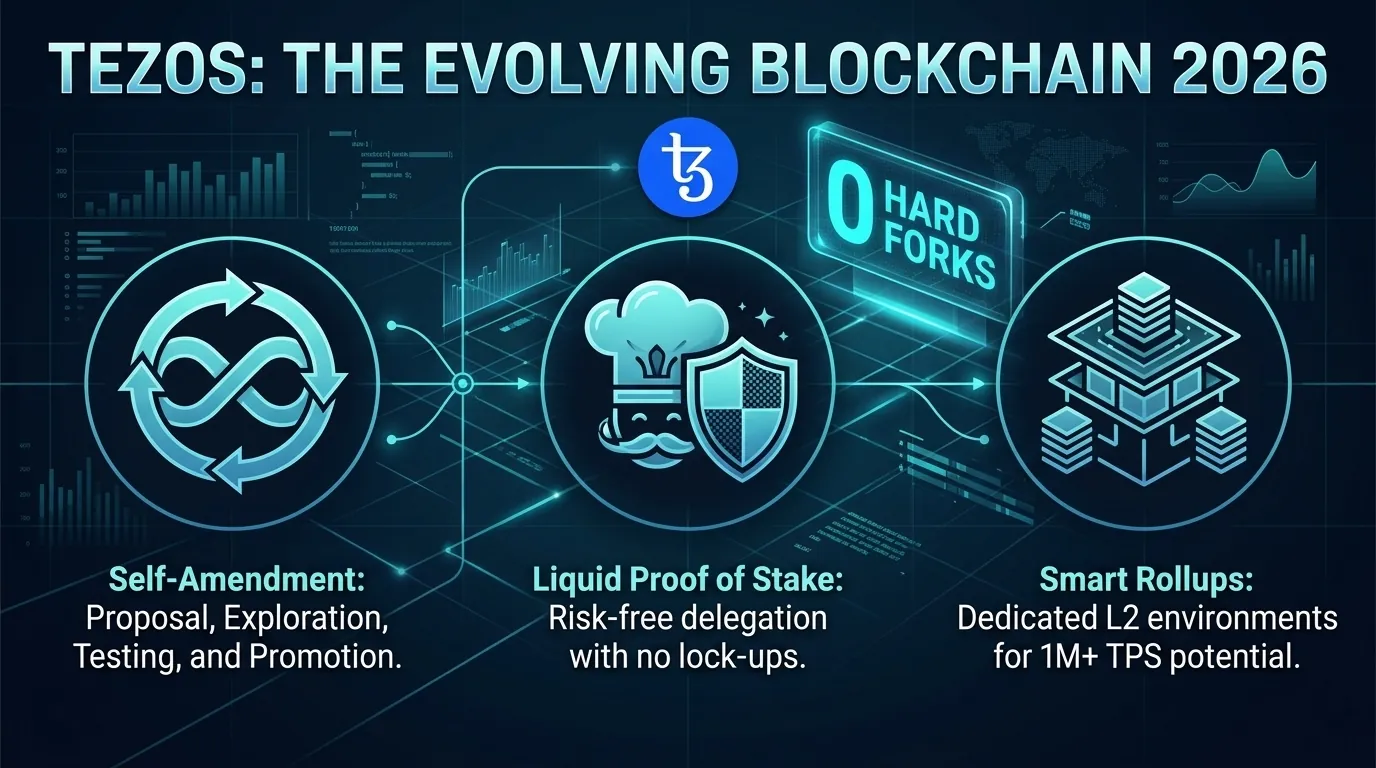
The defining feature of Tezos is its ability to upgrade its own code through a formalized, four-phase voting process. This system is designed to prevent the community fragmentation that led to the creation of Bitcoin Cash or Ethereum Classic.
The Amendment Process:
Proposal Period: Bakers (validators) submit proposals for protocol changes.
Exploration Vote Period: Bakers vote on whether to move the proposal forward to a testnet.
Testing Period: A temporary test fork is created to ensure the upgrade works as intended without bugs.
Promotion Vote Period: A final vote determines whether the test code becomes the new mainnet standard.
This process ensures that Tezos can adopt the latest cryptographic research-such as zero-knowledge proofs or new consensus algorithms, without social coordination crises.
2. Liquid Proof of Stake (LPoS) and "Baking"
Tezos utilizes a unique version of Proof of Stake known as Liquid Proof of Stake (LPoS). The primary goal of this model is to maximize the number of participants in the consensus process while maintaining liquidity for the user.
Baking: Validators in Tezos are called "Bakers." To become a baker, a user typically needs a "roll" (currently set at 6,000 XTZ). Bakers are responsible for creating blocks and "endorsing" (verifying) blocks created by others.
Delegation: Users who do not wish to run their own hardware can delegate their XTZ to a baker. Unlike many other networks, delegated XTZ never leaves the user's wallet and is not locked. Users can spend their delegated funds at any time, though the baker’s voting power and rewards will adjust accordingly.
Rewards: In 2026, the staking yield for Tezos remains consistent, ranging between 4.5% and 5.5% APY, depending on network participation levels.
3. Technical Standards: FA2 and Formal Verification
Tezos is built using OCaml, a functional programming language known for its precision. This facilitates Formal Verification, a mathematical process used to prove that a smart contract will behave exactly as intended. This is a critical feature for high-stakes financial or industrial applications where code errors can lead to catastrophic losses.
FA2 Token Standard: Unlike Ethereum’s separate ERC-20 and ERC-721 standards, Tezos uses a unified standard called FA2 (TZIP-12). This single standard supports fungible, non-fungible, and multi-asset contracts, simplifying the work for developers building complex marketplaces.
Smart Rollups: As of 2026, Tezos has fully integrated Enshrined Layer 2 solutions. These allow specialized applications to run on dedicated "rollups" while inheriting the full security of the Tezos L1, targeting theoretical throughputs of up to 1 million transactions per second (TPS).
Technical Trade-offs and Market Realities
Strengths
Stability: A proven track record of seamless upgrades (over 15 successful migrations as of 2026).
Low Barrier to Entry: Delegation is risk-free (no slashing for delegates) and requires no lock-up periods.
Institutional Fit: Formal verification makes it a preferred choice for central bank digital currencies (CBDCs) and security token offerings (STOs).
Challenges
Developer Adoption: OCaml and Michelson (the low-level language of Tezos) have a steeper learning curve than Solidity or Rust, limiting the number of new developers entering the ecosystem.
Liquidity Fragmentation: While Smart Rollups are technically impressive, liquidity in 2026 remains concentrated on the Layer 1, making the L2 ecosystem feel sparsely populated compared to Ethereum rollups.
Market Mindshare: Tezos often struggles to capture the "hype" cycles of retail-focused blockchains, leading to lower social volume and slower price appreciation relative to its technical peers.
Disclaimer: This article is for informational purposes only and does not constitute investment advice, financial advice, trading advice, or any other kind of advice. DEXTools does not recommend buying, selling, or holding any cryptocurrency or token. Users should conduct their own research and consult with a qualified financial advisor before making any investment decisions. Cryptocurrency investments are volatile and high-risk. DEXTools is not responsible for any losses incurred.
Related Guides
- How to Withdraw from a CEX to Self-Custody Wallets
- What Is Self-Custody in Crypto? Explained 2026
- What Is Gigachad (GIGA)? Solana Self-Improvement Memecoin Guide 2026
- What Is Babylon Bitcoin Staking: Complete BTC Self-Custody Staking Guide (2026)
- What Is a Non-Custodial Wallet: Complete Self-Custody Guide (2026)
Frequently Asked Questions
What makes Tezos different from other blockchains?
Tezos stands out due to its on-chain governance system that allows it to self-amend without the need for hard forks, enabling seamless upgrades and stability in its operations.
How does the amendment process work in Tezos?
The amendment process in Tezos involves a four-phase voting system where bakers propose changes, vote on them, test the proposals, and finally decide whether to implement them on the mainnet.
What is Liquid Proof of Stake in Tezos?
Tezos employs a unique version of Proof of Stake called Liquid Proof of Stake, which allows users to delegate their XTZ while maintaining liquidity, meaning their funds are not locked and can be spent at any time.
What is the FA2 token standard in Tezos?
The FA2 token standard in Tezos is a unified framework that supports fungible, non-fungible, and multi-asset contracts, simplifying the development process for creating complex marketplaces.