What Is Mantle? Modular L2 Beginner Guide (2026)
— By AliceOnChain in Tutorials

What is Mantle? This 2026 beginner guide explains the modular L2 architecture, why it matters and how Mantle is shaping on-chain finance.
What is Mantle? Modular L2 Beginner Guide
The Ethereum Layer 2 (L2) ecosystem has transitioned from a period of experimental rollups into an era of specialized, high-performance infrastructure. Among these, Mantle has carved out a unique position by prioritizing capital efficiency and a modular design. If you are asking what is Mantle, you are exploring an Ethereum L2 network that was born from one of the largest decentralized treasuries in crypto (formerly BitDAO) and designed specifically to separate the core functions of a blockchain to achieve lower costs and higher throughput.
The Architecture of Mantle: Understanding Modularity
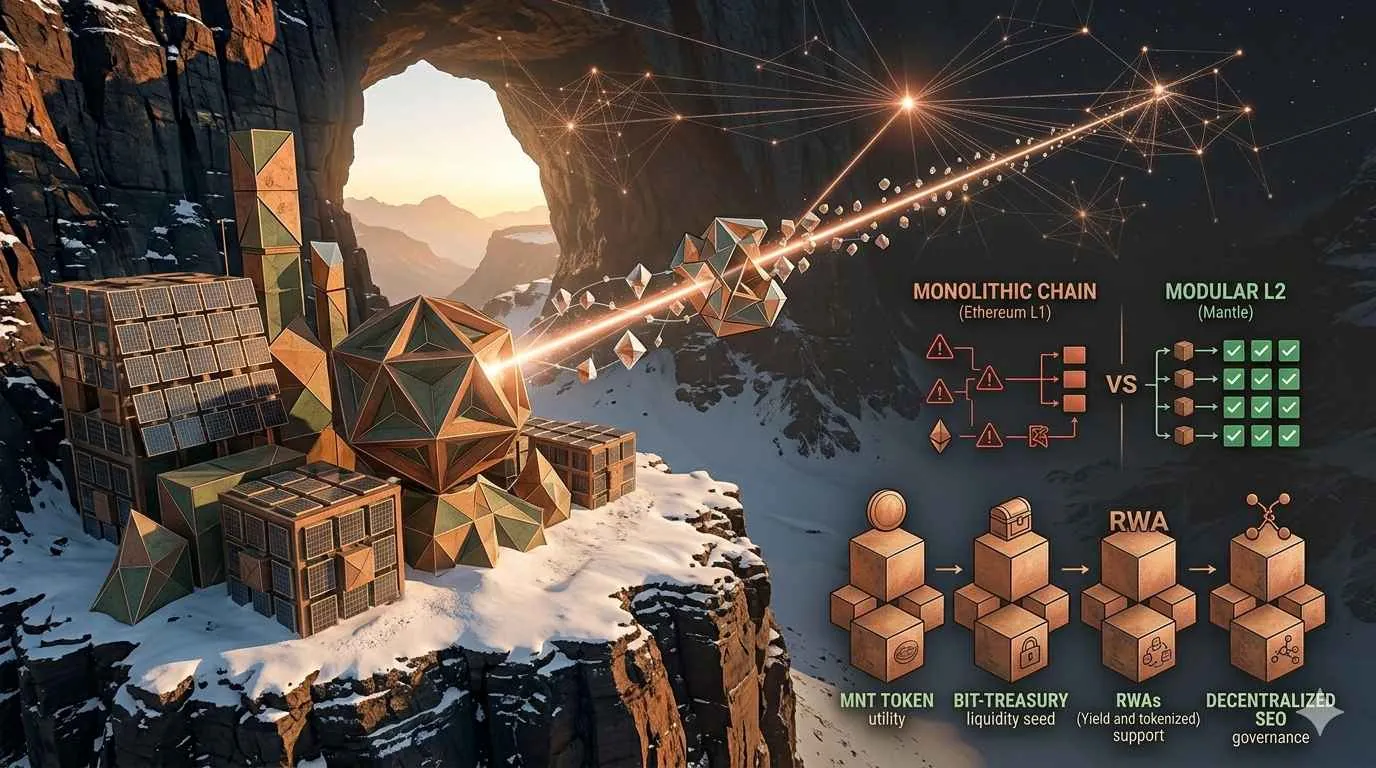
To understand the network, one must first understand what "modular" means in the context of L2s. Most traditional blockchains are "monolithic," meaning execution, settlement, and data availability all happen on the same layer. Mantle, however, breaks these tasks apart.
Mantle's architecture is designed to optimize each part of the transaction lifecycle:
Execution Layer: This is where your transactions are processed. It is fully EVM-compatible, meaning developers can use the same tools and code they use on Ethereum.
Settlement Layer: Mantle uses the Ethereum mainnet as its ultimate source of truth. Every transaction processed on Mantle is eventually finalized on Ethereum, inheriting its massive security.
- Data Availability (DA) Layer: This is Mantle’s most significant innovation. In its early days, it utilized EigenDA (via EigenLayer) to store transaction data. By early 2026, following the Arsia upgrade, Mantle transitioned to using Ethereum Blobs (EIP-4844) as its primary DA source, significantly reducing the overhead costs of the network.
The MNT Token: Governance, Gas, and Staking
A central answer to what is Mantle lies in its native token, MNT. Unlike many other L2s that use ETH for gas, Mantle has a dual-utility model for its token that was established through a governance-led migration from the BIT token.
Gas Fees: On Mantle, transaction fees are denominated and paid in MNT. This creates a constant, direct demand for the token as the network's activity grows.
Governance Weight: MNT is the primary voting asset for the Mantle Governance (formerly BitDAO). Holders can influence how the multi-billion dollar treasury is allocated, from ecosystem grants to liquidity incentives.
Staking and the mETH Protocol: By 2026, MNT has become deeply integrated with the mETH Protocol (Mantle LSP). Users can stake MNT to participate in the network's decentralized security and earn rewards derived from the treasury's yield-generating activities.
On DEXTools, monitoring the price action and distribution of MNT is a key indicator for the strength of the entire "Mantle Liquidity Chain."
The "Treasury-Backed" Advantage
What truly differentiates this infrastructure from its competitors is the massive community-owned treasury. With billions of dollars in assets, Mantle does not rely solely on venture capital to survive.
Liquidity Programs: The treasury is often used to seed liquidity for new dApps, ensuring that traders on DEXs have minimal slippage from day one.
RWA Infrastructure: In 2026, Mantle has become a leader in bringing Real-World Assets (RWAs) on-chain. Projects like USDY (Ondo Finance) and institutional-grade stablecoins are natively integrated, providing users with yield-bearing assets backed by U.S. Treasuries.
When researching what is Mantle, it is important to see it not just as a technology, but as a massive pool of capital seeking to optimize on-chain finance.
The 2026 Roadmap: ZK Proofs and AI Agents
By mid-2026, the project has successfully navigated several major technical pivots. While it started as an optimistic rollup, it has increasingly moved toward a hybrid model:
OP-Succinct ZK Proofs: Mantle has been integrating Zero-Knowledge (ZK) validity proofs into its OP Stack architecture. This aims to reduce the withdrawal period from 7 days to near-instant finality, solving one of the biggest friction points for L2 users.
AI x On-chain Finance: The "Turing Test Hackathons" of 2026 have highlighted Mantle’s focus on autonomous AI agents. The network provides the low-cost infrastructure needed for AI agents to trade, manage risk, and provide liquidity autonomously on-chain.
Decentralized Sequencer: A key goal for 2026 has been the decentralization of the sequencer set. By allowing multiple parties to order transactions, Mantle improves its censorship resistance and network uptime.
Trading on Mantle with DEXTools
For users, the Mantle experience is defined by professional-grade capital efficiency. By using the DEXTools Pair Explorer and selecting the Mantle network, you can access real-time data for its DeFi ecosystem.
High Throughput: With a capacity of over 5,000 transactions per second, price updates on DEXTools are near-instant.
Treasury-Incentivized Pools: Many of the "Hot Pairs" on Mantle are supported by treasury-backed liquidity programs, providing a more stable environment for high-volume trading.
LSP Integration: Traders often use DEXTools to monitor the peg and liquidity of mETH (Mantle Staked ETH) and fBTC, ensuring they can move between liquid staking and core assets with minimal cost.
Security and Trust Considerations
When asking what is Mantle, one must also consider the trust assumptions of the network in 2026.
Ethereum Anchor: Ultimately, all transactions are secured by the Ethereum L1. If the Mantle network ever faces issues, the data published to Ethereum Blobs allows for the reconstruction of the state.
Sequencer Status: While the roadmap toward decentralization is ongoing, users should be aware that the sequencer remains a critical point of network liveness.
Governance Risk: Because Mantle is treasury-heavy, the decisions of the DAO have a significant impact on the network's future. Active participation or monitoring of Mantle Forum discussions is recommended for long-term holders.
Conclusion
Understanding what is Mantle requires looking past the technical jargon and seeing a network built for institutional-grade liquidity and modular flexibility. By separating its data availability from its execution, Mantle has achieved a level of cost-efficiency that makes it ideal for the next generation of DeFi and AI-driven applications. As we progress through 2026, the transition toward ZK-validity proofs and the continued expansion of its RWA offerings make Mantle a foundational layer for anyone seeking to participate in the "On-chain Economy." For traders on DEXTools, it is a high-liquidity, low-fee frontier that represents the best of what modular blockchain design can offer.
--
- How to Bridge Crypto Between Chains: Complete Cross-Chain Tutorial 2026
- How to Use 1inch: Complete DEX Aggregator Swap Tutorial (2026)
- How to Use OKX Web3 Wallet: Multi-Chain DeFi Hub Guide (2026)
Disclaimer: This article is for informational purposes only and does not constitute investment advice, financial advice, trading advice, or any other kind of advice. DEXTools does not recommend buying, selling, or holding any cryptocurrency or token. Users should conduct their own research and consult with a qualified financial advisor before making any investment decisions. Cryptocurrency investments are volatile and high-risk. DEXTools is not responsible for any losses incurred.
Related Guides
- What Is a Modular Blockchain: Celestia and the New Stack (2026)
- What Is Manta Pacific? Modular ZK L2 with Celestia DA Guide 2026
- What Is IoTeX (IOTX)? Modular DePIN Platform for IoT + AI Explained in 2026
- What Is Dymension? RollApps and DYM Modular L1 Guide 2026
- What Is Data Availability (DA): Complete Modular Blockchain Guide (2026)
Frequently Asked Questions
What is Mantle in the Ethereum ecosystem?
Mantle is an Ethereum Layer 2 network designed to enhance capital efficiency and modularity, separating core blockchain functions to lower costs and increase transaction throughput.
How does Mantle's architecture differ from traditional blockchains?
Unlike traditional blockchains that are monolithic, Mantle employs a modular design that separates execution, settlement, and data availability into distinct layers, optimizing each part of the transaction process.
What role does the MNT token play in the Mantle network?
The MNT token serves dual purposes as both a governance asset and a means to pay transaction fees, creating a consistent demand as network activity increases.
How does Mantle support Real-World Assets (RWAs)?
Mantle has established itself as a leader in integrating Real-World Assets on-chain, allowing projects like USDY to offer yield-bearing assets backed by U.
What are the future developments planned for Mantle by 2026?
By 2026, Mantle aims to implement Zero-Knowledge proofs for faster withdrawals and enhance its infrastructure to support autonomous AI agents in on-chain finance.