What is GMX? Decentralized Perpetuals Explained
— By AliceOnChain in Tutorials
Centralized crypto exchanges have long held a monopoly over leveraged derivatives, but decentralized protocols have disrupted this landscape. This comprehensive guide answers the question: what is GMX? Explore the unique multi-asset liquidity mechanisms, oracle-driven pricing engines, and advanced risk parameters that enable trustless, non-custodial perpetual swaps directly from your Web3 wallet.
What is GMX? Decentralized Perpetuals Explained
For much of cryptocurrency history, high-leverage derivatives trading was confined to the walled gardens of centralized exchanges (CEXs). While automated market makers successfully decentralized simple spot token swaps, replicating complex financial products like perpetual futures on-chain remained a technical hurdle. High gas costs, slow execution speeds, and vulnerable order-book designs made leveraged trading on decentralized networks capital-inefficient and highly susceptible to front-running bots. For any user looking to step beyond basic asset conversions into advanced derivatives, understanding what is GMX and how its underlying infrastructure handles trade execution is the critical first step toward mastering decentralized leverage.
The introduction of specialized layer-2 scaling solutions altered this paradigm. Launched in late 2021, GMX pioneered a highly successful architecture for trustless, non-custodial derivatives trading. Operating primarily on Arbitrum and Avalanche-and expanding onto the Ethereum mainnet-the protocol offers deep liquidity and institutional-grade leverage without requiring users to sacrifice custody of their private keys or register with an identity-verifying intermediary.
This structural primer breaks down the mechanical blueprint of the protocol, evaluates its multi-asset liquidity framework, and explains how to integrate its structural metrics with advanced analytical tools like DEXTools to manage risk effectively in volatile markets.
The Core Concept: What are Decentralized Perpetuals?
To grasp the innovation behind the platform, one must first understand perpetual swaps. Unlike traditional futures contracts that feature a fixed expiration date, a perpetual contract has no expiry. Traders can maintain a leveraged long or short position indefinitely, provided they maintain sufficient margin to back their trades.
To ensure the contractual price of a perpetual market aligns with the actual underlying spot market price, the protocol utilizes a continuous funding rate mechanism. If the majority of the market is heavily longing an asset, buyers pay a periodic fee to short sellers. Conversely, if short sentiment dominates, short sellers pay long positions. This rebalancing acts as an economic tether, keeping derivatives prices synchronized with global asset values.
When answering what is GMX, the definitive structural distinction lies in execution. Instead of matching buyers and sellers through a traditional centralized order book, every trade on the platform is executed directly against a decentralized, community-funded liquidity pool. The pool acts as the global counterparty for every long and short position opened on the exchange.
The V1 Blueprint: Understanding the GLP Liquidity Pool
The foundation of the platform’s initial growth was an innovative multi-asset index framework known as the GLP pool. This liquidity model acts as the operational engine for the V1 deployment.
An Index of Blue-Chip Assets
Instead of isolating liquidity into separate, two-token pairs, the GLP pool aggregates a basket of highly liquid assets into a single collective pool. This index typically consists of roughly 50% stablecoins (such as USDC, USDT, DAI, and FRAX) and 50% blue-chip cryptocurrencies (predominantly Ethereum and Wrapped Bitcoin), alongside supporting assets like Chainlink (LINK) and Uniswap (UNI).
Serving as the Global Counterparty
When a liquidity provider mints GLP by depositing any supported asset into the vault, they are effectively purchasing a share of this multi-asset index. When a trader comes to the platform to open a leveraged long position on ETH, they are renting the upside of the ETH held within the GLP pool. If the trader opens a short position, they are betting against the pool using stablecoins as collateral.
This design introduces a unique economic dynamic: GLP liquidity providers collectively profit from the net losses of the traders. Historically, because retail traders frequently underperform over extended horizons, GLP providers have captured robust yields generated by accumulated trading fees, borrowing costs, and liquidations. However, if a sustained, highly profitable market trend occurs and traders win consistently, the pool pays out those winnings, causing GLP holders to underperform a simple hold strategy.
The Evolution: GMX V2 and the GM Pool Framework
While V1 achieved massive total value locked (TVL), its single massive pool design limited the protocol’s ability to list newer, highly volatile tokens without exposing liquidity providers to systemic risk. To address this scaling bottleneck, GMX V2 introduced a highly optimized, market-specific architecture.
Isolated GM Pools
Instead of forcing every single trade to settle against the massive collective GLP index, V2 deploys isolated liquidity pools known as GM (GMX Market) pools. Each GM pool is dedicated to a specific underlying asset pair, such as an isolated ETH/USDC pool or an ARB/USDC pool. This isolation protects the broader protocol; if an exotic or highly volatile asset experiences an extreme exploit or tail-risk event, the potential downside is strictly bounded within that single GM pool, leaving the core assets untouched.
Synthetic Assets and Up to 100x Leverage
By utilizing isolated structures alongside advanced pricing engines, V2 expanded its trading parameters significantly. It introduced up to 100x leverage on select blue-chip assets and expanded the platform’s asset diversity to include synthetic markets for commodities, such as gold and silver. This allows on-chain participants to trade traditional financial instruments directly from their self-custodial wallets.
Oracle-Based Pricing and Zero Price Impact
A major challenge for on-chain derivatives is preventing manipulative front-running and toxic arbitrage. Traditional AMM models suffer from price slippage; as an order size increases, the execution price worsens, making large trades capital-inefficient.
The platform bypasses this limitation entirely by relying on oracle-based asset pricing. The protocol integrates Chainlink Data Streams and aggregated price feeds that pull live, ultra-low-latency price metrics directly from multiple leading high-volume spot exchanges.
Because the execution price is determined by the external oracle fee rather than an internal order book or an algorithmic bonding curve, the protocol can deliver trades with virtually zero price impact. A trader can execute a multi-million dollar position at the exact global mark price provided by the oracle, completely avoiding the immediate slippage penalty typically associated with on-chain execution. This oracle infrastructure also protects positions from localized "scam wicks"-artificial price spikes on individual exchanges designed to trigger liquidations.
Tokenomics and Value Accrual: GMX and esGMX
The protocol’s economic ecosystem operates via a dual-token model consisting of the liquidity vehicle (GLP or GM tokens) and the utility/governance token, GMX.
Protocol Fee Distribution
The GMX token functions as the governance and value-accrual hub of the protocol. When users stake their native GMX tokens on the platform, they receive an equitable share of the total revenue generated by the exchange.
In V1, stakers receive 30% of all protocol fees, while GLP liquidity providers capture 70%.
In V2, the distribution structure assigns 10% of fees back to GMX stakers, while the remaining bulk is distributed directly to the specific GM pool liquidity providers to incentivize deep, isolated market depth. Notably, these fee rewards are distributed in native blue-chip assets like Ethereum (ETH) or Avalanche (AVAX) rather than an inflationary protocol token, providing stakers with real, non-dilutive programmatic yield.
Escrowed GMX (esGMX) and Multiplier Points
To incentivize long-term capital preservation, the protocol rewards stakers with Escrowed GMX (esGMX) and Multiplier Points. Escrowed tokens can be compounded to earn the same protocol rewards as normal GMX, or they can be linearly vested over a 365-day duration by committing a proportional amount of backing capital. Multiplier Points reward continuous staking behavior; if a user unstakes their GMX, a proportional percentage of their accumulated multiplier points is burned, discouraging mercenary liquidity.
Enhancing Leverage Risk Management with DEXTools
Leveraged perpetual trading is inherently high-risk. A minor adverse price movement can quickly push a position toward its liquidation threshold. To protect capital, execution tools must be paired with real-time market data. Integrating the structural mechanics of the protocol with the data layers of DEXTools establishes a powerful workflow for managing risk.
Before opening any leveraged position or committing liquidity to a GM pool, look up the target asset pair on the DEXTools Pair Explorer. Analyze the live macro chart to map out undisputed support and resistance structures, and check technical indicators like the Relative Strength Index (RSI) across daily or weekly timeframes to confirm whether an asset is overextended. Opening a high-leverage long position directly underneath a major macro resistance level significantly increases the probability of immediate liquidation.
Furthermore, monitoring real-time spot volume and whale activity on DEXTools provides crucial context. If DEXTools displays a massive influx of whale distribution or highly concentrated selling volume on a specific token, it indicates that the underlying spot market is experiencing severe downward pressure. Because GMX pricing tracks external spot data via oracles, watching these leading spot indicators on DEXTools allows derivatives traders to anticipate trend reversals and adjust their stop-loss parameters before an adverse oracle update triggers an unwanted exit.
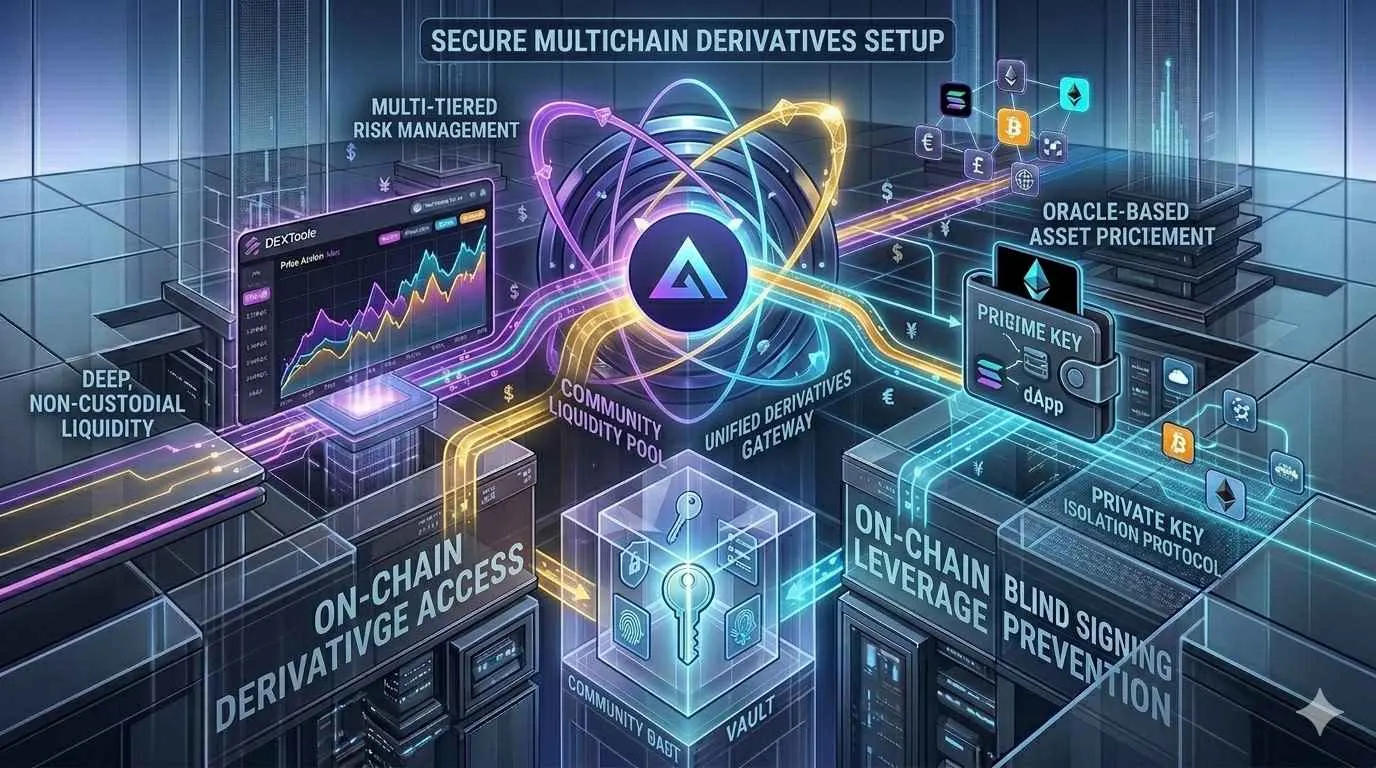
Conclusion: The Horizon of Decentralized Derivatives
Decentralized derivatives protocols have bridged the functional gap between centralized efficiency and self-custodial security. As explored when analyzing what is GMX, the protocol's combination of community-funded multi-asset pools, isolated risk parameters, and low-latency oracle pricing delivers an execution model that rivals centralized platforms without requiring users to undergo KYC or surrender asset control.
However, trading with leverage demands rigorous operational discipline. By utilizing advanced price alerts, analyzing market trends on DEXTools, keeping track of funding rate shifts, and enforcing strict capital allocation limits, market participants can successfully navigate the complexities of on-chain perpetuals while preserving their long-term crypto net worth.
- How to Bridge Crypto Between Chains: Complete Cross-Chain Tutorial 2026
- How to Use 1inch for Swaps: Classic, Fusion and Limit Orders (2026)
- How to Use OKX Web3 Wallet: Multi-Chain DeFi Hub Guide (2026)
Disclaimer: This article is for informational purposes only and does not constitute investment advice, financial advice, trading advice, or any other kind of advice. DEXTools does not recommend buying, selling, or holding any cryptocurrency or token. Users should conduct their own research and consult with a qualified financial advisor before making any investment decisions. Cryptocurrency investments are volatile and high-risk. DEXTools is not responsible for any losses incurred.
Related Guides
- How to Use GMX: Complete Perpetual Trading on Arbitrum Tutorial (2026)
- GMX vs dYdX: Perpetual DEX Platforms Compared (2026)
- What Is Synthetix V3? Perps Multi Collateral Derivatives Guide 2026
- What Is Jupiter Perps? Solana Perpetuals Guide 2026
- Storm Trade Tutorial: TON Perpetuals Guide 2026
Frequently Asked Questions
What is GMX?
GMX is a decentralized exchange focused on perpetual futures trading, allowing users to take leveraged long or short positions onchain. It operates through smart contracts rather than a centralized order book.
What are perpetual futures in crypto?
Perpetual futures are derivative contracts that let traders speculate on an asset's price with leverage and no fixed expiry date. They typically use a funding rate mechanism to keep the contract price aligned with the spot price.
How do decentralized perpetuals differ from centralized exchanges?
Decentralized perpetual protocols let users trade directly from their own wallets without depositing funds with a central custodian. This reduces custodial risk but introduces smart contract risk and depends on onchain liquidity and oracles.
What is leverage in perpetual trading?
Leverage lets a trader open a position larger than their deposited collateral, amplifying both potential gains and losses. Higher leverage increases the risk that a small adverse move triggers liquidation.