Tokenized Stocks Explained: How Backed and Dinari Work
— By AliceOnChain in Tutorials
An analytical investigation into the legal, technical, and financial structures enabling real-world asset tokenization on public blockchains, focusing on Backed and Dinari frameworks.
The intersection of traditional equity markets and decentralized ledger technology has driven the evolution of Real-World Asset tokenization. As blockchain infrastructure matures, the demand to migrate traditional financial securities onto public chains has grown significantly. Within this paradigm, having tokenized stocks explained helps clarify how cross-chain collateralization functions for modern asset managers. This institutional evolution bridges the gap between traditional brokerage frameworks and 24/7 on-chain execution, allowing global capital to flow seamlessly across previously isolated ecosystems.
For on-chain traders, the emergence of tokenized equities provides a novel avenue for asset allocation, portfolio diversification, and volatility management. Rather than exiting the decentralized financial architecture to hedge into fiat currency or traditional tech equities, capital allocators can now retain exposure inside their non-custodial software wallets. Evaluating the structural integrity, legal compliance mechanisms, and technical implementation of these synthetic or backed vehicles is essential for effective digital asset risk management.
The Core Concept of On-Chain Equities with Tokenized Stocks Explained
To get the mechanics of tokenized stocks explained properly, one must first differentiate between synthetic token formats and fully backed asset designs. Early decentralized finance experiments relied heavily on purely synthetic models, where derivative platforms used decentralized price feeds and over-collateralized crypto assets to mirror equity prices without holding the underlying shares.
The modern paradigm has shifted decisively toward asset-backed tokens. When an investor purchases a tokenized stock from an institutional provider, the issuing entity holds the equivalent underlier in a regulated financial depository. Each digital token acts as a highly liquid, fractionally divisible certificate of ownership representing a direct claim on the underlying share or security. This structural layout provides genuine economic alignment with traditional capital markets, capturing corporate actions like stock splits and dividend distributions.
Backed Assets: The Structured Financial Model
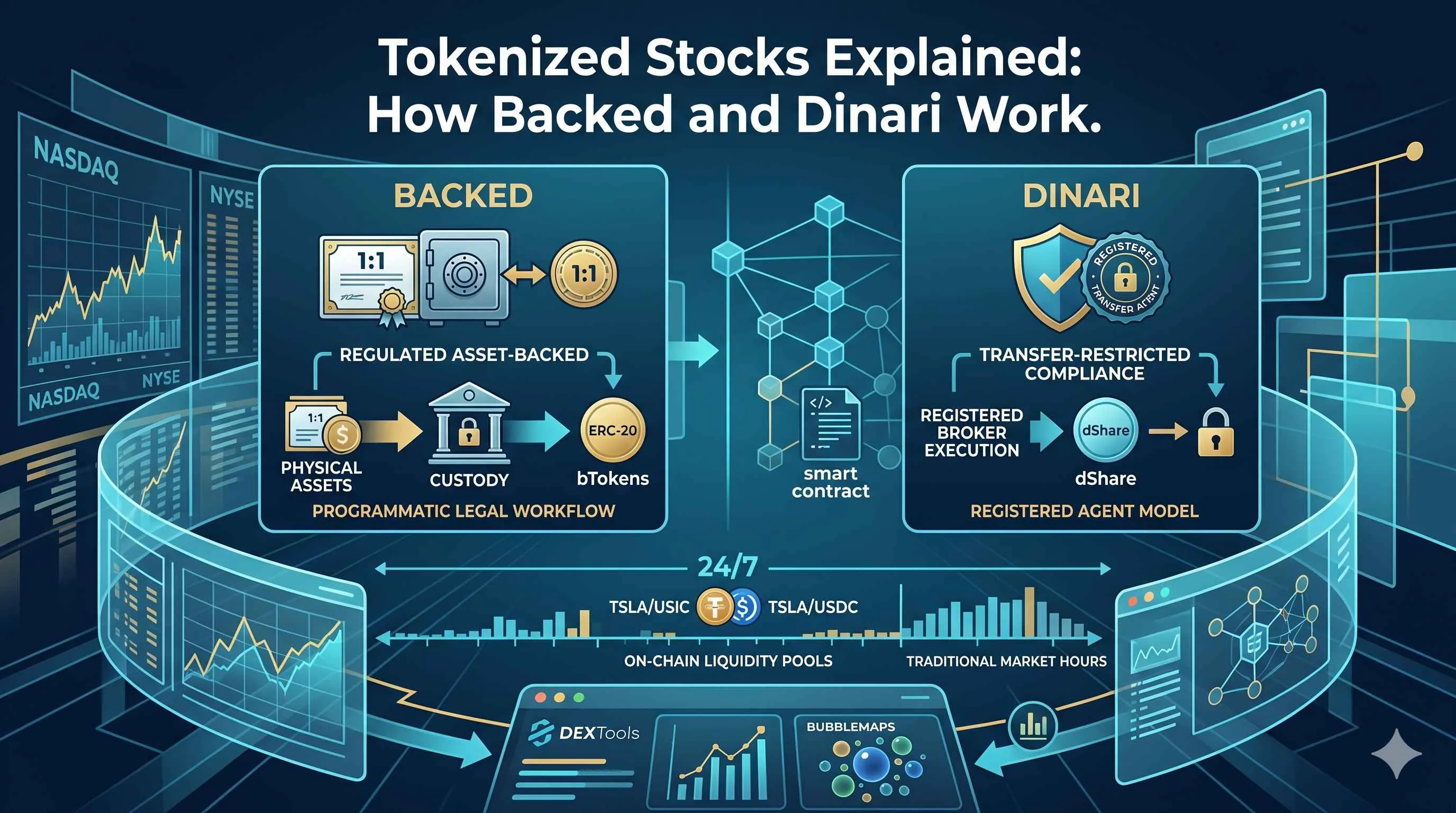
Backed Assets represents a prominent institutional infrastructure protocol facilitating the tokenization of public equities, structured notes, and exchange-traded funds. Operating under structured Swiss regulatory parameters, Backed issues ERC-20 tokens called bTokens that represent an exact tracking structure of the targeted underlying asset.
The issuing process for Backed follows a strict programmatic legal workflow:
Capital Inflow and Purchase: A verified client deposits capital into the Backed platform interface to initiate a creation request for a specific equity token, such as tokenized Apple or Tesla shares.
Custodial Asset Acquisition: Backed utilizes authorized brokerage counterparties to buy the corresponding physical shares on the regulated public stock exchanges.
Secure Third-Party Depository: The newly purchased securities are immediately deposited into a regulated, fully segregated bank custody account, isolated entirely from the balance sheet of the issuance firm.
On-Chain Token Minting: Once the asset custody is validated, the platform deploys the smart contract mechanism to mint the exact fractional equivalent of bTokens directly into the buyer's designated web3 wallet.
Because bTokens operate as standard ERC-20 contracts on public layers, they are fully composable across decentralized financial systems. They can be utilized as collateral inside non-custodial lending pools, integrated into structured yield products, or monitored directly via decentralized analytics suites. Crucially, Backed tokens are designed as freely transferable assets, meaning they can change hands peer-to-peer across public ledgers without necessitating continuous interface intervention from the original issuer.
Dinari: The Direct Compliance Architecture
Dinari approaches real-world equity tokenization through a highly regulated, transfer-restricted infrastructure framework designed to satisfy strict oversight parameters. Through its dShare platform, Dinari acts as a registered transfer agent under regulatory frameworks, providing a transparent, asset-backed equity token standard.
Unlike alternative models that allow unregulated secondary transferability, Dinari prioritizes a strict circle of compliance:
Registered Broker Integration: When an operator interacts with the dShare platform, the order routes through an institutional clearing network that executes the underlying equity transaction in real time.
1:1 Collateralization Matching: Every dShare token minted on-chain matches exactly 1:1 with an identical equity share held securely in a specialized, fully audited institutional brokerage vault.
Closed-Loop Secondary Transfers: To ensure complete adherence to continuous regulatory policies, dShare tokens feature specialized transfer restrictions hardcoded into the contract's standard logic.
This specific restriction means that secondary market trades or liquidations of Dinari tokens often happen within verified, compliant ecosystems or directly through the primary protocol engine. For risk-averse institutional market participants, this structural framework offers high security, eliminating the compliance friction often found when handling fully unpermissioned decentralized assets.
Analyzing On-Chain Liquidity and Market Dynamics
The deployment of real-world equity frameworks onto public blockchains fundamentally transforms how analysts evaluate macro market sentiment and asset allocation profiles.
Tracking Capital Migration and Pool Depth
When traditional stock representations migrate into decentralized protocols, tracking on-chain asset liquidity becomes a critical operational requirement. Because tokenized equities are often paired with prominent stablecoins across automated market maker pools, liquidity depth can fluctuate based on changing macroeconomic conditions or structural market events.
Traders looking to navigate these emerging pools must utilize sophisticated analytics suites. Monitoring real-time order books and pool updates via tools like the DEXTools Pair Explorer allows allocators to determine exact execution slippage, map capital efficiency trajectories, and pinpoint historical support and resistance levels across specific asset pairs.
Evaluating Holder Distribution to Mitigate Systemic Risk
Understanding ownership concentrations within real-world asset contracts is a cornerstone of modern digital asset risk management. If a significant percentage of a tokenized stock's circulating supply becomes heavily concentrated inside a small cluster of connected wallet addresses, the protocol can face systemic vulnerability during sudden liquidation events.
Using advanced deep-data tooling helps expose these vulnerabilities before they impact capital. Utilizing precise holder analysis configurations alongside native visualization charts, such as the integrated Bubblemaps view on DEXTools, enables market participants to trace underlying wallet relationships. Spotting large whale accumulations or unannounced entity distributions early helps traders adjust their risk profiles ahead of sudden momentum shifts.
[On-Chain Equity Pair Deployed] ---> [DEXTools Pair Explorer Validation] ---> [Bubblemaps Holder Analysis Execution] ---> [Risk Evaluation & Position Optimization]
Technical and Operational Risks to Monitor
While having tokenized stocks explained reveals significant capital efficiencies, these hybrid structures introduce a unique set of technical and operational risks that market participants must evaluate:
Smart Contract and Protocol Vulnerabilities: Like any decentralized application, the underlying ERC-20 contract configurations governing bTokens or dShares remain exposed to code bugs, logic errors, or oracle dependencies. A breakdown in the pricing oracle mechanism can distort localized pricing, regardless of the underlying share's value on Wall Street.
Counterparty and Segregation Risk: Although both platforms use segregated bank depositories, users rely on the legal integrity and continuous solvency of the issuing firm, the custodian bank, and the authorized brokerage execution networks.
Market Hours and Redemption Friction: Traditional equities trade strictly during localized business hours, whereas blockchain layers operate continuously. This temporal disconnect can create unique pricing deltas or execution lag during overnight corporate announcements, as the physical asset backing cannot be adjusted until traditional markets reopen.
Conclusion
The structural frameworks engineered by Backed and Dinari demonstrate that the financial landscape is steadily shifting toward a unified, on-chain future. By translating legacy legal rights into programmatically verifiable smart contract structures, these protocols provide traders with unprecedented flexibility to hedge, diversify, and manage asset allocation profiles without breaking non-custodial workflows.
As real-world asset structures expand across major public networks, maintaining objective data awareness remains the primary competitive edge for digital asset allocators. Leveraging comprehensive on-chain analytical suites like DEXTools to verify real-time pool volume, configure custom price alerts, and evaluate shifting holder concentrations ensures that market participants remain resilient, objective, and highly agile as traditional equities increasingly adopt web3 mechanics.
Wall Street's Crypto Push: Tokenized Stocks & StakingTop 5 Whale Tracking Tools in 2026: Large Wallet Monitoring Across Chains
DEXTools Pair Explorer for Early Liquidity Signals
What Is Backed Finance (bIB01)? Tokenized Stocks and Bonds RWA Guide 2026
Disclaimer: This article is for informational purposes only and does not constitute investment advice, financial advice, trading advice, or any other kind of advice. DEXTools does not recommend buying, selling, or holding any cryptocurrency or token. Users should conduct their own research and consult with a qualified financial advisor before making any investment decisions. Cryptocurrency investments are volatile and high-risk. DEXTools is not responsible for any losses incurred.
The Regulatory Tightrope: Navigating Compliance for Tokenized Securities
While the technical architecture of platforms like Backed and Dinari provides the rails for tokenized securities, the true challenge and innovation lie in their meticulous approach to regulatory compliance. Unlike native crypto assets, tokenized stocks operate at the intersection of traditional financial law and nascent blockchain regulations. This necessitates a multi-jurisdictional understanding and a proactive stance toward evolving legal frameworks, ensuring investor protection and market integrity.
The "backed" nature of these tokens is not merely a technical detail; it's a legal cornerstone. Each token must represent a legitimate claim to an underlying asset, held in a legally recognized and regulated custody arrangement. This often involves partnerships with licensed financial institutions and adherence to established securities laws in relevant jurisdictions, such as the US, EU, or UK. The legal wrapper around the token is as critical as its smart contract code.
Operationalizing Compliance: Beyond the Whitepaper
- KYC/AML Integration: Robust Know Your Customer and Anti-Money Laundering procedures are fundamental, often extending beyond typical DeFi protocols to meet stringent financial industry standards.
- Accreditation Verification: For certain tokenized securities, platforms must implement mechanisms to verify investor accreditation status, ensuring compliance with offerings restricted to qualified investors.
- Jurisdictional Restrictions: Smart contracts and off-chain processes must enforce geo-blocking and other restrictions to prevent trading or ownership by individuals in prohibited jurisdictions.
- Reporting and Auditing: Regular reporting to regulatory bodies and independent audits of underlying assets and custody arrangements are essential for transparency and trust.
- Legal Opinion and Counsel: Continuous engagement with legal counsel specializing in securities and blockchain law is critical to navigate new directives and interpret existing regulations effectively.
- Asset Segregation and Custody: Ensuring clear legal segregation of client assets from platform operational funds, held by regulated third-party custodians, is paramount for investor protection.
Related Guides
- What Is Backed Finance (bIB01)? Tokenized Stocks and Bonds RWA Guide 2026
- Nasdaq, NYSE Owner Race to Put $126 Trillion Equity Market on Blockchain
- What is Ondo Finance (ONDO)? Tokenized Treasuries Explained
- What Is BlackRock BUIDL: Complete Tokenized Treasury Fund Guide (2026)
- Top 5 Real World Asset (RWA) Tokens in 2026: Tokenized Finance Goes Mainstream
Frequently Asked Questions
What are tokenized stocks?
Tokenized stocks are blockchain based tokens designed to represent ownership or exposure to traditional equities. They aim to bring stock exposure on chain so it can be used within crypto ecosystems.
How are tokenized stocks backed?
Tokenized stocks are typically backed by the underlying shares held by a custodian or issuer, so each token is meant to correspond to a real asset. The structure relies on the issuer maintaining proper backing and disclosures.
What are the risks of tokenized stocks?
Risks include reliance on the issuer and custodian, legal and regulatory uncertainty across jurisdictions, and questions about how token holder rights are enforced. Smart contract and liquidity risks can also apply.
How do tokenized stocks differ from owning shares directly?
Direct share ownership is recorded through traditional brokers and registries, while tokenized stocks rely on a blockchain representation backed off chain. The rights and protections can differ from holding the actual security.