What Does PvP Mean in Crypto? Memecoin Market Dynamics
— By AliceOnChain in Tutorials

In fast-paced decentralized markets, the term PvP highlights a shift from collaborative growth to a zero-sum environment. This guide breaks down the technical indicators of a PvP market and how to use on-chain metrics to manage risk effectively.
Understanding PvP in Crypto: A Technical Guide to Memecoin Market Dynamics
The lifecycle of decentralized finance (DeFi) assets, particularly memecoins, is heavily influenced by shifts in market psychology and liquidity concentration. When exploring trading communities, understanding the pvp meaning crypto context is essential, as the phrase frequently highlights a structural shift from collaborative ecosystem growth to a highly competitive, zero-sum environment. To navigate these volatile environments successfully, traders must move past social media terminology and analyze the technical realities behind shifting order flows.
What Does PvP Mean in Crypto?
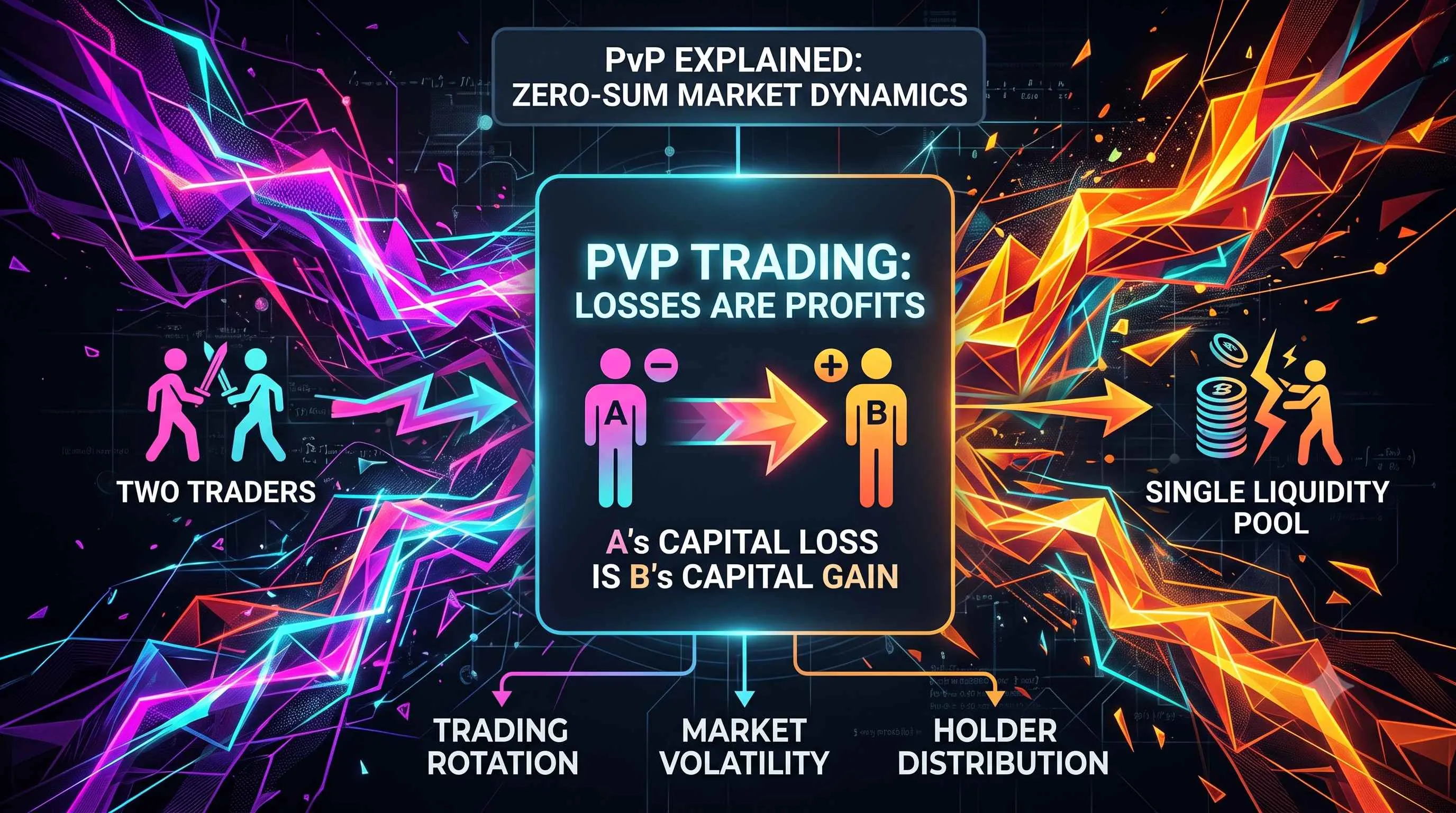
In conventional gaming, PvP stands for "Player versus Player," contrasting with Player versus Environment (PvE). When applied to cryptocurrency markets, particularly high-volatility sectors like memecoins, the pvp meaning crypto concept describes an intense, zero-sum market environment where participants compete directly against one another for limited capital.
Zero-Sum Market Mechanics
In a traditional expansionary bull market, external capital flows continuously into the ecosystem. This macro liquidity influx can allow multiple asset classes and tokens to appreciate simultaneously. This is the financial equivalent of a PvE environment, where most participants experience upward portfolio mobility due to systemic growth.
Conversely, a crypto pvp environment is characterized by stagnant or contracting net liquidity. When new retail capital or institutional inflows slow down, the existing capital within the ecosystem simply rotates from one token to another. In this pvp crypto market setup, for one trader to realize a profit, another trader must absorb the corresponding depreciation. The market stops operating as a rising tide and transforms into a hyper-competitive arena where timing, on-chain execution, and data asymmetrical advantages dictate survivability.
The Lifecycle Shift of Memecoin Ecosystems
Memecoin trading often transitions rapidly through these stages. Early-stage token launches often exhibit highly localized, aggressive pvp market dynamics. Because these assets frequently lack underlying utility or institutional backing, their valuation relies entirely on short-term attention capital and order flow imbalance, embodying the true meaning of pvp in crypto.
Identifying a PvP Market Environment On-Chain
Traders cannot rely solely on social sentiment to identify a zero-sum environment. Recognizing a pvp trading environment requires structural verification through specific on-chain metrics and technical indicators.
Declining Aggregate Volume vs. Surging Launch Frequency
One of the most reliable macroeconomic signals of a pvp crypto trading landscape is a divergence between token creation velocity and aggregate trading volume. When decentralized exchange (DEX) platforms see thousands of new contract deployments daily, but total ecosystem volume remains flat or declining, the available liquidity becomes highly fragmented.
Traders can monitor this trend on DEXTools by tracking macro volume trends across specific networks like Solana, Ethereum, or Base. A sudden drop in average volume per pair often signals a pvp crypto phase where capital is shifting too quickly for sustained trends to establish.
Brief Attention Cycles and Kinetic Price Action
In expansionary phases, a token may sustain an upward trend for weeks or months, characterized by healthy consolidation phases and higher lows. In a pvp market, the lifespan of a trend can compress into days, hours, or even minutes.
The price charts typically display aggressive spikes followed by rapid, near-total retracements. This occurs because early buyers actively look to take profits at the first sign of momentum deceleration, knowing that secondary buyers are scarce in a pvp token market.
Key Technical Metrics for Navigating PvP Conditions
Successfully surviving a zero-sum trading environment requires shifting from emotional trading to strict data-driven analysis. Utilizing advanced charting tools and on-chain analytics platforms allows traders to evaluate pvp crypto risk objectively.
1. Volume Profile and Liquidity Depth
Before interacting with any high-volatility token, analyzing the relationship between its circulating supply, market capitalization, and locked liquidity is vital. A common vulnerability in pvp memecoin trading is low liquidity depth relative to market cap.
Using the DEXTools Pair Explorer, traders can evaluate the Liquidity Score and verified locked liquidity. If a token possesses a high fully diluted valuation (FDV) but thin liquidity pools, large market orders will cause significant slippage. In a pvp scenario, thin liquidity accelerates downward cascades as traders scramble for the same exit parameters.
2. Holder Distribution and Wallet Analysis
A critical step in validating whether a token is an actual market contender or a short-term liquidity trap within a crypto pvp market is examining the distribution of supply among holders. A highly concentrated asset is prone to sudden, catastrophic sell-offs.
Top Holders Analysis: Utilizing the Holder Analysis tab on DEXTools can reveal whether a small group of wallets controls a dominant percentage of the supply.
Cluster Identification: Traders should check integrated visualization tools like Bubblemaps to detect hidden connections between seemingly independent wallets. If multiple top wallets were funded by the same source deployer address, the asset is often a coordinated supply-control mechanism, increasing the probability of a fast pvp market exit by the creators.
3. Tracking Smart Money and Whale Activity
In zero-sum conditions, the order flow generated by highly profitable addresses offers crucial insights. Tracking the "Top Traders" tab on specific pairs allows analytical users to isolate wallets that consistently enter early and exit systematically. Monitoring whether these wallets are accumulating during consolidations or distribution phases provides clues regarding the asset's near-term momentum within the pvp trading structure.
Technical Analysis Strategies for PvP Markets
Standard technical indicators must be adapted when applied to highly volatile, short-term asset classes. Conventional multi-day moving averages or prolonged trend lines often carry reduced predictive weight during fast-paced intraday rotations.
Relative Strength Index (RSI) Divergences
On lower-timeframe charts (such as the 5-minute or 15-minute intervals), the Relative Strength Index can signal when an aggressive pvp run is exhausting its buying pressure.
When the price creates a new marginal high, but the RSI prints a lower high (bearish divergence), it historically indicates that the velocity of incoming market buy orders is slowing. In a pvp context, this divergence often precedes an aggressive liquidity cascade as automated market makers rebalance rapidly.
Support and Resistance Microstructures
Because structural trends break down quickly in zero-sum environments, identifying historical intraday origin points—such as the initial launch consolidation level or previous resistance turned support—is essential. Price action that breaks below a crucial micro-support level rarely experiences sustained buyers stepping in to "buy the dip" if the broader market sentiment has already migrated to a newer token deployment, which is a textbook characteristic of pvp token dynamics.
Volatility and Risk Management Frameworks
Operating within a zero-sum crypto pvp framework requires strict capital preservation strategies. Without precise risk protocols, traders can quickly find themselves serving as market exit liquidity.
Size Asymmetry and Position Sizing
Because the probability of total capital loss on individual memecoin allocations is statistically high under pvp trading conditions, position sizing should reflect a defensive stance. Allocating small percentages of total trading capital to individual high-risk pairs prevents single-event liquidations from destabilizing a broader portfolio.
Automating the Execution Process
Human emotion is a significant liability when execution speed is paramount. Relying on manual order routing during highly volatile market phases can lead to suboptimal execution due to front-running, high gas prioritization failures, or unexpected slippage.
Price Alerts: Utilizing DEXTools Price Alerts enables traders to monitor key technical breaks without constantly watching order books, reducing emotional fatigue.
Limit Orders: Implementing automated buy and sell limits ensures that profit taking occurs at predetermined technical thresholds rather than relying on real-time discipline during intense pvp market volatility.
Conclusion: Balancing Probability and Preservation
Understanding the pvp meaning crypto landscape transforms how a trader approaches decentralized market liquidity. It replaces the speculative hope of sustained exponential appreciation with a realistic framework focused on statistical probability, speed, and strict risk parameters.
When capital rotation cycles compress, survival relies entirely on identifying structural anomalies, verifying holder distribution profiles, tracking liquidity depth, and utilizing advanced on-chain toolsets like DEXTools to maintain an analytical edge over the broader market.
Memecoin Trading Strategy: When to Take ProfitsThe Liquidity Decay Curve: How Token Markets Lose Depth Before They Lose Price
Liquidity Rotation: How Capital Moves Between Tokens Inside the Same Narrative
How to Analyze Liquidity Like a Pro Memecoin Trader
Disclaimer: This article is for informational purposes only and does not constitute investment advice, financial advice, trading advice, or any other kind of advice. DEXTools does not recommend buying, selling, or holding any cryptocurrency or token. Users should conduct their own research and consult with a qualified financial advisor before making any investment decisions. Cryptocurrency investments are volatile and high-risk. DEXTools is not responsible for any losses incurred.