Mark Price vs Index Price in Crypto Perpetuals
— By Whatsertrade in Tutorials
Mark price vs index price explained: learn the key difference in crypto perpetual futures and why it matters for liquidations, funding, and risk.
This guide explains mark price vs index price in perpetual futures. It is about liquidation mechanics and execution risk, not spot-market charting basics.
Key Takeaways
- What Is Index Price?
- What Is Mark Price?
- Mark Price vs Index Price: The Key Difference
- Why Liquidations May Not Follow Spot Price
- Why Exchanges Use Mark Price
- How Index Price Helps Reduce Manipulation
Perpetual futures are popular in crypto because they allow traders to go long or short without owning the underlying asset. But perp trading has risks that spot traders may not fully understand.
One of the most important concepts is the difference between mark price and index price. Many traders assume that liquidations follow the spot price they see on an exchange or chart. In reality, liquidations often depend on mark price.
Understanding mark price vs index price can help traders manage liquidation risk, avoid confusion and trade perps more carefully.
What Is Index Price?
Index price is usually a reference price based on the price of an asset across multiple spot markets.
Instead of relying on one exchange, an index price may combine data from several liquid markets. The goal is to reflect the broader fair market price of the asset.
For example, if Bitcoin trades at slightly different prices across several exchanges, the index price attempts to represent a balanced reference price.
Index price helps reduce the impact of temporary price differences or manipulation on one venue.
What Is Mark Price?
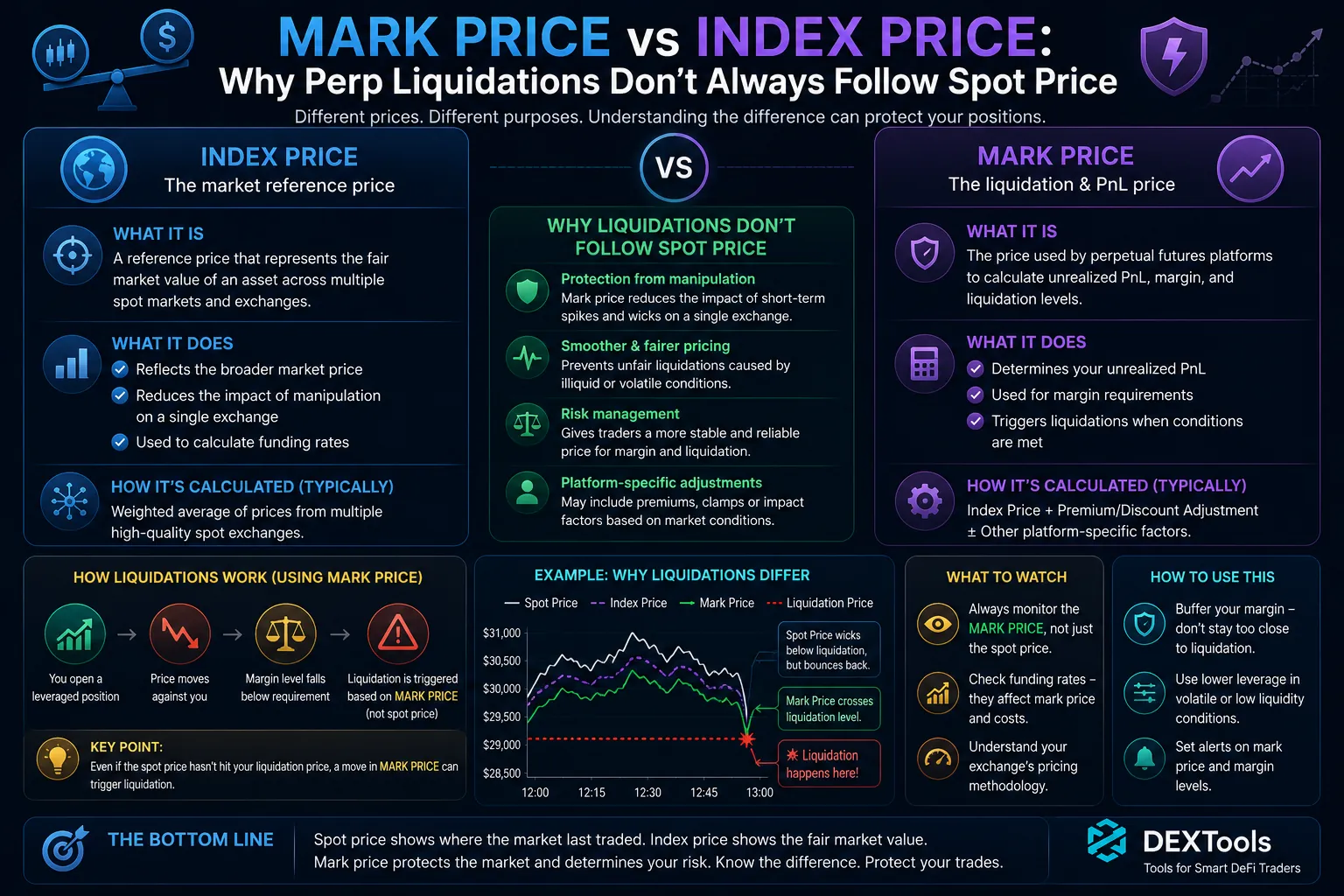
Mark price is the price used by many perpetual futures platforms to calculate unrealized profit and loss and liquidation risk.
It is designed to reduce unfair liquidations caused by temporary market spikes, thin liquidity or manipulation.
Mark price may be based on index price plus additional adjustments, depending on the platform's design.
For traders, mark price is critical because it may determine whether a position is liquidated.
Mark Price vs Index Price: The Key Difference
The key difference is purpose.
Index price is a reference for the broader market price. Mark price is used for risk management inside the perp platform.
Index price tries to answer: what is the fair market price of the asset?
Mark price tries to answer: what price should be used to calculate liquidation and position risk?
These prices are related, but they are not always identical.
Why Liquidations May Not Follow Spot Price
A trader may look at the spot price and think their position is safe. But if the mark price moves closer to their liquidation level, the position may still be at risk.
This can happen because perp platforms often use mark price instead of last traded price to reduce manipulation.
The last traded price may move quickly during volatility. Mark price is designed to be more stable and fair, but it can still differ from what traders see on a basic spot chart.
This is why perp traders should always monitor the price that affects liquidation directly.
Why Exchanges Use Mark Price
Mark price exists to protect traders from unnecessary liquidations caused by temporary price spikes.
Without mark price, a sudden wick in the perp market could liquidate positions even if the broader market did not move significantly.
By using mark price, platforms aim to make liquidations more consistent with fair market value.
However, traders still need to understand how mark price is calculated. Different platforms may use different methods.
How Index Price Helps Reduce Manipulation
Index price can reduce the influence of one market by using multiple reference sources.
If one exchange experiences a temporary spike or crash, a well designed index price may smooth that effect.
This is important in crypto, where liquidity can vary across venues.
For perp traders, index price can provide a more stable reference than a single exchange price.
How Mark Price Affects Liquidation Risk
Mark price directly affects liquidation risk on many perp platforms.
If mark price moves against a trader's position, margin requirements may become unsafe and liquidation can occur.
This means traders should not focus only on entry price and spot price. They should also monitor margin level, leverage, funding, volatility and mark price.
The higher the leverage, the more sensitive the position becomes.
Common Mistakes Traders Make
One common mistake is watching only the spot chart while trading perps.
Another mistake is assuming that liquidation will happen only if the visible market price touches the liquidation level.
Traders may also ignore how funding rates, volatility and platform specific pricing can affect risk.
Perp trading requires understanding the exact price mechanism used by the platform.
Mark Price, Index Price and Funding Rates
Mark price and index price are also connected to funding dynamics.
Perpetual futures do not expire, so funding payments help keep perp prices aligned with spot markets.
When perp prices move too far away from index price, funding can encourage traders to rebalance the market.
This is another reason index price is important. It helps anchor perp markets to broader spot pricing.
What Traders Should Check Before Opening a Perp Position
Before opening a leveraged position, traders should check:
The liquidation price.
Whether liquidation is based on mark price.
The current mark price.
The index price.
Funding rate conditions.
Position size.
Margin level.
Market volatility.
Liquidity around the asset.
These checks can reduce the risk of unexpected liquidation.
How DEXTools Can Help
DEXTools can help traders analyze spot and on chain market behavior around crypto assets. Even when trading perps elsewhere, traders can use live market data, liquidity and volume trends to better understand broader market conditions.
If spot liquidity is weak or price action is unstable, perp risk may increase.
Combining perp platform metrics with broader market analysis can help traders avoid trading blind.
Final Thoughts
Mark price and index price are essential concepts in perpetual futures trading.
Index price reflects a broader market reference. Mark price is used to manage liquidation and position risk.
Liquidations do not always follow the simple spot price traders see on a chart. They often depend on the platform's mark price calculation.
For perp traders, understanding this difference is not optional. It is part of basic risk management.
The more leverage a trader uses, the more important this becomes.
What Is Futures Trading in Crypto? How Leverage, Margin and Liquidation Work What Is Spot Trading in Crypto? How Direct Asset Buying Works How to Read Crypto Candlestick Charts: Complete Beginner's Guide What Is RSI in Crypto Trading? Complete Technical Analysis Guide What Is Order Flow in Crypto Trading? How to Read Buying and Selling PressureFrequently Asked Questions
What is Mark Price?
Mark Price is an estimated true value of a contract, used to prevent market manipulation and reduce unnecessary liquidations. It is typically calculated using a combination of the index price and a moving average of the funding rate.
What is Index Price?
Index Price represents the average price of an asset across multiple major spot exchanges. It serves as a reliable reference point for the underlying asset's value.
Why are both Mark Price and Index Price used?
Both prices are used to provide a more stable and fair liquidation mechanism in perpetual futures. Index Price reflects the broader market, while Mark Price adjusts for short-term volatility and funding rates specific to the perpetual contract.
How does Mark Price relate to liquidations?
Liquidations on perpetual futures exchanges are typically triggered when the Mark Price of a contract reaches the liquidation price. This helps protect traders from sudden price spikes or drops on a single exchange.
Can Mark Price deviate from Index Price?
Yes, Mark Price can deviate from Index Price due to factors like funding rates and premium/discount in the perpetual market. This deviation reflects the cost of holding a perpetual contract relative to the spot market.
Related Guides
- Quote Price vs Mark Price in Crypto Explained
- What Is RSI in Crypto? Beginner Guide to the Relative Strength Index (2026)
- What Is the Crypto Fear and Greed Index: Complete Trader Guide (2026)
- What Is a Crypto Index Fund? Investor Guide (2026)
- What Is Synthetix V3? Perps Multi Collateral Derivatives Guide 2026