Will XRP Hit $1,000? A Data-Driven Reality Check

Will XRP hit $1,000? This reality check looks at supply, market-cap math, and utility assumptions behind the most extreme XRP price target.
A Data-Driven Reality Check on the XRP Price
The digital asset market is no stranger to hyperbole. Since its inception, the XRP community has been defined by a singular, almost mythical target: the $1,000 valuation. In April 2026, with XRP token trading at approximately $1.42 and the legal battles with the SEC firmly in the rearview mirror, the "moonshot" debate has been reignited.
But is a four-figure valuation a mathematical possibility or a flight of financial fancy? To understand the future of the XRP Price, we must strip away the tribalism and look at the cold, hard data regarding global liquidity, tokenomics, and institutional utility.
The Mathematics of a $1,000 XRP
To evaluate the feasibility of this target, we have to start with the most basic metric in crypto: market capitalization. The formula is simple:
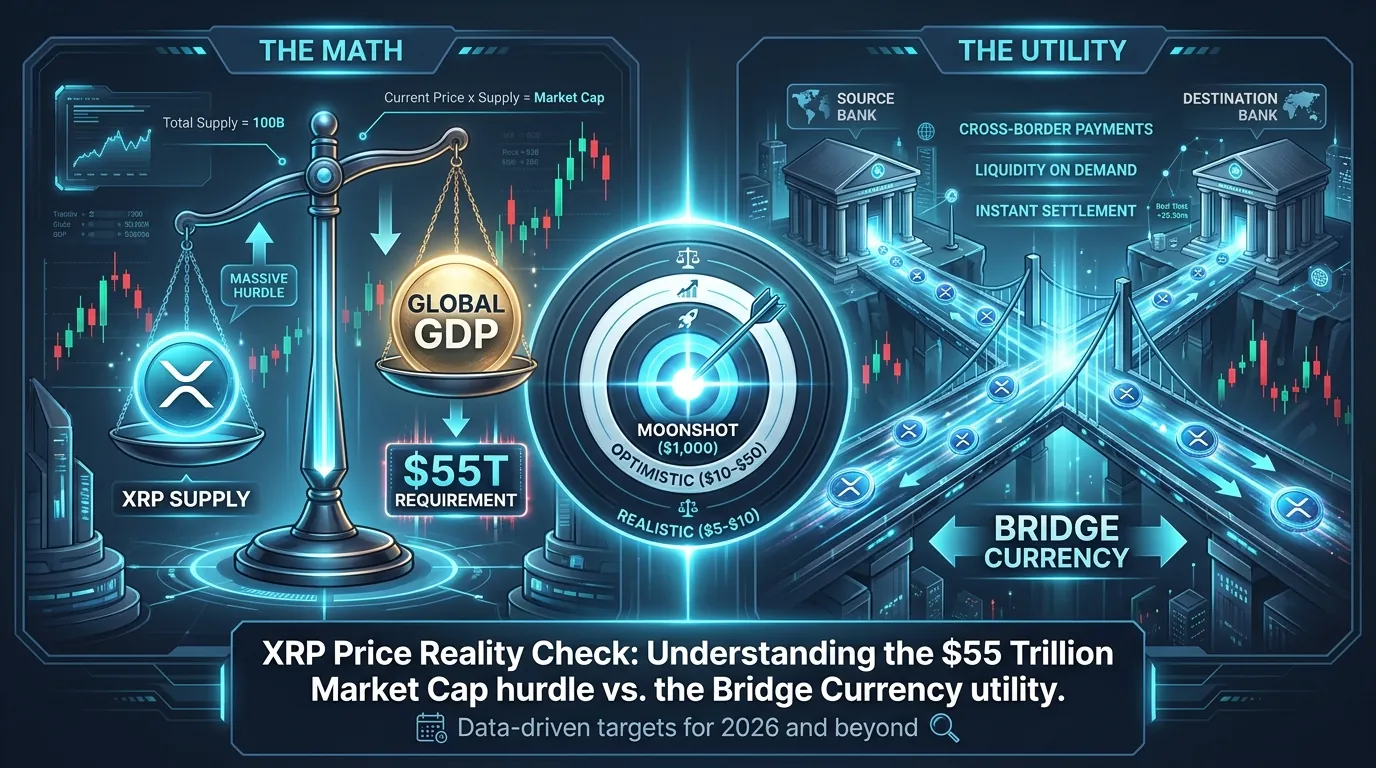
As of early 2026, the circulating supply of XRP stands at roughly 55 billion tokens, with the remaining balance held in Ripple's escrow. If the XRP Price were to reach $1,000, the market capitalization would swell to:
To put that number in perspective, the total GDP of the United States is approximately $28 trillion, and the total global GDP is roughly $110 trillion. For XRP to hit $1,000, it would need to capture nearly half of the world's total annual economic output. This is the primary "reality check" that critics point to when dismissing the $1,000 thesis.
The Bullish Thesis: Can the XRP Token Price Defy Traditional Logic?
Proponents of the high-value thesis argue that comparing XRP token to a traditional stock or even Bitcoin is a category error. They view XRP not as an investment asset, but as a "World Bridge Currency." Here are the data points supporting the extreme bullish case:
The "Bridge Currency" Utility: If XRP becomes the primary liquidity layer for the world's central banks, it doesn't just need to represent a "store of value." It needs to be able to move the world's value. Every day, the SWIFT network handles roughly $5 trillion to $7 trillion in transfers. To facilitate these moves without massive price slippage, the price of the bridge asset must be high enough to provide deep liquidity.
The Escrow and Deflationary Burn: Ripple’s escrow consistently locks up supply, and every transaction on the XRP Ledger (XRPL) "burns" a small amount of XRP. While the burn rate is currently negligible, a massive spike in institutional volume could, over decades, significantly reduce the circulating supply, making a higher price mathematically easier to achieve.
Tokenization of Everything: By 2026, the trend of Real World Asset (RWA) tokenization has accelerated. If trillions of dollars in real estate, gold, and debt are moved onto the XRPL, the demand for XRP to settle these transactions could decouple the asset from the broader "crypto market" trends.
The Bearish Reality: Obstacles to the Moonshot
Despite the optimism, several factors act as a heavy anchor on the XRP token Price. First is the competition. In 2026, Ripple is no longer the only player in the "fast settlement" game. Central Bank Digital Currencies (CBDCs) are being built on various private and public ledgers, including Ethereum L2s and specialized institutional chains like J.P. Morgan’s Onyx.
Furthermore, the sheer volume of "sell pressure" from early holders and Ripple’s own monthly escrow releases creates a constant supply influx. For XRP to reach $1,000, the buying pressure would need to be sustained and institutional on a scale never before seen in human history: exceeding even the early growth of the internet or the gold market.
Inter-Bank Liquidity: A bank in Singapore needs to settle a $100 million trade with a bank in London. Using XRP at $1,000, the bank only needs 100,000 tokens to facilitate the move. If XRP is $1, the bank would need 100 million tokens, which might not be available in a single liquidity pool without moving the price.
Micropayments: A streaming platform uses XRPL to pay creators per second of content viewed. Even at high prices, the drops (the smallest unit of XRP) allow for precise, sub-penny payments.
Cross-Border Remittance: A worker in California sends money to Mexico via a Ripple-enabled app. The transaction settles in 3 seconds, using XRP as the bridge to avoid the "pre-funding" of accounts.
An Honest Conclusion
- Is $1,000 possible? In a vacuum where XRP replaces the entirety of the world's financial plumbing, the math could work, but it would require a global economic paradigm shift that usually takes centuries, not years.
- A more realistic, yet still highly optimistic data-driven target for the next decade lies in the $10 to $35 range. This would put XRP’s market cap in the trillions, rivaling gold or the largest tech companies, which is a monumental feat in itself. Investors waiting for $1,000 may be ignoring the very real, and very profitable, gains that are possible in the more immediate future as institutional adoption scales.
Market Cap Reality: A $1,000 XRP token price requires a $55 trillion market cap, which is half of the global GDP.
The Bridge Factor: High prices are technically better for large-scale institutional settlement to prevent slippage.
2026 Context: XRP is currently stabilizing after its legal victories, with institutional ETFs providing a new liquidity floor.
The Verdict: While $1,000 remains a statistical outlier, the utility of the XRPL ensures XRP remains a top-tier financial asset.
The path to new highs is paved with data and real-time movements. To monitor alerts, institutional liquidity shifts, and the latest XRPL pair performance, start using DEXTools today here and take control of your trading data.
Disclaimer: This article is for informational purposes only and does not constitute investment advice, financial advice, trading advice, or any other kind of advice. DEXTools does not recommend buying, selling, or holding any cryptocurrency or token. Users should conduct their own research and consult with a qualified financial advisor before making any investment decisions. Cryptocurrency investments are volatile and high-risk. DEXTools is not responsible for any losses incurred.