Who Uses XRP in 2026? Banks, Institutions and Real Adoption

Who actually uses XRP in 2026? We separate myth from reality by looking at banks, institutions, ETF demand, and real adoption signals.
Banks, Institutions, and the Facts of XRP Adoption
- The question of who is actually using XRP network has evolved from a speculative debate into a data-driven reality. For years, skeptics argued that Ripple’s technology was merely in a "permanent pilot phase." However, as of April 2026, the landscape has shifted dramatically.
- With legal clarity finally established in the United States and the launch of spot XRP ETFs, the narrative has moved from "if" to "how much." To understand the true state of XRP Adoption, one must look at the specific corridors where liquidity is actually flowing, from the bustling financial hubs of Tokyo to the emerging instant payment systems in the United States.
Japan Leads Global XRP network Adoption Efforts
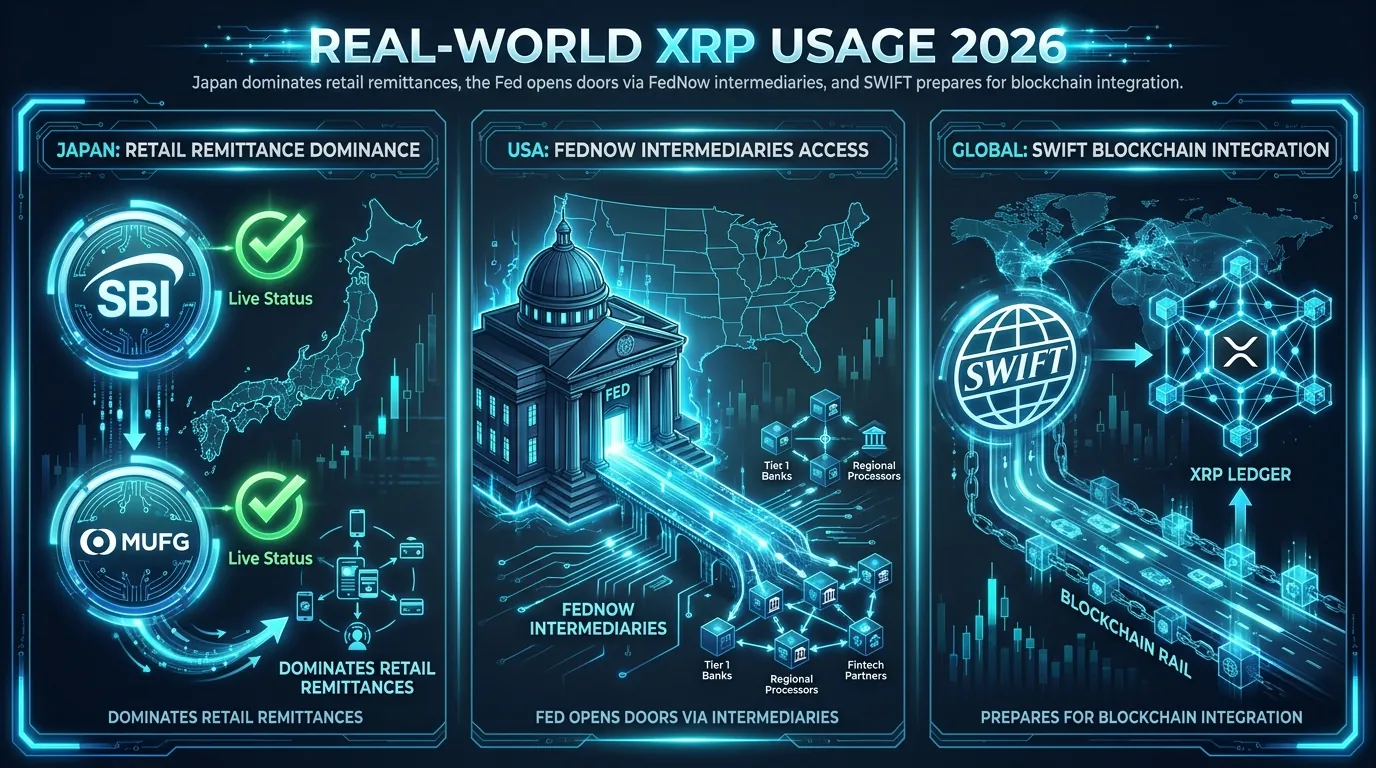
- If there is a ground zero for the institutional use of XRP network, it is Japan. Through the long-standing strategic partnership between Ripple and SBI Holdings, the Japanese financial sector has become the most integrated ecosystem for the XRP Ledger (XRPL).
- SBI Remit has already deployed XRP-based On-Demand Liquidity (ODL) for several years to facilitate remittances between Japan and countries like the Philippines, Vietnam, and Indonesia.
- By early 2026, the scale has expanded. Major Japanese institutions, including MUFG Bank (the largest in the country) have integrated RippleNet to streamline their internal treasury movements. The regional success in Asia proves that XRP network Adoption is most effective when backed by a supportive regulatory framework and a large-scale institutional champion like SBI. This "Japan model" is now being studied by other nations as a blueprint for replacing aging correspondent banking relationships with real-time, blockchain-based settlement.
The Federal Reserve, FedNow, and the Intermediary Gateway
- One of the most frequent questions from investors is: "Will the Federal Reserve use XRP network?" The answer requires a nuanced understanding of the U.S. financial infrastructure. The Federal Reserve operates FedNow, an instant payment service that currently handles domestic U.S. transactions. On April 8, 2026, the Fed released a landmark proposal to allow U.S. banks to use "intermediaries" to facilitate the international side of cross-border payments via FedNow.
- This development is a massive "unlock" for Ripple. While the Federal Reserve is unlikely to hold XRP directly on its balance sheet in the near term, Ripple’s conditional approval for a national trust bank charter from the OCC positions the company to act as one of these authorized intermediaries. By plugging into FedNow, Ripple can use XRP as the bridge currency to settle international transfers for thousands of smaller U.S. credit unions and regional banks that lack the capital to maintain pre-funded accounts overseas. This isn't just theory; it is a structural shift in how the U.S. central bank is opening its rails to blockchain-powered liquidity.
Is Bank of America Using XRP?
- Bank of America (BoA) has been a member of RippleNet’s steering committee for years, but its public stance remained cautious during the SEC litigation. In 2026, the bank's involvement has moved into a more active phase. While BoA primarily utilizes Ripple’s software for messaging and data standardization, internal reports and regulatory filings suggest they are now exploring XRP-based liquidity models for specific commercial banking corridors.
- The bank’s strategy reflects a broader trend among "Tier 1" institutions: using RippleNet for the speed of messaging today, while keeping the technical "plumbing" ready to switch on XRP liquidity as soon as the market depth reaches institutional requirements. With Goldman Sachs disclosing a $153.8 million position in spot XRP ETFs in early 2026, the stigma of holding the asset has evaporated, allowing giants like Bank of America to integrate XRP Adoption into their long-term digital asset roadmaps without reputational risk.
Will XRP Replace SWIFT?
- The "XRP vs. SWIFT" debate is no longer a zero-sum game. SWIFT has announced plans for a "blockchain go-live" in June 2026, aiming to modernize its own network of 11,000 institutions. Interestingly, the industry is seeing a convergence rather than a total replacement. A technical routing path involving SWIFT, Thunes, and Ripple has emerged as a viable solution.
- In this scenario, a bank uses the SWIFT messaging standard to initiate a payment, which then routes through a partner like Thunes that is directly connected to Ripple’s ODL. XRP acts as the hidden "engine" that provides the instant liquidity needed to settle the transaction. This means XRP doesn't need to "destroy" SWIFT to be successful; it simply needs to become the most efficient liquidity layer that SWIFT-connected banks choose to use behind the scenes.
RLUSD and the Future of Institutional Settlement
- The 2026 launch of RLUSD (Ripple’s USD-pegged stablecoin) on the XRP network has been a game-changer for institutional trust. Many banks are still hesitant to deal with the volatility of XRP for long-term holding. RLUSD provides a stable on-ramp, allowing institutions to move value into the ecosystem with zero price risk, then "hop" into XRP for the split-second bridge transaction, and settle back into RLUSD or local fiat.
- This dual-asset strategy has driven record on-chain volume. In March 2026, the XRPL network hit a milestone of 3 million daily transactions, largely fueled by these stablecoin-to-XRP swaps. The "bridge" is no longer just a concept; it is a high-speed financial highway used for everything from aid delivery in Africa to corporate treasury management in Europe.
Real-World Use Examples in 2026
Retail Remittances: A worker in Dubai sends $500 to a family member in India. The transaction uses XRP as the bridge, settling in 3 seconds with a fee of less than $0.02.
Corporate Treasury: A European manufacturing firm uses the XRPL to pay a supplier in Mexico. Instead of waiting 48 hours for a SWIFT wire, the funds are available instantly, improving the firm's working capital.
ETF Liquidity: Large-scale arbitrageurs use the deep liquidity of the XRPL’s native Automated Market Makers (AMMs) to balance the pricing of Spot XRP ETFs across global exchanges.
Key Points to Remember
Japan’s Role: SBI and MUFG are currently the world leaders in operational XRP integration.
Federal Reserve Proposal: The April 2026 FedNow update allows intermediaries like Ripple to bridge international payments.
SWIFT Convergence: XRP is becoming a "technical route" for SWIFT-connected institutions rather than just a competitor.
Institutional Holdings: Major banks and asset managers (like Goldman Sachs) are now officially holding XRP through ETFs.
As the institutional landscape becomes more complex, having the right tools to track these massive liquidity shifts is essential.
Disclaimer: This article is for informational purposes only and does not constitute investment advice, financial advice, trading advice, or any other kind of advice. DEXTools does not recommend buying, selling, or holding any cryptocurrency or token. Users should conduct their own research and consult with a qualified financial advisor before making any investment decisions. Cryptocurrency investments are volatile and high-risk. DEXTools is not responsible for any losses incurred.