Why SOL Cannot Be Mined and What to Do Instead
Learn why SOL cannot be mined, examine different ways to earn it in today’s evolving crypto space, and understand how validators secure the network by staking tokens instead of mining.
Can you mine Solana?
- As cryptocurrencies continue to evolve in 2026, many newcomers still ask a common question: Why SOL Cannot Be Mined? Unlike Bitcoin or other proof of work cryptocurrencies, Solana operates on a completely different architecture that removes the need for mining altogether.
This article explains why Solana cannot be mined, how its system actually works, and what you can do instead to earn SOL in today’s ecosystem.
What Does “Mining” Mean in Crypto?
- Mining is the process used by proof of work blockchains like Bitcoin. It involves powerful computers solving complex mathematical problems to validate transactions and secure the network. In return, miners receive rewards in the form of newly minted coins.
- For example, Bitcoin miners compete using GPUs or ASIC machines to solve cryptographic puzzles. The first one to solve it earns BTC rewards. This system requires high energy consumption and specialized hardware.
However, not all blockchains use this model.
Why SOL Cannot Be Mined
- Solana cannot be mined because it does not use proof of work. Instead, it relies on a combination of Proof of Stake and Proof of History to validate transactions and secure the network.
- In proof of stake systems, there are no miners competing with computational power. Instead, participants called validators are chosen based on the amount of cryptocurrency they lock or “stake” in the network.
This fundamental difference eliminates the concept of mining entirely.
Key Reason
No computational competition
No mining hardware required
Rewards come from staking, not mining
If a website or service claims you can mine Solana directly, it is misleading or potentially a scam.
Understanding Solana’s Unique Technology
To fully understand why SOL Cannot Be Mined, you need to understand Solana’s architecture.
Proof of History Explained
Proof of History is a cryptographic timekeeping system that records the order and timing of transactions before consensus is reached.
Think of it as a built in clock that timestamps every event on the blockchain. This allows validators to process transactions extremely fast without needing to agree on timing first.
For example, instead of waiting for a block to be created every few seconds, Solana can process transactions in milliseconds because the order is already verified.
This innovation enables speeds of hundreds of milliseconds per block, far faster than many other networks.
Proof of Stake and Validators
Proof of Stake is the mechanism that secures the network. Validators stake SOL tokens and are selected to confirm transactions based on their stake.
In simple terms:
The more SOL you stake, the higher your chance of participating
Validators earn rewards from transaction fees and network inflation
No energy intensive mining is required
This model is far more energy efficient than traditional mining systems.
Validators vs Miners: What’s the Difference?
A common misunderstanding is thinking validators are just another type of miner. They are not.
Miners (Proof of Work)
Compete with computing power
Require expensive hardware
Consume large amounts of electricity
Validators (Solana)
Stake tokens instead of computing power
Validate transactions and vote on blocks
Earn rewards without mining
For example, instead of buying a mining rig, a Solana participant might stake 1,000 SOL with a validator and earn passive rewards.
Can You “Indirectly” Mine Solana?
Some platforms claim to offer “Solana mining,” but this is usually misleading.
In most cases, what actually happens is:
You mine another cryptocurrency like Ethereum Classic or Ravencoin
The platform converts your earnings into SOL
This is not real Solana mining. It is simply an exchange process.
Example:
-You mine ETH with your GPU
-You receive payouts in SOL
-But the network you supported was not Solana
What to Do Instead of Mining Solana
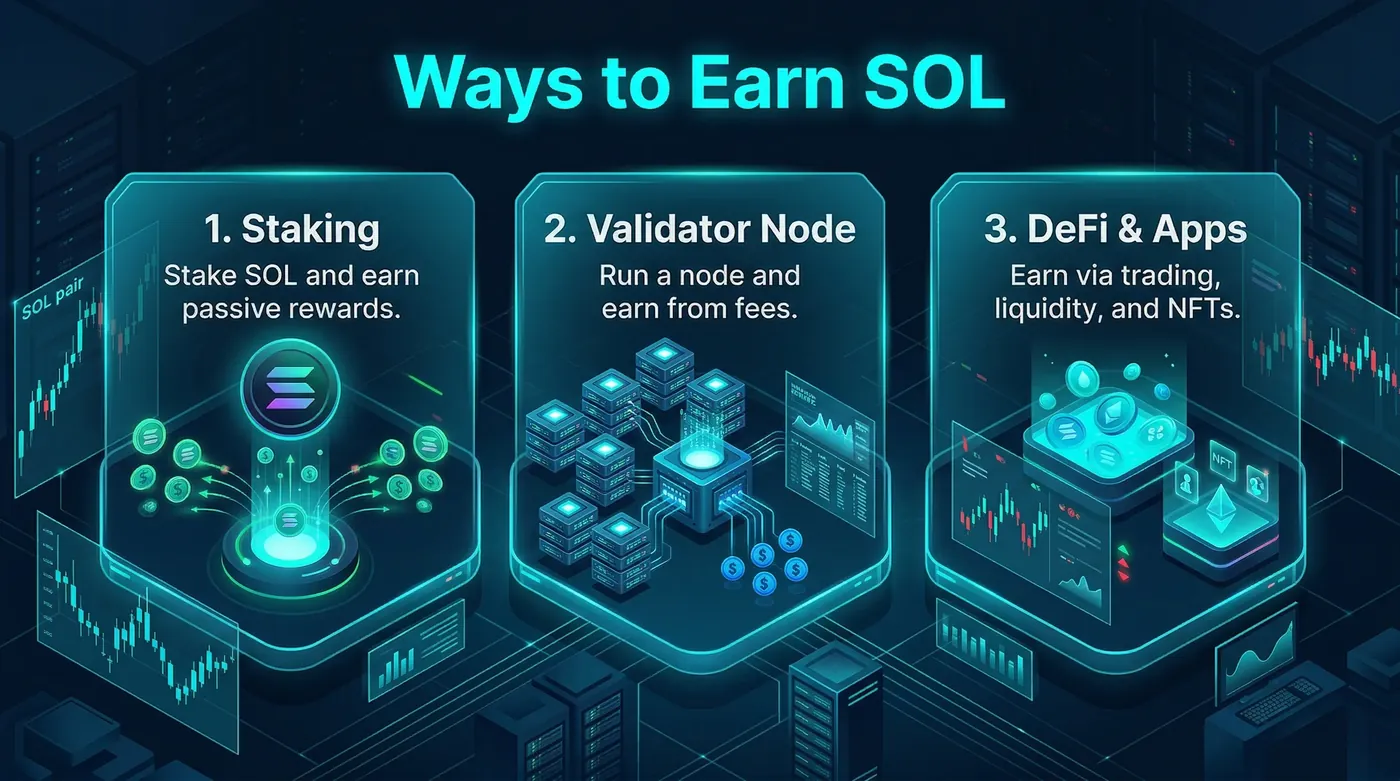
Since SOL cannot be mined, here are the most effective ways to earn SOL in 2026.
1. Staking SOL
Staking is the most popular and accessible method.
You delegate your SOL to a validator, and in return, you earn a share of rewards.
Example:
You stake 100 SOL
The validator earns rewards
You receive a percentage based on your stake
This is considered the closest equivalent to mining in the Solana ecosystem.
2. Running a Validator Node
For advanced users, running a validator is another option.
However, this requires:
High performance hardware
Technical knowledge
Significant SOL stake
Validators are responsible for processing transactions and maintaining network integrity.
Example:
A professional operator runs a validator and earns rewards from fees and inflation, similar to running a mining operation but without solving puzzles.
3. Participating in DeFi
Solana’s ecosystem in 2026 is heavily focused on decentralized finance and high speed trading.
Users can earn SOL by:
Providing liquidity
Trading tokens
Example:
You deposit SOL into a liquidity pool and earn fees from traders using that pool.
4. Earning Through NFTs and Ecosystem Apps
Solana is also widely used for NFTs and consumer applications.
You can earn SOL by:
Creating and selling NFTs
Participating in play to earn games
Building decentralized apps
Example:
An artist sells digital artwork as NFTs and receives SOL payments.
Why Solana Chose Not to Use Mining
Solana’s design prioritizes speed, scalability, and efficiency.
Mining would slow down the network and increase costs. Instead, the combination of Proof of History and Proof of Stake allows:
Extremely fast transaction speeds
Low fees
High scalability
This makes Solana ideal for real time applications such as trading platforms and consumer apps.
The Future of Solana in 2026 and Beyond
Solana continues to evolve rapidly. Its 2026 roadmap includes major upgrades to its consensus and infrastructure, aiming to further improve performance and reliability.
As the ecosystem grows, earning opportunities will likely expand beyond simple staking into more advanced financial and on chain activities.
Conclusion
You cannot mine Solana because it does not use proof of work. Instead, it relies on a more efficient system based on staking and time based validation.
Rather than investing in expensive mining hardware, users can participate in the network through staking, validating, or engaging with the broader ecosystem.
Understanding this distinction is essential for anyone entering the crypto space in 2026.
Key Takeaways
Solana cannot be mined because it does not use proof of work
It relies on Proof of Stake and Proof of History
Validators replace miners in securing the network
Staking is the primary way to earn SOL
“Solana mining” platforms are usually misleading
Additional earning methods include DeFi, NFTs, and validator nodes
Solana focuses on speed, efficiency, and scalability
Access Solana on DEXTools dashboard here and start trading safely today!
Disclaimer: This article is for informational purposes only and does not constitute investment advice, financial advice, trading advice, or any other kind of advice. DEXTools does not recommend buying, selling, or holding any cryptocurrency or token. Users should conduct their own research and consult with a qualified financial advisor before making any investment decisions. Cryptocurrency investments are volatile and high-risk. DEXTools is not responsible for any losses incurred.
Related Guides
- SOL to USD: Solana Price Today | Live Converter
- SOL Staking Calculator: Estimate Solana Rewards Live (2026)
- How to Stake Solana (SOL): Complete Staking Guide for Maximum Rewards (2026)
- How to Stake SOL with Jito: Complete Tutorial (2026)
- How to Send SOL from Coinbase to Phantom: Time, Fees and Safety Checks (2026)
Frequently Asked Questions
Why can't Solana (SOL) be mined?
Solana cannot be mined because it operates on a Proof of Stake and Proof of History architecture, which eliminates the need for mining and computational competition.
What is the difference between mining and staking in cryptocurrencies?
Mining involves solving complex mathematical problems to validate transactions in Proof of Work systems, while staking involves locking up cryptocurrency to participate in transaction validation in Proof of Stake systems.
How can I earn SOL if it can't be mined?
You can earn SOL by staking your tokens with a validator, which allows you to earn rewards from transaction fees and network inflation.
What is Proof of History in Solana?
Proof of History is a cryptographic timekeeping system that timestamps transactions, allowing for faster processing without needing to agree on timing first.
Are there platforms that allow you to mine Solana?
Some platforms may claim to offer Solana mining, but this is usually misleading; they typically involve mining other cryptocurrencies and converting the earnings to SOL.