Solana Ecosystem Growth in 2026: ETFs, Upgrades and Market Reaction
This page tracks the broader Solana ecosystem in 2026, connecting ETF inflows with network upgrades, institutional adoption, and market reaction across the chain.
Intent check: This page is the broader Solana ecosystem angle. If you only want the ETF vehicle impact on SOL, read Solana ETF Impact 2026: Filings, Flows and What They Mean for SOL.
A Turning Point for Solana Blockchain in 2026
- As of March 23, 2026, Solana blockchain stands at a critical intersection of institutional adoption, regulatory clarity, and rapid technological evolution. Once viewed primarily as a high-speed alternative to Ethereum, the network has now matured into a key infrastructure layer for decentralized finance, tokenized assets, and institutional products.
- Recent developments including ETF inflows, regulatory classification, and major upgrades are shaping both investor sentiment and price action. At the same time, macroeconomic uncertainty continues to create volatility, resulting in a complex but opportunity-rich landscape for traders and long-term holders alike.
ETF Momentum: Institutional Capital Reshaping Demand
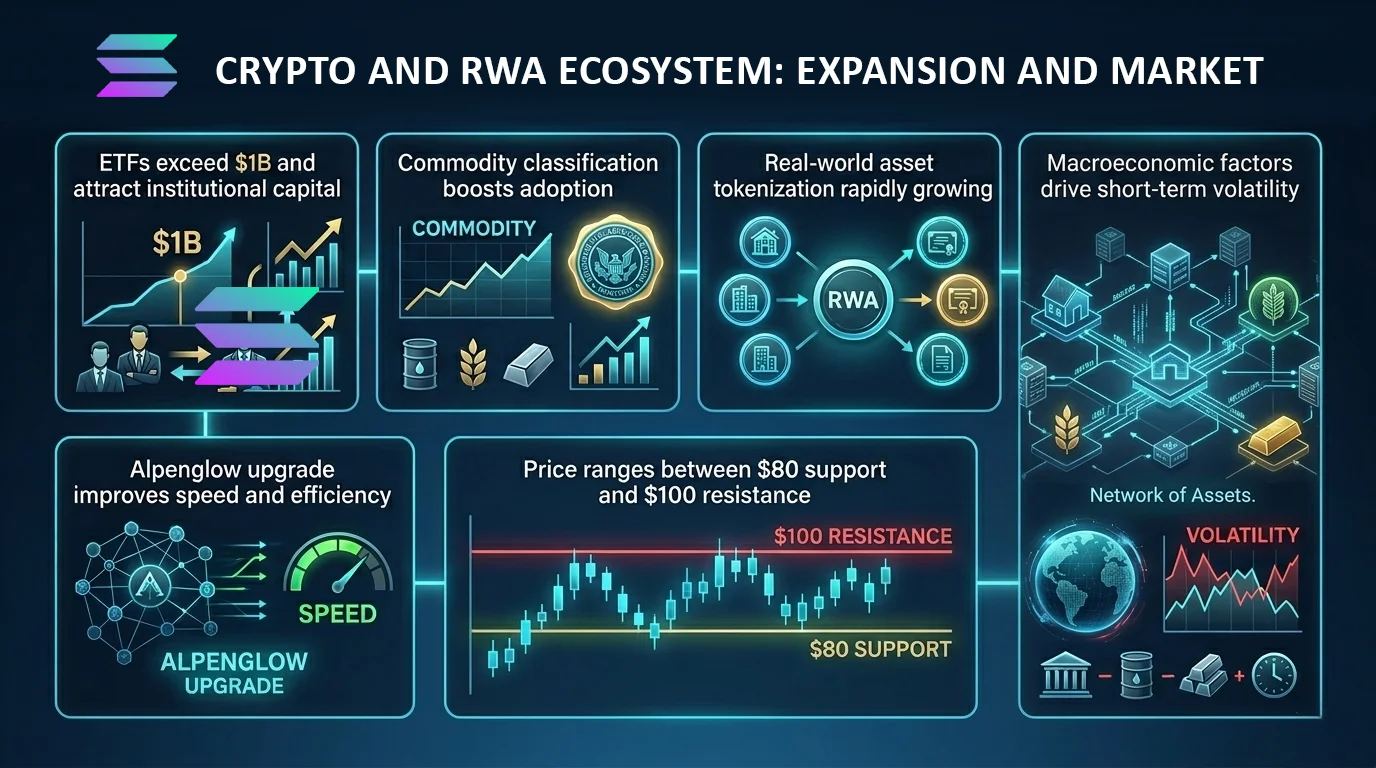
- One of the most significant narratives surrounding Solana blockchain in 2026 is the rapid expansion of exchange-traded funds tied to SOL. Since late 2025, multiple spot Solana ETFs have entered the market, attracting over $1 billion in assets under management and signaling strong institutional demand.
- These ETFs have consistently recorded inflows even during broader market downturns. In some cases, they logged extended streaks of positive daily inflows, reinforcing the idea that institutional investors are accumulating rather than exiting positions.
- For example, large asset managers and financial institutions are now using Solana ETFs as a gateway to gain exposure without directly holding the asset. This shift has helped establish a structural demand floor, particularly in the $80 to $85 price range, where on-chain data shows accumulation by large holders.
Example:
A hedge fund seeking exposure to high-performance blockchain infrastructure can allocate capital into a Solana ETF instead of managing wallets, custody, and staking operations directly. This lowers operational risk while maintaining upside exposure.
Regulatory Clarity: Commodity Classification Unlocks Growth
- A landmark development occurred on March 17, 2026, when U.S. regulators officially classified Solana as a digital commodity. This decision, coordinated between major regulatory bodies, provides long-awaited clarity for institutional investors.
- This classification removes a major barrier that had previously limited participation from banks, asset managers, and pension funds. It also opens the door for new financial products, including derivatives, structured products, and expanded ETF offerings.
Example:
A traditional investment bank that previously avoided SOL due to regulatory ambiguity can now legally integrate Solana-based products into its portfolio offerings, accelerating capital inflows.
Ecosystem Catalysts: Real-World Assets and Network Upgrades
- Beyond financial products, Solana’s ecosystem is experiencing rapid expansion driven by real-world asset tokenization and major technical upgrades.
- Tokenized real-world assets on Solana have surpassed $1.8 billion, reflecting growing adoption in areas such as treasury bills, equities, and commodities. This trend signals a shift away from speculative use cases toward tangible financial infrastructure.
- Simultaneously, network upgrades such as Alpenglow and Firedancer are set to dramatically improve performance and reliability. Alpenglow aims to reduce transaction finality to under 150 milliseconds, positioning Solana as one of the fastest blockchain networks available.
Example:
A financial platform can tokenize U.S. Treasury bonds on Solana, enabling near-instant settlement and significantly lower transaction costs compared to traditional systems.
Expanding Ecosystem: DeFi, Tokenization and Developer Activity
- The broader Solana ecosystem continues to grow across multiple sectors, including decentralized finance, payments, and tokenized securities.
- Recent developments include expansion in tokenized markets offering hundreds of digital representations of stocks, ETFs, and commodities, as well as increasing stablecoin supply and developer activity.
This diversification strengthens Solana’s long-term value proposition by reducing reliance on cyclical trends such as memecoins and NFTs.
Example:
A fintech startup can build a global payments system on Solana that enables instant cross-border transfers with minimal fees, competing directly with traditional remittance providers.
Market Reaction: Consolidation Amid Strong Fundamentals
- Despite strong fundamentals, Solana’s price action in March 2026 reflects a period of consolidation. The asset is trading around the mid-$80 range, caught between strong support and macro-driven resistance.
- Key technical levels suggest support near $80 and resistance between $95 and $100. A breakout above this range could trigger renewed bullish momentum, while a breakdown may lead to further downside.
- Interestingly, there is a divergence between retail and institutional sentiment. Retail traders remain highly bullish, while institutional indicators suggest a more cautious approach.
Example:
Retail traders may open leveraged long positions expecting a breakout, while institutional desks accumulate gradually through ETFs, avoiding short-term volatility.
Macro Pressures: External Factors Driving Volatility
Macroeconomic conditions continue to play a critical role in Solana’s price performance. Factors such as interest rate expectations, inflation concerns, and geopolitical tensions have contributed to a risk-off environment in early 2026.
These external pressures have led to temporary price declines across the crypto market, including Solana, despite strong internal growth metrics.
Example:
A sudden increase in global energy prices can trigger inflation fears, leading investors to reduce exposure to risk assets like cryptocurrencies, including SOL.
Institutional vs Retail Dynamics: A Structural Shift
One of the defining characteristics of the current cycle is the growing divide between institutional and retail behavior.
Institutional investors are focusing on long-term fundamentals such as ETF inflows, real-world asset adoption, and network performance. Meanwhile, retail traders are often driven by short-term price movements and leverage.
This shift suggests that Solana is transitioning into a more mature asset class, where long-term capital plays a dominant role in price stability.
Example:
While retail traders react to daily price swings, institutions may continue accumulating SOL through structured products, reinforcing long-term support levels.
Outlook: What Comes Next for Solana
Looking ahead, several key factors will determine Solana’s trajectory throughout 2026:- Continued institutional ETF inflows and sustained demand
- Successful implementation of major technical upgrades such as Alpenglow
- Stabilization of global macroeconomic conditions
- Increasing adoption of real-world asset tokenization on the network
If these elements align, Solana could break above key resistance levels and enter a new growth phase. However, failure to maintain institutional inflows or worsening macro conditions could delay this scenario.
Conclusion: A Maturing Asset with Strong Tailwinds
Solana blockchain in 2026 represents a fundamentally different asset compared to previous cycles. The combination of ETF-driven demand, regulatory clarity, and ecosystem expansion has transformed it into a serious contender in global financial infrastructure.
While short-term volatility remains, the long-term outlook is increasingly supported by structural growth drivers that extend beyond speculative trading.
Key Takeaways
- Solana ETFs have surpassed $1 billion in assets and continue attracting institutional capital
- Regulatory classification as a digital commodity has removed major adoption barriers
- Real-world asset tokenization on Solana exceeds $1.8 billion and is rapidly growing
- Network upgrades like Alpenglow aim to drastically improve speed and efficiency
- Price action remains range-bound between $80 support and $100 resistance
- Macroeconomic conditions continue to influence short-term volatility
- Institutional accumulation contrasts with retail-driven speculation
- Solana is evolving into a mature, infrastructure-focused blockchain
Access Solana on DEXTools dashboard here and start trading safely today!
Disclaimer: This article is for informational purposes only and does not constitute investment advice, financial advice, trading advice, or any other kind of advice. DEXTools does not recommend buying, selling, or holding any cryptocurrency or token. Users should conduct their own research and consult with a qualified financial advisor before making any investment decisions. Cryptocurrency investments are volatile and high-risk. DEXTools is not responsible for any losses incurred.