What Is a Modular Blockchain: Celestia and the New Stack (2026)
— By Whatsertrade in Tutorials

Modular blockchains separate execution, consensus, settlement, and data availability into specialized layers. Learn how Celestia, EigenDA, and Avail are reshaping blockchain infrastructure in 2026.
Blockchain technology has evolved rapidly since Ethereum first introduced smart contracts in 2015. For years, every major blockchain followed the same playbook: one chain handles everything. Transaction execution, consensus, settlement, and data storage all happen on a single network. This monolithic approach worked well enough for early use cases, but as adoption surged and demand for blockspace exploded, the cracks became impossible to ignore. High gas fees, network congestion, and scalability bottlenecks pushed developers and researchers to rethink the very foundations of blockchain design. The answer they arrived at is the modular blockchain, a paradigm shift that is fundamentally transforming how we build, scale, and interact with decentralized systems in 2026.
If you have spent any time following crypto development over the past two years, you have likely encountered terms like "data availability layers," "modular stacks," and "sovereign rollups." These concepts can seem abstract at first glance, but they represent one of the most important architectural shifts in blockchain history. Instead of forcing a single chain to handle every task, the modular approach breaks blockchain functionality into specialized layers, each optimized for a specific job. The result is a system that can scale horizontally, reduce costs dramatically, and unlock new design possibilities that were simply not feasible under the old monolithic model.
This guide will walk you through everything you need to understand about modular blockchains in 2026. We will cover the core concepts, compare monolithic and modular architectures side by side, take a deep dive into Celestia and its competitors, explain data availability sampling, and explore what this means for developers, investors, and the future of the industry. Whether you are a builder looking to deploy on the modular stack or an investor evaluating modular infrastructure projects, this article has you covered.
What Is a Modular Blockchain?
A modular blockchain is a blockchain that intentionally delegates one or more of its core functions to external, specialized chains or layers. Rather than handling execution, consensus, settlement, and data availability all on a single network, a modular blockchain outsources specific tasks to purpose-built systems that excel at those particular jobs. Think of it like the difference between a single employee doing every task at a company versus a team of specialists, each handling what they do best.
Every blockchain, at its core, must perform four fundamental functions:
In a monolithic blockchain like traditional Ethereum (pre-Dencun), all four functions run on the same chain. This creates an inherent tension: optimizing for one function often comes at the expense of another. Increasing throughput might compromise decentralization. Improving data availability might slow down execution. The modular thesis argues that by separating these concerns, each layer can be independently optimized without forcing tradeoffs on the others.
Key Insight: A modular blockchain does not mean a weaker blockchain. It means a smarter blockchain. By allowing each layer to specialize, the overall system achieves better performance, lower costs, and greater flexibility than any monolithic chain could deliver alone.
The concept of modularity is not unique to blockchains. The internet itself evolved from monolithic mainframes to a modular stack of specialized protocols (TCP/IP, HTTP, DNS, TLS). Cloud computing followed a similar path, moving from single servers to microservices architectures where each component scales independently. Modular blockchains represent the same evolutionary step for decentralized systems, and 2026 is the year this architecture has firmly established itself as the industry standard for new deployments.
Monolithic vs Modular Architecture
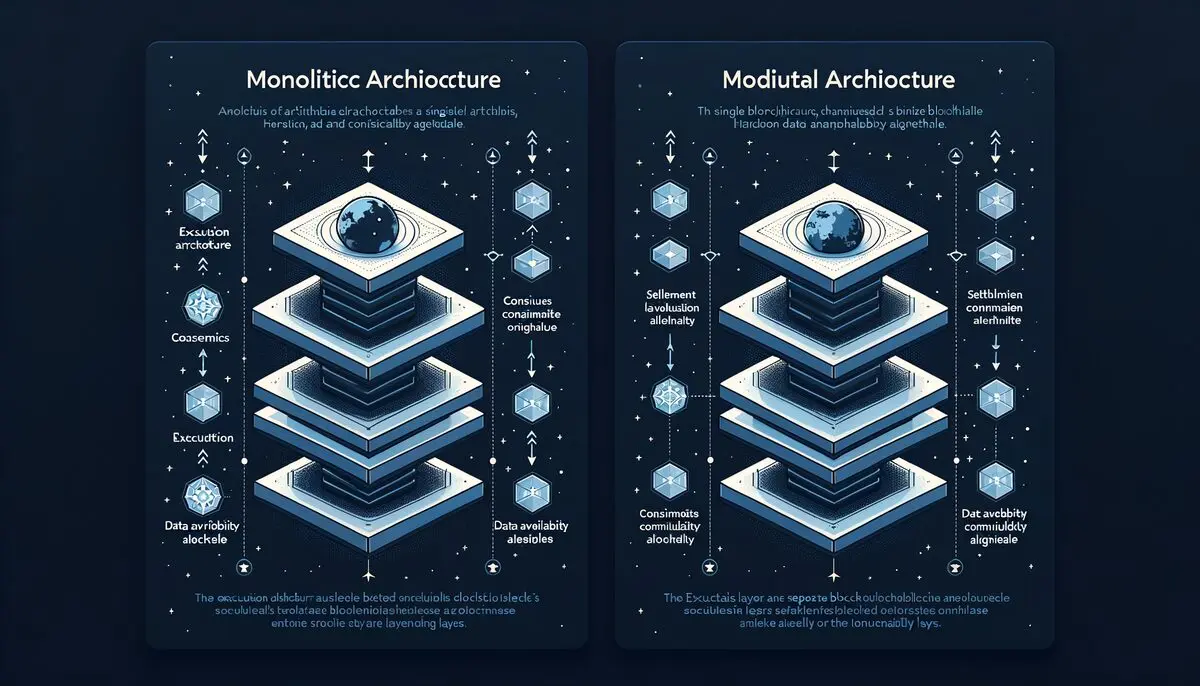
To truly appreciate what modular blockchains bring to the table, it helps to understand the limitations of the monolithic approach and see the two models compared directly. Monolithic chains have served the industry well, but they face fundamental constraints that become more severe as usage grows.
In a monolithic blockchain, every validator must execute every transaction, store all historical data, participate in consensus, and verify data availability. This "do everything" approach creates several problems. First, hardware requirements scale with network usage, which tends to centralize the validator set over time because only well-resourced operators can keep up. Second, throughput is limited by the slowest component in the pipeline. If data availability becomes a bottleneck, the entire chain suffers, even if execution capacity is abundant. Third, upgrading any single component requires coordinating changes across the entire system, which makes innovation slow and risky.
Modular architectures address these issues by allowing each layer to scale, upgrade, and optimize independently. A rollup can increase its execution throughput without waiting for the data availability layer to upgrade. A data availability layer can improve its sampling techniques without affecting settlement. This separation of concerns accelerates innovation across the entire stack.
| Feature | Monolithic Blockchain | Modular Blockchain |
|---|---|---|
| Architecture | Single chain handles all functions | Specialized layers for each function |
| Scalability | Limited by weakest component | Each layer scales independently |
| Transaction Cost | Higher (all resources on one chain) | Lower (optimized data availability) |
| Decentralization | Hardware requirements grow with usage | Light nodes verify via sampling |
| Upgradeability | Full system coordination needed | Individual layers upgrade independently |
| Flexibility | One-size-fits-all design | Mix and match layers for specific needs |
| Security Model | Unified (all validators secure all functions) | Composable (each layer has own security) |
| Examples | Solana, BNB Chain, original Ethereum | Celestia + rollups, Ethereum post-Dencun |
| Throughput (2026) | 5,000 - 65,000 TPS typical | 100,000+ TPS across combined layers |
| Data Cost | $0.01 - $0.50+ per tx | $0.0001 - $0.001 per tx |
It is worth noting that the line between monolithic and modular is not always binary. Ethereum itself has been transitioning toward a modular architecture since the introduction of EIP-4844 (Proto-Danksharding) in 2024. By creating a dedicated blob space for rollup data, Ethereum effectively separated its data availability function from execution, making it a hybrid design. In 2026, with full Danksharding on the roadmap, Ethereum continues to move further along the modular spectrum, validating the thesis that modularity is the natural endpoint for mature blockchain infrastructure.
The Modular Stack: Execution, Settlement, Consensus, and Data Availability
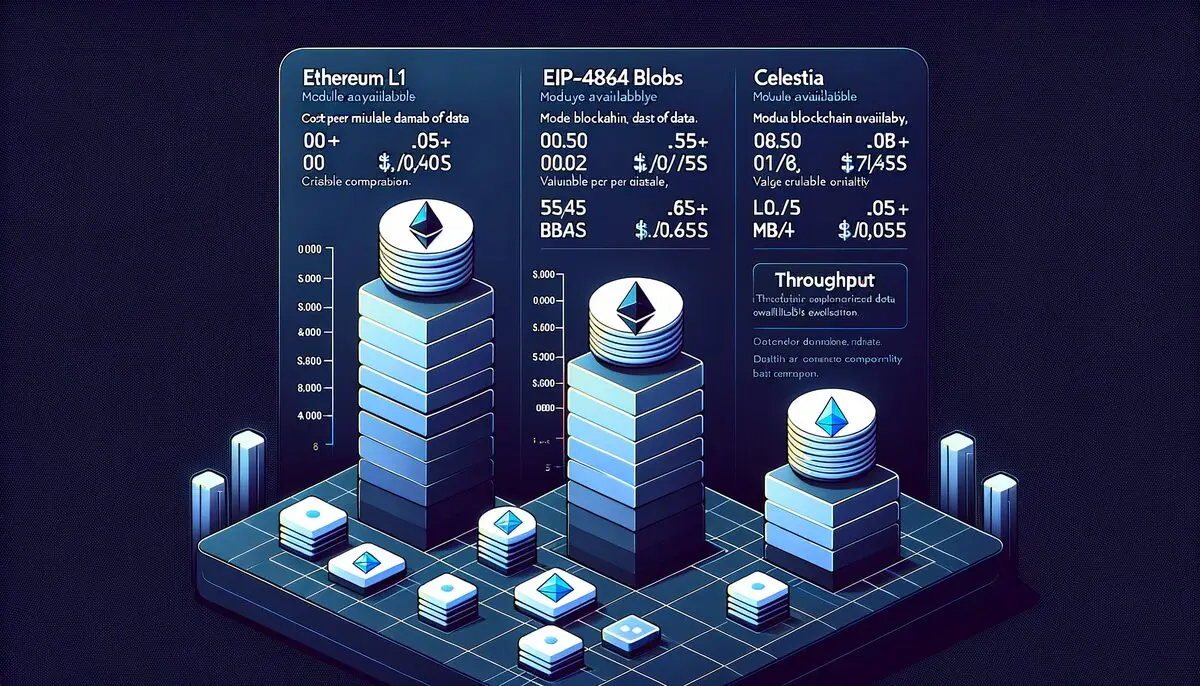
The modular blockchain stack can be thought of as four distinct layers, each responsible for a critical function. Understanding these layers is essential for grasping how modular systems work together to deliver performance that no single chain could achieve alone. Let us examine each layer in detail and explore the projects that specialize in them.
The Execution Layer
The execution layer is where transactions are actually processed and smart contract code runs. In the modular world, this is typically handled by rollups, which are chains that execute transactions off the main network and then post compressed results back to a settlement or data availability layer. Rollups come in two main varieties: optimistic rollups (like Optimism and Arbitrum), which assume transactions are valid unless challenged with a fraud proof, and zero-knowledge (ZK) rollups (like zkSync and StarkNet), which generate cryptographic proofs that verify correctness without requiring trust assumptions.
The beauty of the modular execution layer is that multiple rollups can operate simultaneously, each optimized for different use cases. A gaming rollup might prioritize low latency and high throughput, while a DeFi rollup might prioritize security and composability. Both can share the same data availability and settlement layers, benefiting from shared security without competing for the same blockspace.
The Settlement Layer
The settlement layer serves as the final arbiter of truth. It is where fraud proofs and validity proofs are verified, disputes are resolved, and the canonical state of rollups is anchored. Ethereum is the most prominent settlement layer today, providing a high-security environment where rollup state roots are posted and verified. However, specialized settlement layers like Dymension have emerged to offer tailored settlement services for specific types of rollups.
The Consensus Layer
The consensus layer determines the ordering of transactions and ensures all participants agree on the current state. In a modular system, the consensus layer can be shared across multiple execution environments. Celestia, for example, provides consensus and data availability as a bundled service, allowing rollups to inherit its consensus guarantees without running their own validator sets. This shared consensus model dramatically reduces the barrier to launching new chains, since developers do not need to bootstrap their own validator networks from scratch.
The Data Availability Layer
The data availability (DA) layer is arguably the most critical innovation in the modular stack. Its job is to ensure that all transaction data is published and retrievable so that anyone can verify the state of the chain. Without reliable data availability, rollups cannot function securely because users and verifiers would have no way to reconstruct the state and detect fraud.
Why Data Availability Matters: Imagine a rollup that posts its state roots to Ethereum but withholds the underlying transaction data. Even if the state root is correct, nobody can verify it independently. A malicious sequencer could steal funds, and users would have no recourse. Data availability guarantees prevent this scenario by ensuring that the data is always accessible for verification.
Celestia was the first blockchain designed from the ground up as a dedicated data availability layer, and its approach has inspired an entire category of DA-specialized projects. Let us take a closer look at how Celestia works and why it has become the reference implementation for modular data availability.
Celestia Deep Dive: How It Works and the TIA Token
Celestia launched its mainnet in October 2023 and has since established itself as the leading dedicated data availability layer in the blockchain ecosystem. Unlike Ethereum or Solana, Celestia does not execute smart contracts or process application-level transactions. Instead, it focuses exclusively on two things: ordering transactions and making data available. This laser focus allows Celestia to achieve remarkable efficiency in its core function while providing a foundation that other chains can build upon.
How Celestia Works
Celestia uses a unique architecture built around several key innovations. At the network level, Celestia validators accept data blobs from rollups and other chains, arrange them into blocks, and reach consensus on the ordering. Crucially, Celestia validators do not interpret or execute the data. They simply ensure it is ordered and available. This means Celestia blocks can contain data from any type of chain, whether it uses the EVM, CosmWasm, SolanaVM, or any other execution environment.
The data is organized using a structure called a Namespaced Merkle Tree (NMT). Each rollup or chain that posts data to Celestia is assigned a unique namespace, and its data is grouped together within the block. This allows light nodes to download only the data relevant to the chains they care about, rather than having to process the entire block. For a rollup user, this means they only need to verify the data for their specific rollup, not all the data on Celestia.
Celestia's consensus mechanism is based on CometBFT (formerly Tendermint), which provides fast finality and strong consistency guarantees. Blocks are finalized in approximately 12 seconds, giving rollups quick confirmation that their data has been published and is available. The validator set is secured by staked TIA tokens, with delegated proof-of-stake ensuring that economic incentives align with honest behavior.
Perhaps Celestia's most important innovation is Data Availability Sampling (DAS), which we will cover in detail in a dedicated section below. DAS allows light nodes to verify data availability without downloading entire blocks, which is the breakthrough that makes the modular approach viable at scale.
The TIA Token
TIA is Celestia's native token, serving multiple essential functions within the network:
As of April 2026, TIA has established itself as a core infrastructure asset within the modular ecosystem. The token's value proposition is directly tied to the growth of the modular stack, since every rollup that uses Celestia for data availability must acquire and spend TIA. This creates a natural demand flywheel: more rollups means more data posted, which means more TIA burned in fees, which means greater scarcity and potential value appreciation for TIA holders.
Other Modular Projects: EigenDA, Avail, and NEAR DA
While Celestia pioneered the dedicated data availability layer concept, it is far from the only player in this space. Several strong competitors have emerged, each with distinct technical approaches and value propositions. Understanding the differences between these projects is crucial for developers choosing a DA layer and for investors evaluating the modular infrastructure landscape.
EigenDA
EigenDA takes a fundamentally different approach to data availability by leveraging Ethereum's existing validator set through the EigenLayer restaking protocol. Instead of bootstrapping a new validator network (as Celestia does), EigenDA allows Ethereum validators to "restake" their ETH to simultaneously secure the DA layer. This means EigenDA inherits a significant portion of Ethereum's economic security from day one, which is a powerful advantage in terms of trust and adoption.
EigenDA's architecture uses erasure coding and a dispersal network to distribute data blobs across restaked operators. Each operator stores only a fraction of the data, but the erasure coding ensures that the full data can be reconstructed from any sufficient subset of fragments. This design achieves high throughput (targeting 10 MB/s and beyond) while keeping individual operator requirements manageable.
Avail
Avail positions itself as a modular blockchain focused on data availability and data attestation. Originally incubated within the Polygon ecosystem, Avail has since launched as an independent project with its own validator set and consensus mechanism. Avail uses a KZG polynomial commitment scheme combined with data availability sampling, similar in concept to Celestia but with some technical differences in implementation.
One of Avail's distinguishing features is its Nexus, a unification layer designed to aggregate proofs and enable cross-rollup communication. This positions Avail not just as a DA layer but as a coordination hub for the modular ecosystem, potentially addressing one of modularity's key challenges: fragmentation and interoperability between independent rollups.
NEAR DA
NEAR Protocol entered the data availability market by offering its existing sharded architecture as a DA solution for Ethereum rollups. NEAR DA leverages NEAR's Nightshade sharding technology to provide high-throughput data availability at competitive prices. Because NEAR already has a mature, battle-tested network with significant economic security, NEAR DA benefits from an established infrastructure foundation.
| Feature | Celestia | EigenDA | Avail | NEAR DA |
|---|---|---|---|---|
| Security Source | Own validator set (TIA staking) | Ethereum restaking via EigenLayer | Own validator set (AVAIL staking) | NEAR validators (NEAR staking) |
| Consensus | CometBFT | N/A (relies on Ethereum) | BABE/GRANDPA (Substrate) | Nightshade (sharded PoS) |
| DA Sampling | Yes (2D Reed-Solomon) | Erasure coding, partial | Yes (KZG commitments) | No (full shard storage) |
| Throughput Target | 8 MB/s (with upgrades) | 10+ MB/s | 4 MB/s | 4 MB/s per shard |
| Block Time | ~12 seconds | ~12 seconds (Ethereum epochs) | ~20 seconds | ~1.3 seconds |
| Native Token | TIA | EIGEN (governance) + ETH (security) | AVAIL | NEAR |
| Light Client | Full DAS light nodes | Relies on Ethereum light clients | Full DAS light nodes | Standard NEAR light client |
| Ecosystem Focus | Chain-agnostic, Cosmos SDK | Ethereum-aligned | Multi-chain, Substrate | NEAR ecosystem + Ethereum L2s |
| Cost per MB (approx) | ~$0.01 - $0.05 | ~$0.008 - $0.03 | ~$0.01 - $0.04 | ~$0.005 - $0.02 |
Each of these projects occupies a slightly different niche within the modular ecosystem. Celestia appeals to teams that want a purpose-built, chain-agnostic DA layer with full data availability sampling. EigenDA is the natural choice for projects deeply integrated with Ethereum that want to leverage its economic security. Avail targets teams looking for a DA layer with built-in interoperability features. NEAR DA offers a cost-effective option for teams that value throughput and existing infrastructure maturity. The competition between these projects is driving rapid innovation and pushing costs lower, which benefits the entire modular ecosystem.
How Rollups Use Modular Data Availability
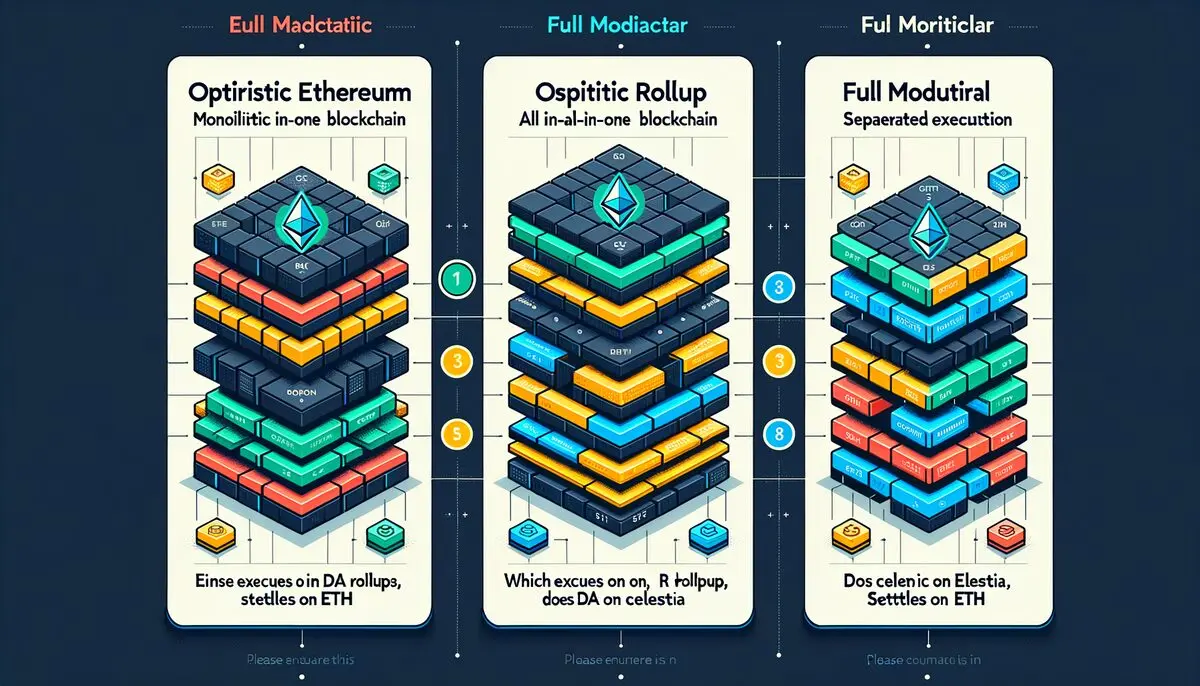
Understanding how rollups actually integrate with modular DA layers is essential for grasping the practical implications of this architecture. The process is more nuanced than simply "posting data to another chain," and the design choices rollups make in how they use DA layers have significant implications for security, cost, and user experience.
The typical flow works as follows. A rollup sequencer collects user transactions, orders them, and executes them to produce a new state. The sequencer then takes the transaction data (or a compressed version of it) and submits it as a "blob" to the data availability layer. Once the DA layer includes this blob in a block and reaches consensus, the data is considered available. The rollup then posts a state root (a cryptographic commitment to its current state) along with a proof that the data was published to the DA layer, to the settlement layer (often Ethereum).
This architecture creates a clear separation of concerns:
- The rollup handles execution and produces state transitions
- The DA layer (e.g., Celestia) guarantees that transaction data is published and retrievable
- The settlement layer (e.g., Ethereum) verifies proofs and serves as the ultimate source of truth
The cost savings from this approach are dramatic. Before modular DA layers, rollups like Arbitrum and Optimism posted all their transaction data as calldata to Ethereum L1, which was expensive because every Ethereum validator had to process and store that data. With Ethereum's blob space (EIP-4844) and external DA layers like Celestia, rollups can post data at a fraction of the cost. Some rollups have reported cost reductions of 90% or more after switching to modular DA solutions.
Sovereign Rollups: A particularly interesting variant enabled by modular DA is the "sovereign rollup." Unlike traditional rollups that derive their security from a settlement layer, sovereign rollups use the DA layer only for data availability and handle their own settlement internally. This gives them full sovereignty over their protocol rules, upgrade schedules, and governance, while still benefiting from the security guarantees of an external DA layer. Projects like Rollkit make it straightforward to deploy sovereign rollups on Celestia.
Data Availability Sampling Explained
Data Availability Sampling (DAS) is the core technical breakthrough that makes modular blockchains practical. Without DAS, verifying data availability would require downloading the entire block, which is exactly the scalability bottleneck that modular architectures are trying to avoid. DAS solves this by allowing light nodes to verify data availability with high confidence while downloading only a tiny fraction of the actual data.
Here is how DAS works, step by step:
Step 1: Erasure Coding. When a block producer creates a block, the data is encoded using a technique called erasure coding (specifically, 2D Reed-Solomon coding in Celestia's case). This process takes the original data and expands it by adding redundancy. For example, if the original data is a 4x4 grid, erasure coding extends it to an 8x8 grid. The key property is that the entire original data can be reconstructed from any 50% of the extended data. This means that even if half the data is missing, a verifier can still recover the complete block.
Step 2: Random Sampling. Light nodes do not download the full block. Instead, they randomly select a small number of cells from the extended data grid and request those specific cells from the network. If they receive valid responses for all their sampled cells, they can conclude with high probability that the data is available. The mathematics behind this are compelling: with just 15 random samples, a light node can achieve over 99.99% confidence that the data is available, even if up to 50% of the data is being withheld by a malicious block producer.
Step 3: Verification. Each sampled cell comes with a Merkle proof that ties it back to the block header's data root. The light node verifies these proofs to ensure the cells it received are genuine and correctly positioned in the data grid. If any proof is invalid, the light node rejects the block.
Step 4: Network Effects. As more light nodes join the network and sample different random cells, the collective probability of detecting any data withholding attack approaches 100%. This is a beautiful property: the more participants there are, the more secure the system becomes, without requiring any individual participant to download more data. Each light node only downloads a few kilobytes, but together they ensure the availability of megabytes of data.
DAS fundamentally changes the economics of blockchain verification. In a monolithic chain, the cost of verification scales linearly with the amount of data: more data means more work for every node. With DAS, verification cost remains roughly constant regardless of block size, because each light node only needs to sample a fixed number of cells. This enables DA layers to increase throughput (by increasing block size) without increasing the burden on individual verifiers, breaking the scalability trilemma in a way that was previously thought impossible.
Modular vs Monolithic Performance in 2026
As we enter the middle of 2026, the performance gap between modular and monolithic architectures has become increasingly clear. Real-world data from production deployments shows that modular systems consistently deliver better throughput, lower costs, and improved user experiences compared to their monolithic counterparts. However, the comparison is not entirely one-sided, and monolithic chains retain certain advantages that are worth acknowledging.
Throughput: Modular systems have a fundamental advantage in aggregate throughput because multiple rollups can operate in parallel, each posting data to the same DA layer. A single DA layer like Celestia can support dozens of rollups simultaneously, with each rollup processing thousands of transactions per second. The total throughput of the system is the sum of all rollups, which can easily exceed 100,000 TPS. Monolithic chains like Solana, while impressive in their own right (achieving 5,000-10,000 effective TPS in 2026), are constrained by the fact that all transactions compete for the same blockspace on a single chain.
Latency: This is one area where monolithic chains still hold an advantage. Because a monolithic chain handles execution and finality in one place, transaction confirmation can be faster. Solana achieves sub-second finality, while a modular rollup posting to Celestia and settling on Ethereum might take 12-15 seconds for data availability confirmation and much longer for full settlement finality. However, most rollups offer "soft confirmations" within milliseconds through their sequencers, providing users with a fast experience even if final settlement takes longer.
Cost: Modular architectures win decisively on cost. By using dedicated DA layers instead of posting data to expensive L1 blockspace, rollups have reduced transaction costs to fractions of a cent. Some rollups on Celestia report average costs below $0.001 per transaction, compared to $0.01-$0.50 on monolithic chains (depending on network congestion). This cost advantage makes entire categories of applications viable that would be economically impossible on monolithic chains, including high-frequency trading, gaming, social media, and micropayment systems.
Developer Experience: The modular stack has matured significantly since its early days. Frameworks like OP Stack, Polygon CDK, and Rollkit allow developers to deploy custom rollups with minimal effort. However, the modular approach does introduce additional complexity in terms of choosing and integrating different layers. Monolithic chains still offer a simpler "deploy and forget" experience for developers who do not need the scalability benefits of modularity.
Building on the Modular Stack
For developers looking to build on the modular stack in 2026, the ecosystem offers a rich set of tools, frameworks, and services that make it easier than ever to deploy custom chains and applications. The barrier to entry has dropped dramatically compared to even two years ago, thanks to mature rollup frameworks and well-documented integration paths with DA layers.
The most common approach is to use a rollup framework that handles the heavy lifting of chain deployment, sequencing, and DA integration. Here are the primary options available today:
OP Stack: Developed by the Optimism team, the OP Stack is the most widely adopted rollup framework, powering chains like Base (Coinbase), Zora, and dozens of others. It supports multiple DA backends, including Ethereum blobs, Celestia, and EigenDA. Deploying an OP Stack chain on Celestia can be done through tools like Rollkit or through direct integration using the Celestia DA adapter.
Arbitrum Orbit: Arbitrum's framework for launching custom L2 and L3 chains. Orbit chains can be configured to use different DA layers and offer flexible customization options for gas tokens, permissions, and execution environments.
Polygon CDK: A modular framework for deploying ZK-powered chains. Polygon CDK integrates with Avail for data availability and uses Polygon's aggregation layer for cross-chain interoperability. It is particularly well-suited for enterprise deployments that require ZK-proof-based security guarantees.
Rollkit: A modular framework specifically designed for deploying sovereign rollups on Celestia. Rollkit supports multiple execution environments and gives developers maximum flexibility in designing their chain's architecture and governance.
The typical development workflow looks like this: First, choose your execution environment (EVM, CosmWasm, SolanaVM, or a custom runtime). Second, select a rollup framework that supports your chosen execution environment. Third, choose your DA layer based on your cost, security, and ecosystem preferences. Fourth, deploy your chain using the framework's tooling, which handles sequencer setup, DA layer integration, and settlement configuration. Fifth, build your applications on top of the deployed chain, just as you would on any other EVM-compatible or otherwise standard chain.
One important consideration for builders is the concept of shared sequencing. In the modular stack, each rollup typically runs its own sequencer, which creates fragmentation in terms of MEV (Maximal Extractable Value) and cross-rollup composability. Shared sequencing protocols like Espresso and Astria aim to solve this by providing a common sequencing layer that multiple rollups can share. This enables atomic cross-rollup transactions and more efficient MEV distribution, which are critical for maintaining a cohesive user experience across the modular ecosystem.
Investing in Modular Infrastructure
The modular blockchain thesis has created a new category of infrastructure investments that did not exist just a few years ago. For investors evaluating this space, understanding the value accrual dynamics of each layer in the modular stack is essential for making informed decisions. Unlike monolithic chains where value accrues to a single token, the modular stack distributes value across multiple specialized tokens, each with distinct demand drivers and risk profiles.
Data Availability Tokens (TIA, AVAIL, NEAR): DA layer tokens capture value through fees paid by rollups for data posting. The investment thesis is straightforward: as the number of rollups grows and the volume of data they produce increases, demand for DA layer blockspace rises, driving fee revenue and token demand. TIA, as the first-mover in dedicated DA, has established the strongest brand and network effects, but competition from EigenDA (which leverages existing ETH staking), Avail, and NEAR DA means pricing power may be limited over time.
Restaking Tokens (EIGEN): EigenLayer's EIGEN token represents a bet on the restaking paradigm itself. If restaking becomes the dominant model for bootstrapping new actively validated services (AVS), EIGEN could capture significant value as the governance and coordination token for this ecosystem. However, restaking introduces new risk vectors (cascading slashing, systemic leverage) that investors should carefully consider.
Rollup Framework Tokens (OP, ARB, MATIC/POL): Tokens associated with rollup frameworks and their ecosystems capture value through transaction fees on chains built with their frameworks. The "superchain" thesis (multiple chains sharing a common framework and interoperability layer) creates network effects that benefit early adopters but may be challenged by newer, more flexible alternatives.
Shared Sequencing Tokens: Projects like Espresso and Astria are developing shared sequencing layers that could become critical middleware in the modular stack. Their tokens would capture value through sequencing fees from multiple rollups, potentially creating a new category of MEV-related infrastructure investment.
Investment Disclaimer: This information is provided for educational purposes only and does not constitute financial advice. Cryptocurrency investments carry significant risk, including the potential for total loss. Always conduct your own research and consult with a qualified financial advisor before making investment decisions.
One important framework for evaluating modular infrastructure investments is to consider which layers are likely to become commoditized versus which will maintain pricing power. DA layers, for example, may face commoditization pressure as more competitors enter the market and technology improves, similar to how cloud storage prices have declined over time. Execution layers (rollups with strong application ecosystems) may retain more pricing power due to network effects and user lock-in. Settlement layers (primarily Ethereum) benefit from being the Schelling point for security, which creates a natural moat.
The Future of Modular Blockchains
The modular blockchain paradigm is still in its early stages despite the significant progress made through 2024, 2025, and into 2026. Several emerging trends and technologies promise to push the modular stack even further, potentially reshaping the landscape in ways we are only beginning to understand.
Full Danksharding on Ethereum: Ethereum's roadmap includes full Danksharding, which will dramatically increase the amount of blob space available for rollup data. This will make Ethereum itself a more competitive DA layer, potentially challenging dedicated DA projects like Celestia and Avail. The interplay between Ethereum's native DA capabilities and external DA layers will be one of the most important dynamics to watch over the next two years.
Cross-Rollup Interoperability: One of the biggest challenges in the modular world is fragmentation. When every application can launch its own rollup, liquidity, users, and composability become scattered across dozens or hundreds of chains. Projects working on cross-rollup bridges, shared sequencing, and aggregation layers (like Polygon's AggLayer and Avail's Nexus) are racing to solve this problem. The success of these interoperability solutions will determine whether the modular future feels seamless or fragmented to end users.
ZK-Powered DA: Zero-knowledge proofs are being applied to data availability verification, potentially enabling even more efficient and secure DA layers. ZK-DA could allow verifiers to confirm data availability with cryptographic certainty rather than statistical sampling, which would further strengthen the security guarantees of the modular stack.
AI and Modular Blockchains: The intersection of artificial intelligence and modular blockchains is an emerging frontier. AI agents that operate onchain need high-throughput, low-cost execution environments, which modular rollups can provide. Additionally, AI model verification and decentralized inference could benefit from the modular stack's ability to separate computation from verification, allowing AI workloads to run on specialized execution layers while verification happens on settlement layers.
Institutional Adoption: As modular infrastructure matures and costs continue to decline, institutional adoption is accelerating. Banks, asset managers, and large enterprises are increasingly deploying private or permissioned rollups on public DA layers, benefiting from the security of public infrastructure while maintaining control over their execution environment. This trend could drive massive growth in DA layer usage and, by extension, value for DA layer tokens.
The modular blockchain thesis represents a fundamental shift in how we think about building decentralized systems. Rather than asking "which chain should I use?", the question becomes "which combination of layers best serves my application's needs?" This composability and flexibility is the modular stack's greatest strength, and it is why many industry observers believe that the future of blockchain infrastructure is inherently modular.

Frequently Asked Questions
What is a modular blockchain in simple terms?
A modular blockchain is a blockchain that splits its core functions (execution, consensus, settlement, and data availability) across multiple specialized layers instead of handling everything on a single chain. Think of it like the difference between one person doing every job at a restaurant versus having a dedicated chef, server, host, and dishwasher. Each layer focuses on what it does best, resulting in better performance, lower costs, and greater flexibility for the overall system. In practice, this usually means a rollup handles transaction execution while a separate chain like Celestia handles data availability and Ethereum handles settlement.
How is Celestia different from Ethereum?
Celestia and Ethereum serve fundamentally different roles in the blockchain ecosystem. Ethereum is a general-purpose blockchain that handles smart contract execution, consensus, settlement, and (increasingly) data availability. Celestia, on the other hand, is a purpose-built blockchain that focuses exclusively on two things: ordering transactions and making data available. Celestia does not execute smart contracts or process application logic. Instead, it provides a specialized data availability layer that rollups and other chains can use to store their transaction data at low cost. Think of Ethereum as a full-service platform and Celestia as a specialized infrastructure service that other chains plug into.
What is Data Availability Sampling and why does it matter?
Data Availability Sampling (DAS) is a technique that allows light nodes to verify that block data has been published without downloading the entire block. Using erasure coding and random sampling, a light node can check just a handful of small data fragments and achieve extremely high confidence (over 99.99%) that the full data is available. DAS matters because it breaks the fundamental scalability limitation of blockchains: traditionally, increasing throughput meant increasing the hardware requirements for every node. With DAS, block sizes can grow without increasing the burden on individual verifiers, enabling massive scalability improvements while maintaining decentralization.
What is the TIA token used for?
TIA is Celestia's native token and serves four primary functions. First, it is used to pay for data availability, as rollups and other chains must pay fees in TIA when they post data blobs to Celestia. Second, TIA is staked by validators and delegators to secure the network and earn rewards. Third, TIA holders can participate in governance by voting on protocol upgrades and parameter changes. Fourth, TIA can be used as a gas token by new rollups that have not yet launched their own native token, helping solve the cold-start problem for new chains. As more rollups adopt Celestia for data availability, demand for TIA increases proportionally.
Is Ethereum becoming a modular blockchain?
Yes, Ethereum has been progressively moving toward a modular architecture. The introduction of EIP-4844 (Proto-Danksharding) in March 2024 was a pivotal moment, as it created dedicated blob space for rollup data, effectively separating Ethereum's data availability function from its execution layer. Ethereum's roadmap envisions full Danksharding, which will further expand its DA capacity. In the current landscape, Ethereum functions as a hybrid: it still supports direct execution through smart contracts on L1, but it increasingly serves as a settlement and DA layer for rollups. Vitalik Buterin has described Ethereum's endgame as a "rollup-centric" roadmap where most user activity happens on rollups (execution layers) while Ethereum provides settlement and data availability.
Which modular DA layer should I choose for my project?
The best DA layer for your project depends on your specific requirements. Choose Celestia if you want a purpose-built, chain-agnostic DA layer with full data availability sampling and the most mature ecosystem of modular tooling. Choose EigenDA if your project is deeply integrated with the Ethereum ecosystem and you want to leverage Ethereum's economic security through restaking. Choose Avail if you prioritize cross-rollup interoperability through Avail's Nexus and want a DA layer with built-in proof aggregation features. Choose NEAR DA if cost is your primary concern and you value the maturity of NEAR's sharded infrastructure. Choose Ethereum blob space if security is paramount and you want the strongest possible settlement guarantees with native DA integration. Many projects start with one DA layer and add support for others over time, so the choice is not necessarily permanent.
What are the risks of modular blockchains?
Modular blockchains introduce several risks that users and developers should be aware of. Fragmentation is the most commonly cited concern: when every application can launch its own rollup, liquidity and users become scattered across many chains, potentially degrading the user experience. Composability challenges arise because smart contracts on different rollups cannot interact atomically the way they can on a single monolithic chain. Bridge risk is introduced whenever value moves between layers, as bridge exploits remain one of the most significant attack vectors in crypto. DA layer dependency means that rollups are reliant on the security and liveness of their chosen DA layer; if the DA layer experiences downtime or a consensus failure, all dependent rollups could be affected. Complexity is another factor, as the modular stack introduces more components that developers must understand and integrate, increasing the surface area for bugs and misconfigurations.
Will modular blockchains replace monolithic ones?
It is unlikely that modular blockchains will completely replace monolithic ones. Instead, the industry appears to be moving toward a hybrid landscape where both approaches coexist and serve different needs. Monolithic chains like Solana will continue to thrive for applications that prioritize single-chain composability, low latency, and simplicity. The modular stack will dominate for applications that need customizable execution environments, maximum scalability, and cost efficiency. Some blockchains, like Ethereum, will continue to evolve along the modular spectrum, offering both direct L1 execution and rollup-based scaling. The most probable future is one where users interact with applications across both modular and monolithic chains, often without knowing or caring about the underlying architecture, as abstraction layers and cross-chain bridges make the experience seamless.
Related Guides
- What Is Manta Pacific? Modular ZK L2 with Celestia DA Guide 2026
- What is Celestia (TIA)? Modular Data Availability Explained
- What Is IoTeX (IOTX)? Modular DePIN Platform for IoT + AI Explained in 2026
- What Is Data Availability (DA): Complete Modular Blockchain Guide (2026)
- What Is Tenderly: Web3 Simulation, Debugging and Full-Stack Infrastructure (2026)