Ethereum vs Bitcoin: 2026 Exchange Guide

Ethereum vs Bitcoin in 2026: discover strategies for trading both top cryptocurrencies and learn how to exchange them efficiently as the market evolves.
The 2026 Guide to Exchanging the Two Giants
- As of April 10, 2026, the cryptocurrency market has reached a state of relative maturity, yet the rivalry between its two largest assets, Ethereum (ETH) and Bitcoin (BTC), remains as dynamic as ever. Following the successful Pectra and Fusaka upgrades for Ethereum and the continued institutional adoption of Bitcoin ETFs, investors often find themselves needing to move value between these two ecosystems.
- Whether you are rotating profits from Ethereum's decentralized applications into the "digital gold" of Bitcoin, or moving capital into ETH to participate in the latest staking yields, understanding how to convert these assets safely and efficiently is a core skill for the modern trader.
The 2026 Philosophy: Digital Gold vs. The World Computer
- In 2026, the distinction between BTC and ETH has never been clearer. Bitcoin has solidified its position as a Tier 1 macro asset. With its fixed supply and Proof of Work (PoW) security, it is the primary hedge against global currency debasement. Most institutional portfolios in 2026 treat BTC as a digital version of gold, focused on long term preservation of wealth.
- Ethereum, conversely, has moved into its "Modular Era" following the 2025 upgrades. It is no longer just a currency; it is a programmable financial layer. While BTC is about "staying still," ETH is about "doing things." It powers decentralized finance (DeFi), tokenized real estate, and global identity systems. In the current market, the ETH/BTC ratio is a closely watched metric that represents the market's appetite for utility and risk versus pure store-of-value stability.
Why Investors Swap ETH for BTC (and Vice Versa)
The decision to exchange one for the other is usually driven by portfolio rebalancing or market sentiment. In April 2026, many traders use the ETH/BTC ratio to time their entries. The formula for the ratio is simple:
When this ratio is low, it implies that Ethereum is undervalued relative to Bitcoin, often prompting traders to exchange BTC for ETH. When the ratio is high, traders might "rotate" their ETH gains back into the safety of Bitcoin to protect their capital during a market cooling phase.
Example:
Imagine an investor named David who bought ETH at the start of the "Fusaka" hype. After a 40% rally in ETH while BTC remained stagnant, David decides to lock in his gains. He doesn't want to go to cash (USD) because he still believes in the crypto market, so he converts his ETH into BTC, effectively "storing" his increased purchasing power in a more stable asset.
How to Exchange ETH to BTC: Centralized Exchanges (CEX)
For the vast majority of retail users in 2026, centralized exchanges like Coinbase, Kraken, or Binance are the most straightforward path. These platforms offer deep liquidity, meaning you can trade large amounts without significantly moving the market price.
The Process:
Deposit your ETH into the exchange wallet.
Navigate to the ETH/BTC trading pair.
Select Sell ETH (which automatically buys BTC).
Withdraw the resulting BTC to your private hardware wallet.
The main benefit here is the ease of use. However, you must be prepared for trading fees, which usually range from 0.1% to 0.6% depending on your volume. In 2026, these platforms are highly regulated, so you will need to have a verified account to complete the swap.
How to Convert ETH to BTC: Cross-Chain DEXs and Aggregators
- If you prefer to keep your funds in your own custody, decentralized cross-chain swaps have become the gold standard in 2026. Protocols like THORChain or Maya Protocol allow for "Native Swaps." This means you can send ETH from your Ethereum wallet and receive real, native BTC in your Bitcoin wallet without using a centralized middleman.
- In 2026, aggregators have simplified this further. Apps like Uniswap or Jupiter now feature "Cross-Chain" tabs. Behind the scenes, they use "Atomic Swaps" or "Streaming Swaps" to ensure that your funds are never at risk during the transition. If the trade fails for any reason, the smart contract simply returns your original ETH to you.
Example Scenario:
A privacy-conscious trader wants to move 2 ETH into BTC. They connect their MetaMask (for the ETH) and their Xverse or Phantom wallet (for the BTC) to a decentralized aggregator. They sign one transaction. Two minutes later, the ETH is gone, and the native BTC arrives in their other wallet. No account creation was required.
The Role of Wrapped Bitcoin (WBTC) on Ethereum
- Sometimes, you don't actually need to move onto the Bitcoin blockchain. If your goal is to use the value of Bitcoin within an Ethereum DeFi app, you can swap your ETH for Wrapped Bitcoin (WBTC).
- WBTC is an ERC-20 token on the Ethereum network that is pegged 1:1 to the price of Bitcoin. In 2026, WBTC remains a massive asset, allowing users to lend their "Bitcoin" to earn interest or use it as collateral for a loan, all while staying within the Ethereum ecosystem. This is a "conversion" of value, but not a change of location. It is important to remember that WBTC is a custodial asset; a third party holds the real BTC in a vault and issues the tokens to you.
Step-by-Step Tutorial: Converting ETH to BTC Safely
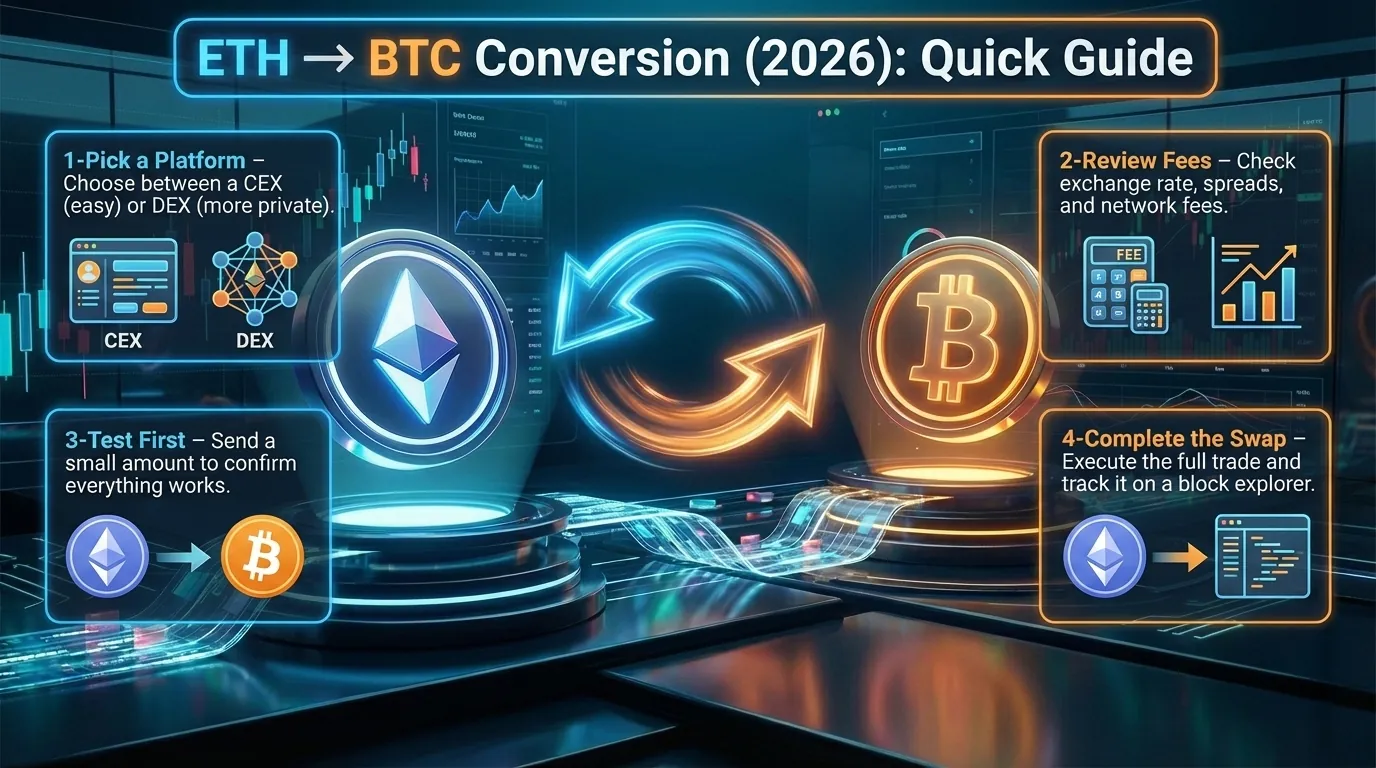
If you are ready to make the move, follow this simple workflow to ensure a smooth transition:
Step 1: Choose Your Platform
Decide if you want the simplicity of a CEX (Coinbase/Binance) or the privacy of a DEX (THORChain/Aggregators).
Step 2: Check the Fees and Spread
Look at the "Exchange Rate." In 2026, gas fees on Ethereum are low due to L2 scaling, but Bitcoin fees can still spike. Ensure that the amount of BTC you receive is fair compared to the current market ratio.
Step 3: Perform a Small Test
If you are moving a significant amount (e.g., 10 ETH), always perform a small test trade first. Swap 0.05 ETH and ensure the BTC arrives in your destination wallet as expected.
Step 4: Execute and Verify
Once the test is successful, execute the full amount. Use a block explorer like Mempool.space (for BTC) or Etherscan (for ETH) to monitor the progress of your transaction.
Comparison of Conversion Methods
| Method | Speed | Security | Complexity | Recommended For |
| CEX (Coinbase/Binance) | Instant | Managed | Low | Beginners |
| Cross-Chain DEX (THORChain) | 2 to 10 Mins | Self-Custody | Medium | Advanced Traders |
| Wrapped BTC (Uniswap) | Seconds | Smart Contract | Low | DeFi Users |
| Atomic Swaps | Variable | Highest | High | Privacy Enthusiasts |
Summary of Key Points
Ethereum (2026) is the platform for utility and DeFi, powered by the Pectra upgrade.
Bitcoin (2026) is the premier global store of value and digital gold.
Portfolio Rotation is the main reason for swapping; traders move between the two based on the ETH/BTC ratio.
Centralized Exchanges provide the highest liquidity and easiest user experience for cashing in and out.
Decentralized Aggregators offer the most privacy and allow for native swaps without giving up control of your keys.
Wrapped BTC allows you to keep Bitcoin's value on the Ethereum chain for use in lending and borrowing.
Always verify networks: Ensure you are sending native BTC to a Bitcoin address and ETH to an Ethereum address.
Remember that DEXTools offers the best DeFi tools for fast and secure trading. You can access the DEXTools dashboard here!
Disclaimer: This article is for informational purposes only and does not constitute investment advice, financial advice, trading advice, or any other kind of advice. DEXTools does not recommend buying, selling, or holding any cryptocurrency or token. Users should conduct their own research and consult with a qualified financial advisor before making any investment decisions. Cryptocurrency investments are volatile and high-risk. DEXTools is not responsible for any losses incurred.
Related Guides
- How to Invest in Crypto ETFs - Bitcoin and Ethereum ETF Guide 2026
- Bitcoin vs Ethereum: Complete Investment Comparison 2026
- What Is OKB? The OKX Exchange Token Powering X Layer Explained in 2026
- What Is FTT (FTX Token)? From Top-10 Exchange Token to Bankruptcy Recovery Explained in 2026
- What Is AnySwap? How It Works, Fees, Modes and Safety (2026)
Frequently Asked Questions
What is the difference between Ethereum and Bitcoin in 2026?
In 2026, Bitcoin is viewed as 'digital gold' focused on wealth preservation, while Ethereum has evolved into a programmable financial layer powering decentralized applications and services.
How do I exchange ETH for BTC?
You can exchange ETH for BTC through centralized exchanges like Coinbase or Kraken by depositing your ETH, navigating to the ETH/BTC trading pair, selling ETH, and withdrawing BTC to your wallet.
What is the ETH/BTC ratio and why is it important?
The ETH/BTC ratio measures the relative value of Ethereum to Bitcoin; a low ratio suggests Ethereum is undervalued, prompting traders to swap BTC for ETH, while a high ratio may lead to converting ETH gains back into BTC for stability.
What are the fees associated with exchanging ETH for BTC on centralized exchanges?
Trading fees on centralized exchanges typically range from 0.1% to 0.6%, depending on your trading volume.
What are decentralized cross-chain swaps?
Decentralized cross-chain swaps allow users to exchange ETH for native BTC directly from their wallets without a centralized intermediary, using protocols like THORChain or aggregators like Uniswap.