How to Avoid Rug Pulls on Solana: Red Flags Every Trader Should Know
— By AliceOnChain in Tutorials
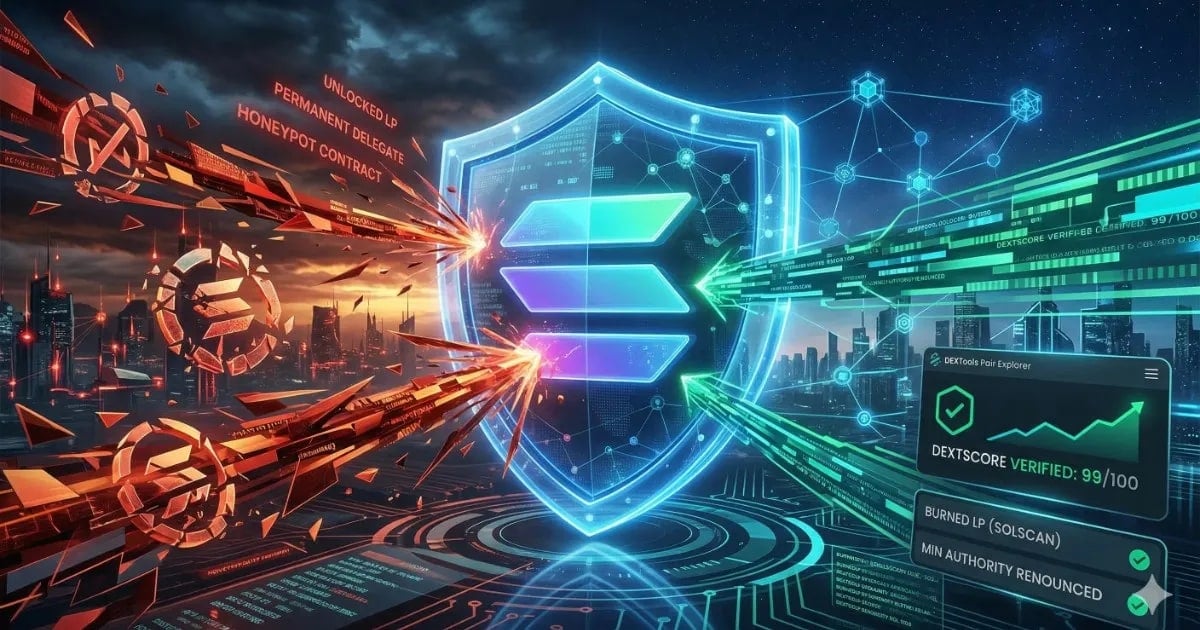
Is Solana crypto safe? Learn how to avoid rug pulls on Solana by analyzing Token Extensions, locked liquidity, and holder data using DEXTools security analytics.
Intent check: This page is the Solana-specific rug-pull guide. If you want the broader multi-chain framework across Solana, Ethereum, and Base, read How to Avoid Rug Pulls: Solana, Ethereum and Base.
How to Avoid Rug Pulls on Solana: Red Flags Every Trader Should Know
The speed and efficiency of the Solana network have made it the epicenter of the 2026 decentralized trading landscape. Its sub-cent, sub-second finality is unmatched. However, this high-velocity environment is a double-edged sword. While it enables unprecedented profit opportunities, it also provides a fertile hunting ground for malicious actors. If you are active in Solana crypto markets, learning how to avoid rug pulls on Solana is not just a defensive skill; it is a fundamental requirement for capital preservation.
The term "rug pull" has evolved. It no longer just means the simple removal of liquidity. It now encompasses a complex spectrum of developer maliciousness, from slow-rugs with hidden token allocations to sophisticated honey pots that utilize Advanced Token Extensions. To navigate this minefield, traders must move beyond hype and adopt a rigorous, data-driven methodology, using professional analytics tools like DEXTools to verify every position.
This definitive guide will dissect the critical red flags that every Solana network trader must master to protect their capital in the relentless pursuit of alpha.
1. The Liquidity Red Flags: Verified vs. Unverified
When you look at a new Solana crypto pair on DEXTools, the first thing you must analyze is the liquidity. Liquidity is the lifeblood of any trading pair. When it is removed or unverified, the token is dead.
Is the Liquidity Locked?
The most classic rug pull involves a developer withdrawing the pool’s liquidity (e.g., SOL or USDC), making it impossible for others to sell their tokens. On the DEXTools Pair Explorer, you will see a specific "Locked Liquidity" badge. This is not negotiable for long-term holds. If the liquidity is not locked for a significant period (e.g., at least 6 months), the developer can "pull the rug" at any moment.
Is the LP Token Burned?
Even better than "locked" is "burned." When a developer burns the Liquidity Provider (LP) tokens, they are sent to a null address, meaning nobody-not even the creator-can ever reclaim that initial liquidity. This is the highest level of security for a pool. Always look for the transactional proof on Solscan that the LP tokens were sent to the burn address. A project that refuses to burn or lock its LP tokens is signalling that it intends to retain the option of removing liquidity.
2. Advanced Contract Security: Honey Pots and Token Extensions
As the Solana network matures, so do the scam mechanisms. We have moved past simple contracts. Malicious developers are now exploiting the complexity of Token Extensions to create sophisticated traps, also known as "honey pots."
The "Transfer Hook" and "Permanent Delegate"
Token Extensions are powerful tools designed for institutional and compliant use cases (like RWAs), but they can be weaponized. A "honey pot" rug pull allows you to buy the token but prevents you from selling it. When using DEXTools, pay close attention to the DEXTScore security analysis, which flags these contract vulnerabilities.
The critical red flags to look for include:
Permanent Delegate: This extension gives a specific address total control over all Solana crypto tokens in existence. A malicious delegate can transfer your tokens out of your wallet without your permission. This is an immediate fail.
Transfer Hooks: This allows a contract to intercept and potentially block a transaction before it is executed. Scammers use this to prevent sales while allowing purchases to continue, inflating the price artificially.
Modifiable Mint Authority: If the developer can mint new tokens at will, they can create infinite supply, dump it on the market, and dilute your holdings to zero. A safe contract has its mint authority "renounced" or disabled.
Before swapping, verify the DEXTScore-a 99/100 score on a contract with renounced mint authority and burned LP is significantly safer than a 50/100 score on a contract with unverified code.
3. Top-Heavy Token Distribution: The Snipers' Trap
Even if the contract is technically "clean" and the liquidity is locked, a project can still rug pull through market manipulation. This is known as a "dump" or a "slow rug." Traders must analyze who holds the Solana network tokens.
Sniper Activity and "Bundled" Buys
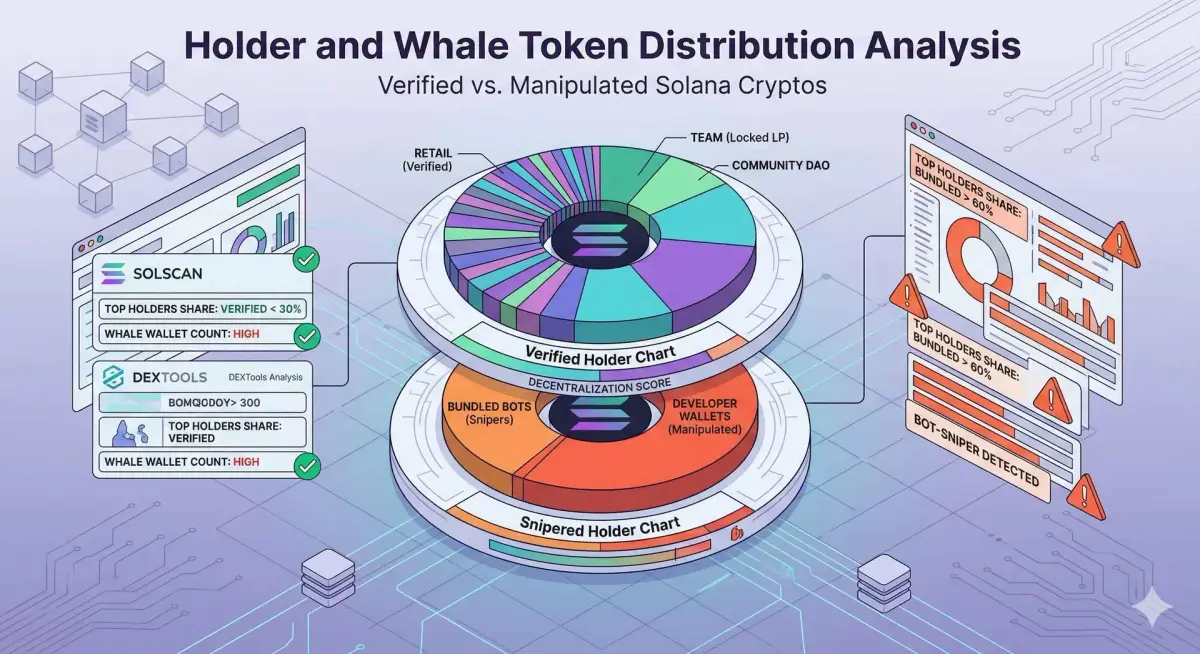
Scammers will often use "snipers" (automated bots) or "bundle" transactions at launch to capture the first 20-30% of the token supply instantly. They do this across hundreds of distinct wallets to make the project look decentralized.
On DEXTools, use the Holders tab. If you see the top 10 wallets holding a massive percentage (e.g., >30%) of the supply-and those wallets are not clearly labeled exchange, staking, or community DAO wallets-you are looking at a sniped project. The developers (or the snipers they colluded with) are just waiting for enough retail liquidity to pour in before they cascade their sells and dump the price, making how to avoid rug pulls on Solana an impossible task once you've already entered.
4. Social & Community Red Flags: Hype vs. Substance
While technical analysis is paramount, social and marketing analysis on the Solana network provides the narrative context. Malicious projects often share common behavioral patterns.
The Marketing-Only Narrative
If a project's whitepaper, website, and social media are entirely focused on "price," "marketing," and "partnerships" with no mention of real utility, development, or long-term vision, it is likely a pump-and-dump scheme. A sudden and aggressive marketing blitz, often involving C-list influencers, is a common prelude to a coordinated dump.
The "Vibe-Only" Community
Legitimate Solana crypto projects build resilient communities focused on governance and development. Rug pulls create artificial communities in Telegram and Discord, filled with bots and "hype men" who immediately attack or ban anyone asking genuine questions about the contract, liquidity, or top holders. If you cannot ask a difficult question in the community chat without being banned, you should not invest.
Anonymous, Untracked Developers
While "doxxing" (revealing identity) is not always possible in crypto, accountability is. Check the project’s DEXTools Socials links. Does the team have a track record of building? Are they responsive to bugs? If the developers are entirely anonymous with no past successes, you are trusting them with your capital with zero recourse.
Conclusion: Use DEXTools as Your Security Shield
The promise of the Solana network in 2026 is unparalleled, but so is the danger. Malicious actors are persistent, but they leave footprints. By rigorously analyzing liquidity locks, contract permissions via Token Extensions, token distribution among top holders, and community behavior, you can significantly reduce your risk.
Learning how to avoid rug pulls on Solana is about changing your mindset from "FOMO" to "FUD" (Fear, Uncertainty, and Doubt) regarding any unverified project. Leverage the full power of DEXTools (including the DEXTScore, Pair Explorer, and the Holder analysis)as your primary security shield before you hit that swap button. Protection of capital must always come first. Only then can you find sustainable alpha in the relentless Solana crypto market.
--
Disclaimer: This article is for informational purposes only and does not constitute investment advice, financial advice, trading advice, or any other kind of advice. DEXTools does not recommend buying, selling, or holding any cryptocurrency or token. Users should conduct their own research and consult with a qualified financial advisor before making any investment decisions. Cryptocurrency investments are volatile and high-risk. DEXTools is not responsible for any losses incurred.
How to Spot a Rug Pull in Crypto: Complete Red Flag Detection Tutorial (2026)
Related Guides
- When Not to Trade: 12 Red Flags Every DeFi Trader Should Know
- How to Avoid Rug Pulls: Solana, Ethereum & Base Guide 2026
- Rug Pull Checklist: 10 Pair Explorer Checks to Avoid Scams
- Spot Rug Pulls Fast: Use DEXTools in 3 Minutes
- Top 5 Crypto Wallets in 2026: Best Wallets for Every Trader
Frequently Asked Questions
What is a rug pull in the context of Solana?
A rug pull on Solana refers to a malicious act where developers withdraw liquidity from a trading pair, making it impossible for investors to sell their tokens. It can also involve more complex schemes like hidden token allocations and honey pots.
How can I identify if liquidity is locked for a Solana token?
You can check if liquidity is locked by looking for a 'Locked Liquidity' badge on DEXTools. It's essential that liquidity is locked for a significant period, ideally at least 6 months, to ensure safety.
What are honey pots in cryptocurrency trading?
Honey pots are sophisticated traps created by malicious developers that allow users to buy tokens but prevent them from selling. This tactic is often used to inflate the token's price artificially.
What should I look for in a secure Solana contract?
In a secure Solana contract, look for a high DEXTScore (preferably 99/100), renounced mint authority, and burned LP tokens. These features indicate a lower risk of rug pulls and scams.
Why is it important to use analytics tools like DEXTools when trading on Solana?
Using analytics tools like DEXTools helps traders verify liquidity, assess contract security, and identify potential red flags, which are crucial for capital preservation in the volatile Solana market.