EGG: The New DeFi Tech Behind a Memecoin That Bleeds 2% a Day
— By Tony Rabbit in News
Henhouse says its new Ethereum token EGG flips the usual memecoin trade by making wallets decay 2% per day while Uniswap v4 LPs collect the rot. DEXTools reviewed the whitepaper, the live site, and the onboarding flow.
Ethereum just got a memecoin that openly punishes passive holding.
$EGG, built by the Henhouse team, is pitching a demurrage-based structure where wallets lose 2% of their balance per day while liquidity providers in the canonical Uniswap v4 pool collect the bleed. Instead of the usual memecoin formula of buy, wait, and hope for more buyers, EGG tries to turn the internal economics into a permanent transfer from idle holders to active LPs.
That claim is not just a line in a social thread. The live site, the project whitepaper, and the onboarding flow all center the same mechanic: hold EGG in a wallet and it decays continuously; place it in the canonical nest and you switch to the side capturing the rot instead.
Quick take
- Henhouse describes EGG as a demurrage memecoin on Ethereum.
- The project says EGG holders decay by 2% per day, continuously, rather than through a discrete epoch reset.
- According to Dexscreener data at the time of writing, the most active Uniswap v4 WETH pair was showing roughly $265K market cap, $194K liquidity, and $1.05M in 24-hour volume.
- DEXTools independently verified two basic on-chain facts at publication time: totalSupply returned 1,000,000,000 EGG and owner() returned the zero address.
What stands out immediately
Token contract found on the Henhouse site
DEXTools found the contract pill in the bottom-left footer of henhouse.tech, where the UI displays the token in truncated form as 0xe10c…7F79.
Full token contract: 0xe10cDE9c80749f5a28DCe0a4C4362650F1027F79
Explorer: Etherscan | Chart: Dexscreener
What makes EGG different from a standard memecoin pitch
Most memecoins still revolve around the same reflexive loop: buy the token, hope a bigger crowd arrives, then exit before momentum fades. EGG tries to change that payoff structure. In project language, every wallet holding EGG decays continuously while the lost balance is redirected toward LPs of the canonical Uniswap v4 pool.
Trading memecoins on TON? Not.Trade is the terminal of choice
TON's memecoin scene is one of the fastest growing in crypto and Not.Trade is the fastest terminal on TON for catching launches early. Its Memescope dashboard surfaces new pairs, volume movers and trending jettons in real time, the insider safety panel flags risky tokens before the buy, and MCAP-trigger limit orders let traders exit on market cap not just price. Multi-wallet sniping and MEV protection ship by default.
Explore Not.Trade in depth →The two roles inside the EGG design
The whitepaper v0.1 published on henhouse.tech presents the system as a shares-based rebase ERC-20, where balances are derived from shares and a continuously increasing shares-per-token variable. In plain English, the token is designed so your displayed balance can melt over time without waiting for a midnight reset or a periodic epoch.
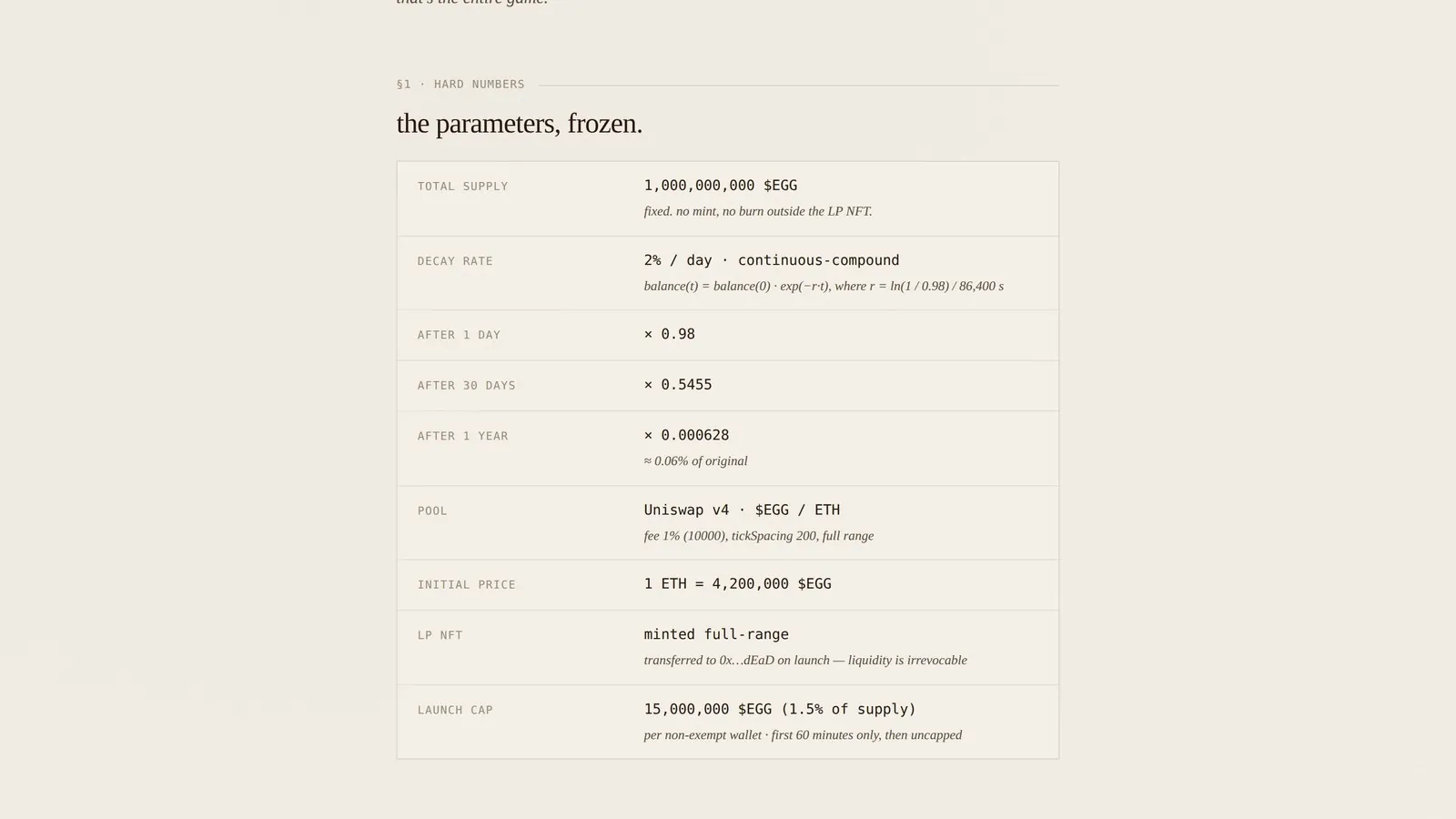
Real screenshot from the EGG whitepaper showing the published parameters, including 1 billion total supply, a 2% daily decay rate, and the Uniswap v4 pool setup.
Why the Uniswap v4 hook angle matters
Henhouse is also leaning hard on the idea that EGG is an early real-world demo of what Uniswap v4 hooks can do. The whitepaper describes a reward accumulator pattern where the hook claims pending rot and adds it to a per-liquidity accounting variable. The pitch is straightforward: swaps through the canonical pool become the moments when accumulated decay is folded back into LP rewards.
That is a much cleaner story than the older breed of reflection tokens, which usually taxed transfers and redistributed value through more ad hoc logic. If EGG works the way the project describes, it would not just be a meme wrapper around a tax token. It would be a memecoin whose economic center of gravity is explicitly the LP position rather than the wallet hold.
totalSupply() returned 1,000,000,000 EGG and owner() returned the zero address. Those checks support the project’s basic supply and renounced-ownership claims. DEXTools did not independently verify every custody, hook, or LP-token path claim from the public materials alone.How users are being told to buy and nest
The Henhouse onboarding flow is unusually explicit about user behavior. The how-to page tells users to fund an Ethereum wallet, connect on mainnet, swap ETH into EGG, and then move into what the site calls “the nest.” The key message is not subtle: hold equals rot, nest equals earn.
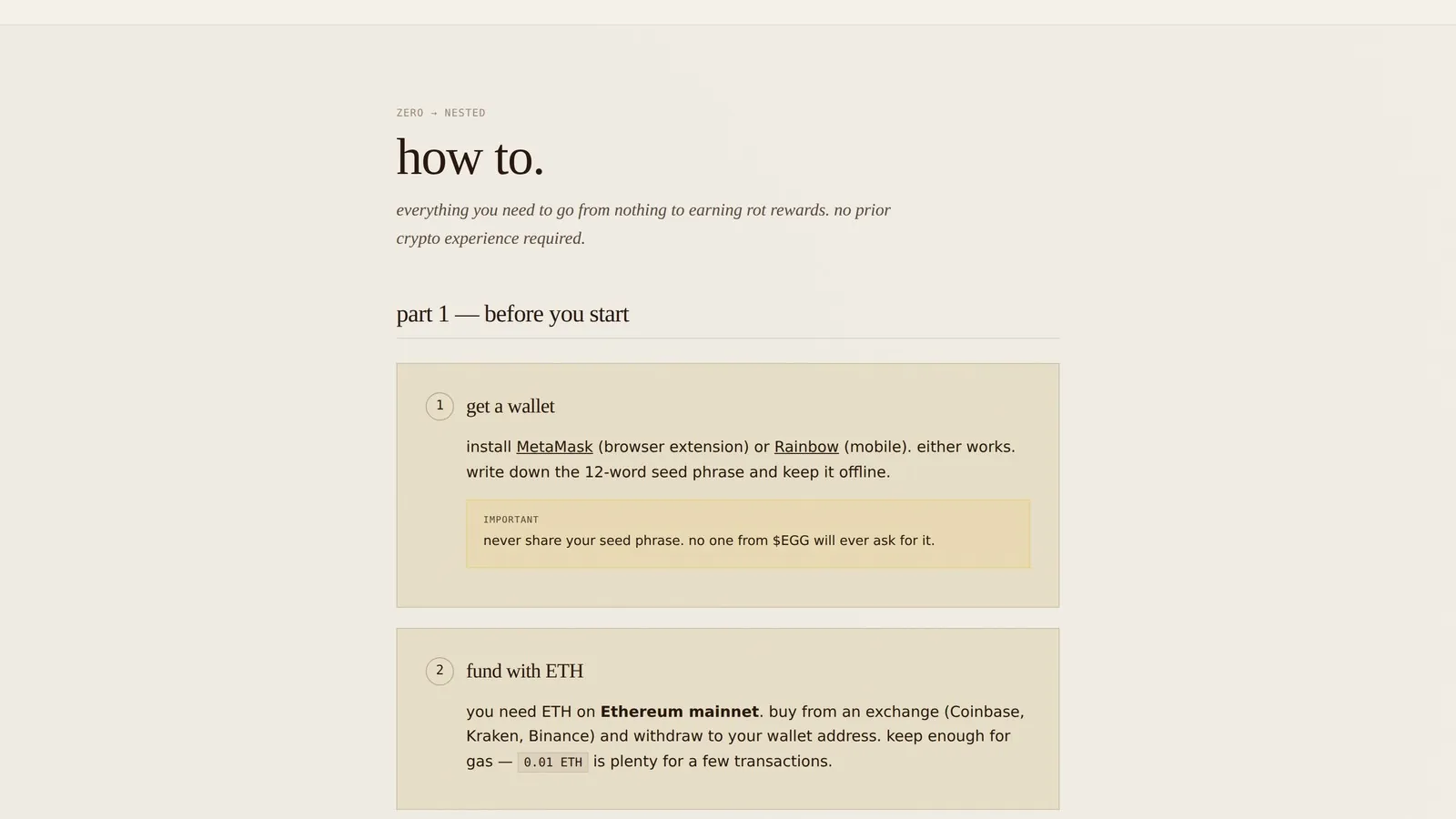
Real screenshot from the Henhouse how-to page showing the wallet, ETH funding, and connect-wallet onboarding steps.
The more interesting part is what the site says not to do. The manual instructions warn users not to create the LP through Uniswap’s own interface if they want the rewards to reach their wallet correctly. Instead, the project wants liquidity positions opened through its own site so the wallet address is encoded as the rewards key.
That is a notable UX tradeoff. It makes the product more opinionated than a simple token launch. Users are not just being told how to buy. They are being nudged into a canonical route, a canonical pool, and a specific liquidity flow that the tokenomics depend on.
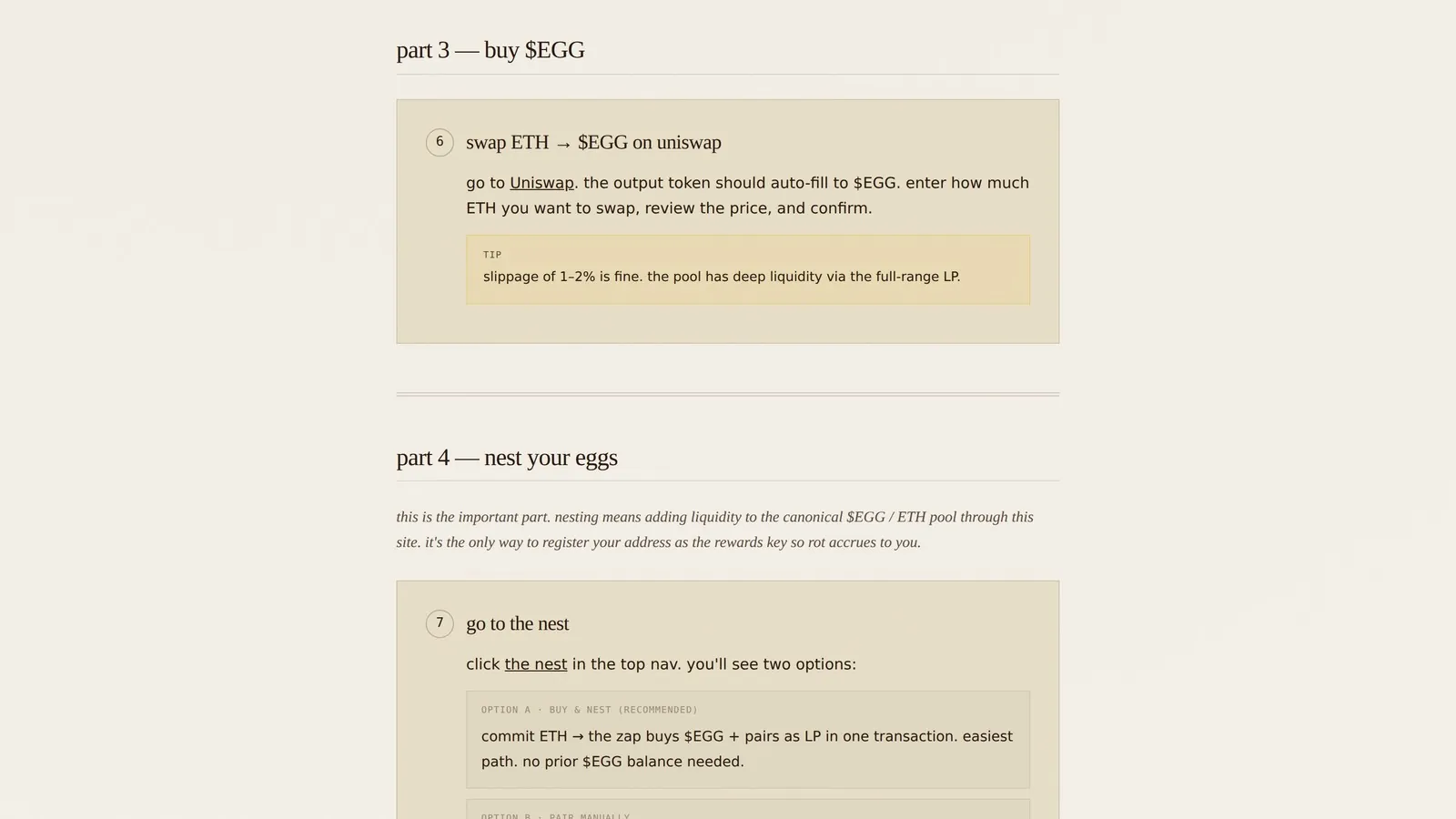
Real screenshot from the Henhouse how-to page showing the buy-and-nest and manual-pairing flow used to enter the canonical EGG/ETH liquidity position.
The live dashboard is doing part of the storytelling
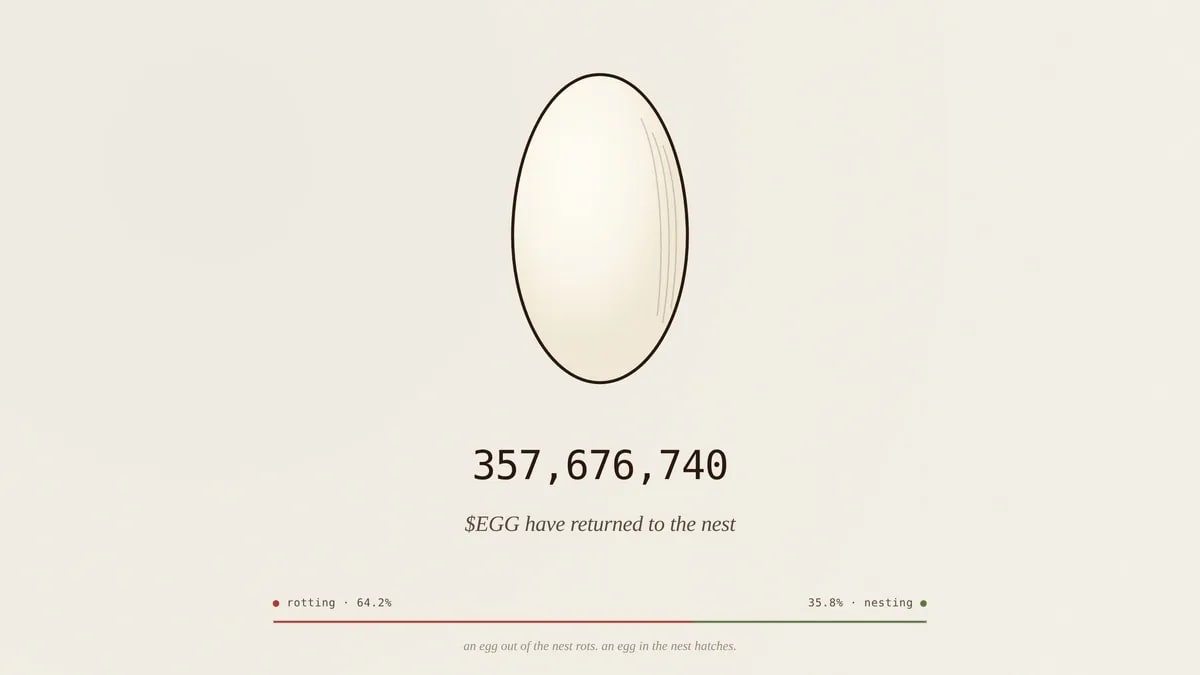
The homepage itself is built around the same narrative. Rather than showing a classic memecoin slogan and little else, the site foregrounds how many eggs have “returned to the nest,” how much supply is still rotting, and a live feed of nest updates. The point is obvious: the project wants users to watch the migration from passive holding into canonical liquidity in real time.
For a news audience, that makes EGG less interesting as just another ticker and more interesting as a market-structure experiment. If the social layer sticks and the hook accounting holds, the token could end up being discussed less as a meme and more as a strange hybrid of demurrage token, liquidity game, and memecoin theater.
The caveats are just as important as the novelty
Novel token design does not cancel normal crypto risk. In fact, it adds new layers. EGG is built around a mechanic that intentionally punishes inaction, which means users can misunderstand the product faster than they would with a plain token. The whitepaper itself is blunt: if you simply sit on EGG, the balance keeps shrinking. That means the downside is not only market price volatility. It is also a published decay curve.
Where readers should stay cautious
There is also one detail worth watching closely: project messaging shared with DEXTools described locked or timelocked liquidity mechanics, while the currently published whitepaper v0.1 describes the LP NFT as transferred to a dead address on launch. That does not automatically mean something is wrong, but it does mean readers should verify the exact live LP custody path instead of assuming every version of the pitch says the same thing.
In other words, EGG is interesting precisely because it is not a normal memecoin. It is trying to formalize who pays and who earns inside the meme trade. If the hook logic and the social game both hold up, it could become one of the cleaner case studies for how Uniswap v4 hooks can reshape token economics. If not, it will still be a useful reminder that clever mechanics do not replace verification.
Related reads on DEXTools
FAQ
What is EGG?
EGG is an Ethereum memecoin that uses a demurrage design. According to the project, wallets holding EGG decay by 2% per day while the accumulated rot is redirected to LPs in the canonical Uniswap v4 pool.
What did DEXTools verify independently?
Using public Ethereum RPC calls, DEXTools verified that the current totalSupply returns 1,000,000,000 EGG and that owner() returns the zero address at the time of writing.
Why is Uniswap v4 important here?
The project says its hook design uses Uniswap v4 callbacks to claim accumulated rot and distribute it to liquidity providers through a per-liquidity accounting system.
Is this a buy-and-hold token?
Not in the usual sense. The core pitch is that passive holding decays while LP participation is positioned as the yield side of the trade.
Disclosure: This article is for informational purposes only and is not financial advice. Live market data, liquidity, and token mechanics can change quickly. Readers should verify the contract, pool, and current project documentation before making any decision.