Beyond the Chart: Decode Holder Distribution Risks
— By Whatsertrade in News

Discover how to analyze holder distribution in crypto to uncover real token risks hidden beyond price movements.
In crypto, price gets most of the attention, but examining holder distribution offers insights into token vulnerability.
A token starts trending, volume rises, and the chart appears inviting. For many traders, that's reason enough to invest. Yet, price action only highlights surface activity, not the structural integrity supporting it.
This is where holder distribution becomes crucial.
To truly gauge token risk, look past charts to understand who holds the supply, how ownership is spread, and if major wallets are interconnected. These indicators can signal instability before any chart decline occurs.
Even with strong price action, a token is risky if supply is concentrated in a few wallets. Conversely, quiet price behavior can mask a healthier distribution. Holder distribution is a valuable on-chain tool for precision risk assessment.
Why Holder Distribution Holds More Weight
Traders often focus on price because it's visible and actionable, but price doesn't reveal power dynamics.
Holder distribution is crucial for assessing stability under pressure. Broad ownership generally indicates a firmer base, while concentrated ownership allows few wallets to sway price and sentiment, posing exit risks.
This matters especially for early tokens, where initial enthusiasm may cloak foundational fragility. A project might seem vibrant, yet if top holders own too much, vulnerability remains despite a strong chart.
Ultimately, chart signals momentum, but holder distribution signals control.
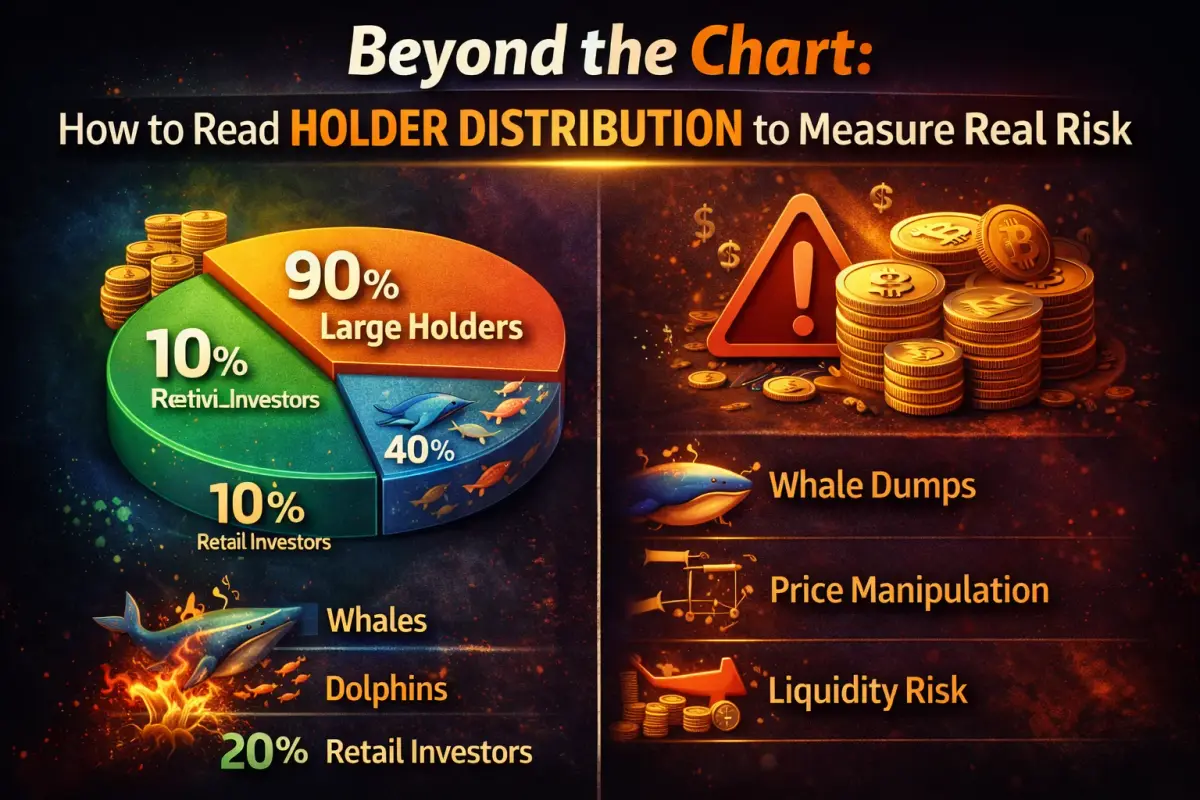
Top 10 Holders: Unveiling Market Structure
First, examine the supply share of the top 10 holders.
This metric highlights token centralization. If top wallets hold a large supply percentage, the market's fragility increases. Even if those holders aren't selling now, their potential exits loom over traders.
A healthier market shows more balanced ownership over time. The top few may still have significant amounts early on, but none should dominate. Lower concentration among top wallets typically suggests a stronger market structure.
Not every large holder is a threat. Some wallets include liquidity pools, treasuries, or exchanges. Yet, the core question remains: How concentrated is real control?
If too much is centralized, the token is riskier than the chart indicates.
New vs. Old Wallets: Gauging Demand Type
Another key signal is the balance of new versus old wallets.
This reveals whether fresh participants are joining or if activity is driven by early holders and insiders.
A healthy token attracts new wallets, suggesting project reach expansion and interest. New entrants distribute ownership and lesson early buyer reliance.
Older wallets also matter. If long-term holders stay active without dominating, it's positive. It indicates retention of trust and continuity. However, problems arise when old wallets hold excessively, hindering new wallet growth. This signals insufficient market expansion, maintaining concentration risk.
A strong token balances both. Older wallets engage while new ones arrive, leading to more distributed ownership as the market matures.
Buy Dispersion: Differentiating Demand
Buying pressure isn't uniform.
A token may rise due to widespread buying or concentrated purchases by few wallets. Although charts appear similar, risks differ drastically.
Thus, buy dispersion is vital, showing whether demand is widespread or focused on few actors.
Healthy buy dispersion suggests accumulation by varied participants. Small, medium, and larger buyers contribute, creating a sustainable structure not reliant on a few decisions.
Weak buy dispersion signals fragility. A rally may be less organic if a narrow wallet cluster drives most buying. The market becomes vulnerable if momentum relies on few participants.
Charts can rise both ways. Holder structure reveals dependence on broad participation.
Connected Whales: A Major Red Flag
Connected whales are often overlooked in token analysis.
Large wallets might seem like healthy distribution, but if one entity controls them through related addresses or coordinated actions, decentralization is deceptive. Multiple large holders may, in fact, be a single power bloc.
This is crucial because connected whales create upside illusions and downside shocks. They can simulate strong demand, appear diversified, and exit rapidly, misleading traders into false security.
A token becomes riskier when its largest wallets aren't independent. Even with a healthy chart, the market centralization is more severe.
Simply counting large wallets isn't enough. Determine if they act as separate participants or a unified cluster.
Broad Ownership Supports Healthier Prices
Holder distribution affects not just risk, but market behavior.
Broader ownership often manifests in healthier price behavior. Moves remain volatile, yet they draw support from a wider participant base. Dependence on few wallets decreases, reducing extreme swings from concentrated exits.
Heavily concentrated tokens react more sharply. Prices rise quickly when few wallets accumulate, then reverse when they reduce exposure. The chart is less reliable, relying on few decisions.
This explains why strong charts sometimes collapse suddenly. The market was narrower than it appeared, based on a weak holder structure.
Distribution Over Hype: The Smart Bet
Hype generates buzz, but distribution ensures resilience.
A token might trend on social media, dashboard hotspots, and show high volumes. However, a narrow ownership still exposes concentration risk. No promotion can shield a token when few control supply.
Experienced traders focus more on distribution than noise, knowing attention is quick to make, while healthy ownership builds over time. A broad holder base can't be easily faked and holds lasting value.
When ownership expands naturally, a token goes from a short trade to a functional market. While risks remain, the project's volatility absorption capacity strengthens.
Holder Distribution Warning Signs
Several patterns should heighten trader vigilance.
A high supply percentage with top 10 holders is a glaring warning, as is weak new wallet growth during rallies. If buying seems led by few large players, it suggests narrow conviction.
Beware connected whales. If large wallets share funding paths or synchronized moves, token centralization may exceed appearances, hiding risks from traders focusing solely on charts and volumes.
Multiple warning signs strengthen the cautionary case. Concentrated top holders, weak new wallet growth, poor buy dispersion, and potential whale clustering demand more trader care than surface chart inspection suggests.
Healthy Holder Distribution Traits
Healthier distribution shows recognizable traits.
Top holders shouldn't have an overwhelming supply share after excluding non-directional wallets. New wallets should consistently join, demonstrating expanding interest beyond early participants. Buying should be dispersed, not concentrated intensely.
Large wallets should exist, but not appear as a coordinated group dominating the market.
Such structures suggest more credible growth. Though crypto assets always face risks, extreme concentration doesn't intensify it.
Healthy distribution grants more market functioning room, lowering chances of one wallet cluster determining outcomes for everyone.
Practical Use of Holder Distribution
The practical value of holder distribution lies in assessing token health before price forces an issue.
Beyond examining chart strength, ask crucial questions. How much is controlled by top 10 holders? Are new wallets consistently joining? Is buying spread or dominated by few? Do top wallets look independent?
These questions shift your chart interpretation. Rallies backed by improving distribution differ from those based on concentrated ownership. The former remains risky but signifies a real market, while the latter might be fragile.
The advantage lies in recognizing this difference early.
In crypto, analysis begins where price ends. That's why understanding holder distribution matters.
Community vs Hype: Spot Real Token Support Spotting Real vs. Manipulated Crypto Rallies High Volume, Low Conviction: Detecting Inflated DEX Activity How to check token crypto holders with DEXTools What Drives Token Explosions: Supply, Hype, or Structure?