Clarity Act Stalls: Banks Resist Stablecoin Rewards
— By Whatsertrade in News

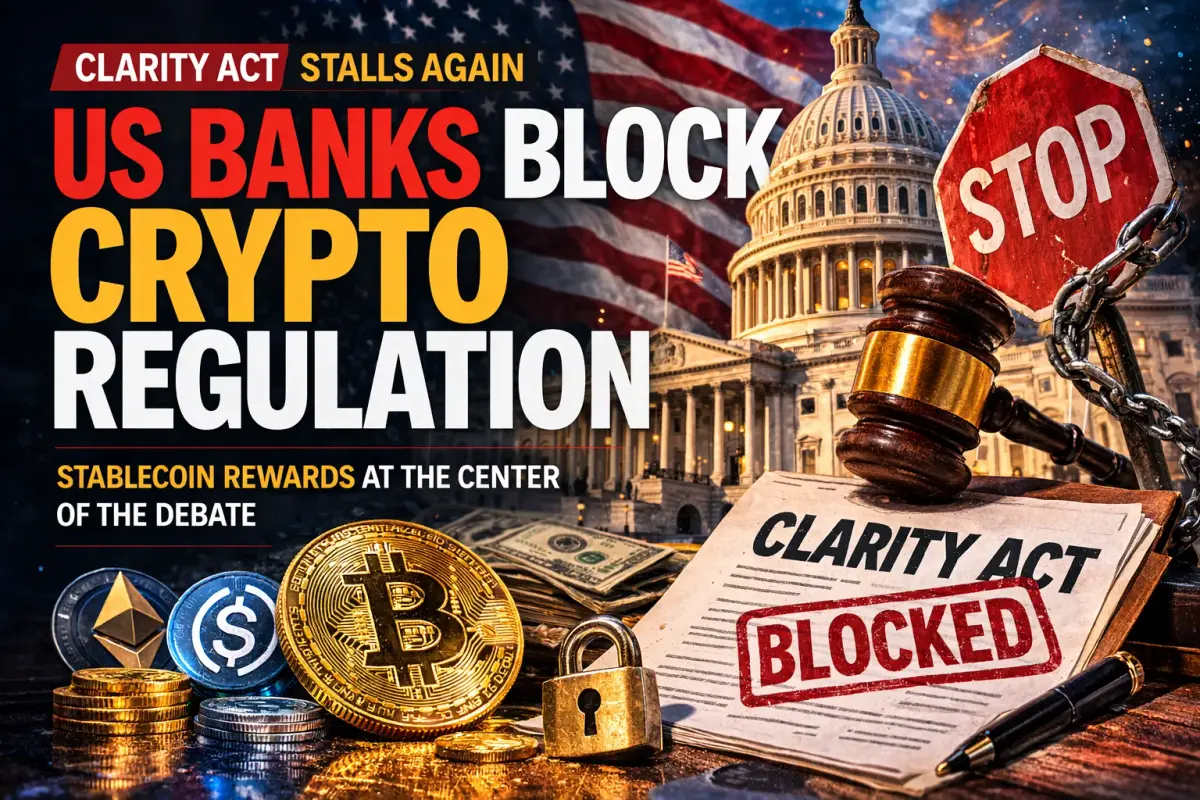
Banks push back on stablecoin rewards, stalling the Clarity Act. Crypto regulation delayed amid the battle over US digital finance.
The latest impasse centers on one of the most sensitive issues in digital asset regulation: whether crypto exchanges and stablecoin issuers should be allowed to offer rewards tied to stablecoins without triggering a migration of deposits away from the traditional banking system.
For the crypto industry, this delay represents more than a procedural setback. It underscores the ongoing influence of the banking sector in shaping US crypto regulation. If the bill does not advance by July, the political window for passing major legislation could narrow as midterm elections take center stage in Washington.
Why the Clarity Act matters for the crypto industry
The Clarity Act is seen as pivotal to creating a functional legal structure for the US digital asset market.
For years, crypto companies have operated under a patchwork of enforcement actions, overlapping agencies, and vague rules. Exchanges, token issuers, and investors have all faced uncertainty about digital asset classification and regulation. This uncertainty hampers firms from developing long-term strategies.
A bill focused on crypto market structure could help define responsibilities, reduce legal confusion, and create a predictable environment for innovation. That is why every delay matters. When legislation stalls, the entire sector stays trapped in a gray zone.
Stablecoin rewards become a flashpoint
Stablecoin rewards have emerged as a key disagreement point.
The core issue is whether exchanges and issuers should be allowed to offer yield-like incentives or rewards linked to stablecoin holdings. Proponents argue these features are part of a competitive digital finance market and could aid the adoption of regulated stablecoins. Critics, especially in banking, worry these incentives could lead consumers and businesses to move money away from traditional banks and into digital assets.
This tension is now at the center of the Clarity Act debate. It represents a broader struggle over who controls the next stage of payments, digital cash, and blockchain-based finance in the United States.
Why banks are pushing back
Banks have much at stake in the stablecoin debate.
Deposits are a core component of the traditional banking model. If stablecoins offer attractive rewards and easier access, they could compete more directly with bank accounts, especially for users seeking convenience, speed, and flexible on-chain utility.
From the banking sector’s perspective, this goes beyond crypto innovation. It's about preserving funding stability and defending a key part of the financial system. That's why the industry continues to oppose proposals that strengthen stablecoins in daily finance.
This pressure sheds light on why crypto legislation in Washington frequently encounters resistance even when there's momentum for reform.
Another setback for US crypto regulation
The latest delay is a major frustration for crypto firms awaiting regulatory clarity.
The US often speaks of leading in financial innovation, yet crypto regulation drags on. As other regions progress with clearer digital asset rules, the US struggles to align lawmakers, regulators, and financial institutions around a unified framework.
This leaves crypto businesses in a tough spot. They deal with rising compliance pressure without clear legislation. They must navigate enforcement risk while competing globally amidst tokenization, stablecoins, and blockchain-based financial products.
The longer the Clarity Act remains stalled, the more uncertainty weighs on the sector.
Why timing is critical now
Timing stands as a vital aspect of this narrative.
If lawmakers can't move the Clarity Act forward by July, prospects of significant progress diminish as Washington embraces midterm election politics. When campaigns dominate, major financial legislation often finds less room to advance.
This narrows opportunities for the crypto industry. Missing this chance could delay market structure reform well beyond this session, keeping exchanges, issuers, and investors in regulatory uncertainty longer.
For US-based companies, such delay influences capital flows, product launches, and future innovation.
The bigger issue behind the Clarity Act fight
At its core, the Clarity Act debate is about power.
It's about whether digital finance's future will be shaped mainly by crypto-native firms, traditional financial institutions, or a blend of both. Stablecoin rewards may seem technical, but they reflect a larger conflict over who controls user funds, payment rails, and the next wave of financial products.
That's why this bill is crucial for the market. It's not just about legal terms. It's about whether the US can establish rules that foster innovation without letting established players obstruct every major transition.
For the crypto sector, the threat is clear. If banking interests continue slowing legislation, the industry may linger in uncertainty while competitors in other markets gain ground.
Impact on crypto exchanges and issuers
For crypto exchanges and stablecoin issuers, the Clarity Act's latest setback is a telltale signal.
Even when legislation seems to progress, powerful financial interests in Washington can still slow or reshape the process. Firms need to be cautious about assuming regulatory clarity is near just because momentum appears to build temporarily.
Meanwhile, the stablecoin rewards controversy highlights where upcoming battle lines might lie. Businesses tied to digital payments, tokenized cash, or yield-linked products will likely face keen scrutiny from both lawmakers and traditional finance.
This makes regulatory positioning even more crucial for companies striving to grow in the US market.
The Clarity Act stalling again in Washington shows US crypto regulation remains deeply contested.
The debate over stablecoin rewards highlights a broader struggle around banking influence, market structure, and digital finance's future in the US. For the crypto industry, the stakes are high. Delays keep exchanges, issuers, and investors waiting for legal clarity long overdue.
If the bill doesn't regain momentum soon, the political calendar could make its passage much trickier. And if that happens, the banking sector may prove its ability to stall the regulatory progress the crypto market eagerly anticipates.
Si quieres, te lo convierto también en una versión más agresiva estilo DEXTools breaking news, con párrafos más cortos y un tono más directo para publicar.
MiCA's Impact on Europe and Stablecoin Dominance EU Regulator Pushes Euro Stablecoins Bank of England Eyes Changes to Stablecoin Regulations Key Regulatory Signals Crypto Traders Must Monitor Tokenized Assets in DeFi: RWAs Revolutionizing FinanceRelated: DeFi Trends | Stablecoin Regulation