What Is Lighter? The Zero-Fee zk Perpetual DEX Explained (2026)
— By Tony Rabbit in Tutorials

Perpetual derivatives trading has outgrown traditional automated market makers. We analyze the underlying cryptographic architecture, order book microstructure, and capital efficiency of Lighter.
Lighter and the Rise of Zero-Fee ZK DEX Infrastructure
- The architecture of decentralized perpetual derivatives exchanges has undergone a profound structural transformation. In the early developmental phases of the decentralized finance (DeFi) ecosystem, developers relied almost exclusively on automated market maker (AMM) frameworks to facilitate leverage trading. While these early vAMM (virtual AMM) and oracle-based liquidity pools democratized access to derivatives, they introduced severe systemic inefficiencies.
- High-frequency traders and institutional allocators were forced to contend with execution latency, massive price slippage on large orders, and the ever-present threat of front-running via Maximal Extractable Value (MEV) searchers.
- Furthermore, trading on legacy layer-1 networks or standard layer-2 networks subjected users to volatile gas fees for every single order placement, modification, or cancellation. This fee model made active market-making strategies and high-frequency algorithmic execution practically impossible on-chain.
- Lighter alters this operational reality by shifting the execution paradigm away from pool-based liquidity toward an ultra-high-performance, order-book-driven Zero-Fee ZK DEX. By leveraging the scalability of custom zero-knowledge (ZK) rollup infrastructure, Lighter combines the sub-millisecond execution speeds and fee-less order interactions of a premier centralized exchange (CEX) with the non-custodial sovereignty and cryptographic security of a decentralized ledger.
- This comprehensive analysis evaluates the underlying cryptographic plumbing, execution mechanics, and structural advantages defining the Lighter protocol.
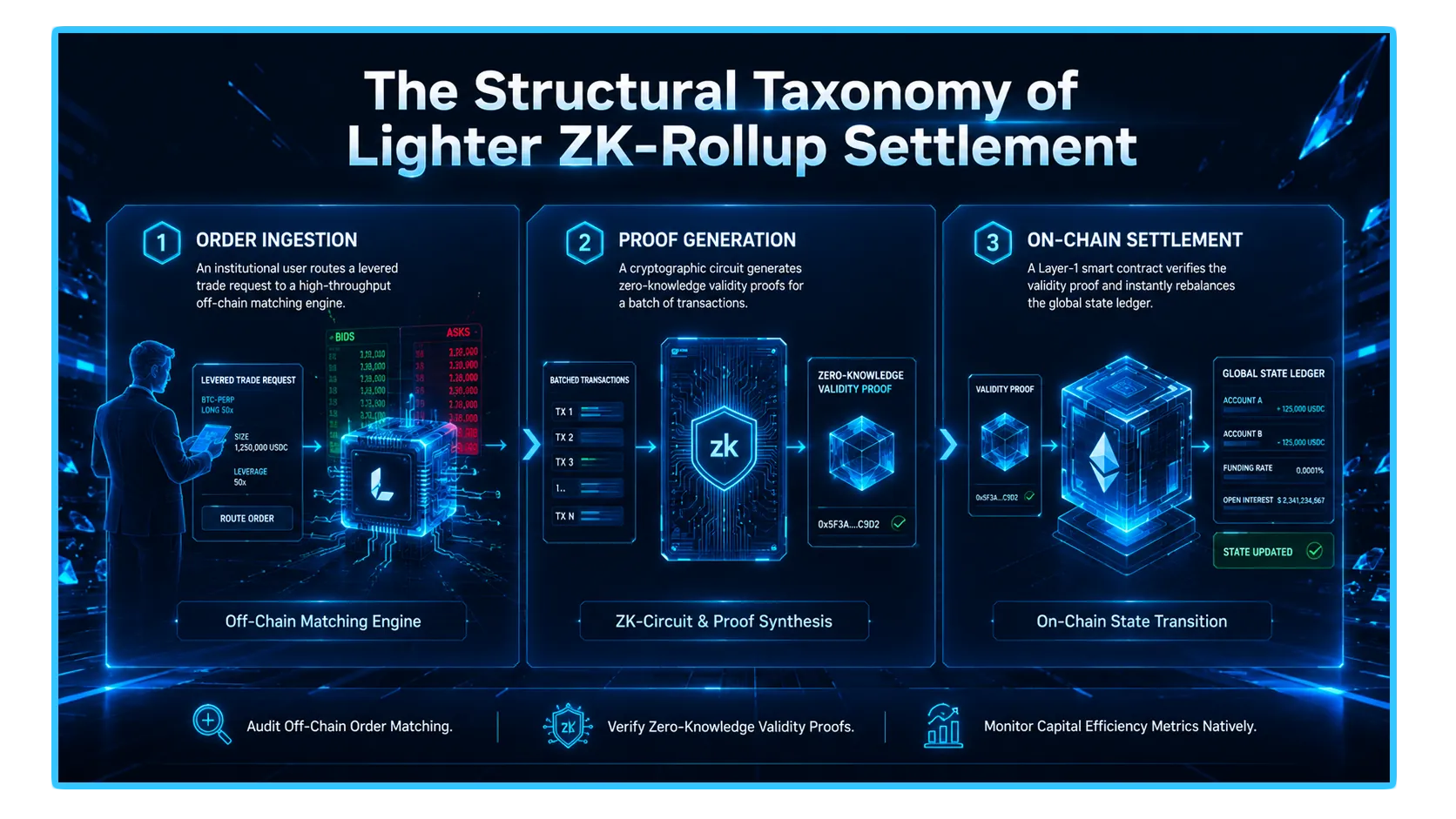
1. The Core Architecture: ZK-Rollups and Off-Chain Matching
- To evaluate Lighter with technical precision, you must decouple the concept of order execution from the concept of asset settlement. Traditional decentralized exchanges force both actions to occur simultaneously on-chain, creating a structural bottleneck bounded by the block time and throughput constraints of the underlying base network.
- Lighter bypasses this limitation through a specialized hybrid pipeline that utilizes an off-chain matching engine paired with an on-chain zero-knowledge rollup verifier.
The Off-Chain Execution Layer
- When a trader interacts with the interface, their order (whether it is a limit order, market order, or conditional stop-loss trigger) is instantly routed to an institutional-grade, off-chain matching engine. This engine operates similarly to legacy centralized financial matching systems, boasting sub-millisecond processing speeds.
- Orders are matched instantly inside an off-chain central limit order book (CLOB). Because the order book does not live directly on the blockchain ledger, traders can place, modify, and cancel orders continuously without executing wallet confirmations or incurring network gas fees.
The Cryptographic Settlement Layer
- Once orders are successfully matched off-chain, they are not simply logged into a private database; they are routed to a specialized batching engine. This engine groups hundreds of matched trades together and passes them to a zero-knowledge circuit. The ZK-circuit analyzes the batch and generates a succinct validity proof (typically a SNARK or STARK proof).
- This validity proof mathematically demonstrates that all state transitions within the batch (such as shifting collateral balances, liquidating underwater positions, and updating account leverage ratios) adhere strictly to the protocol's deterministic rules.
- This proof is then broadcasted to the layer-1 or layer-2 verifier smart contract. The on-chain contract executes a single verification function that updates the global state ledger for all accounts simultaneously. Because the underlying data is verified cryptographically rather than through manual execution by every node on the network, the security of the asset allocation remains fully backed by the base chain's consensus layer, ensuring absolute self-custody for the user.
2. The Economics of Zero-Fee Trading
The primary question raised by institutional allocators when evaluating a Zero-Fee ZK DEX is sustainability. If a platform does not charge explicit maker or taker fees for execution, how does it maintain its infrastructure, incentivize liquidity providers, and underwrite the cost of zero-knowledge proof generation? Lighter resolves this economic puzzle through an optimized market architecture that capitalizes on order flow monetization and hyper-efficient proof synthesis.
Compression of Proof Overhead
The generation of cryptographic validity proofs is a resource-intensive computing process. Lighter minimizes this overhead by implementing specialized hardware acceleration and parallelized proving circuits. By compressing the mathematical complexity of each proof and batching thousands of transactions into a single state update, the per-transaction cost of on-chain verification drops to a fraction of a cent. This hyper-efficiency allows the protocol to absorb the marginal infrastructure costs rather than passing them to the end-user.
Market Maker Subsidies and Liquidity Architecture
- Rather than extracting revenue from retail traders via explicit trading fees, Lighter’s economic model relies on a highly optimized relationship with institutional market makers. The platform provides designated market makers with raw, low-latency API access to the off-chain matching engine.
- By eliminating maker fees entirely, Lighter incentivizes market makers to quote incredibly tight bid-ask spreads with deep liquidity, mimicking the depth of premier centralized venues. The protocol sustains its operational treasury through alternative avenues, such as structured institutional access fees, premium API telemetry subscriptions, and the internalization of systemic arbitrage revenue generated through its lightning-fast liquidation engine.
3. Order Book Microstructure vs. Legacy AMMs
The operational divergence between Lighter's central limit order book and a traditional AMM liquidity pool radically alters the capital efficiency and execution quality of every trade.
Elimination of Slippage and Capital Efficiency
- In an AMM framework, the price of an asset changes dynamically along a deterministic curve based on the transaction size relative to the total liquidity locked in the pool. This model introduces inherent execution slippage; a large buy or sell order shifts the pool's ratio, forcing the trader to accept an execution price significantly worse than the initial market quote.
- Lighter eliminates this friction through its order book design. Because liquidity is represented as distinct limit orders placed at specific price ticks by global market makers, traders can execute large institutional block trades at a flat, predictable price, provided there is sufficient counterparty depth at that specific tick. This microstructure maximizes capital efficiency, allowing traders to utilize higher leverage with significantly lower tracking error.
Absolute MEV Protection
- On standard decentralized platforms, transactions sit inside a public mempool before being confirmed in a block. This transparency allows malicious bots to front-run or sandwich retail trades, artificially manipulating the execution price to extract value from the user.
- Inside the Lighter ecosystem, the off-chain matching engine processes orders privately before they are compressed into a cryptographic batch. Because there is no public mempool for individual orders, external actors cannot see or front-run pending trades. The zero-knowledge validity proof ensures that by the time the transaction data hits the public layer, the trade has already been irrevocably executed and settled, providing absolute immunity against toxic on-chain MEV extraction.
4. Cross-Margin Frameworks and Account Abstraction
To support professional derivatives trading, an exchange must provide a sophisticated risk-management engine capable of optimizing collateral efficiency across multiple open positions. Lighter achieves this by integrating an advanced cross-margin framework powered by account abstraction.
Portfolio Margin Optimization
- Unlike isolated margin systems (where each individual position requires its own dedicated collateral pool and can be liquidated independently) Lighter’s cross-margin engine evaluates the user’s entire account portfolio as a unified entity.
- The system continuously calculates the net risk of all open positions simultaneously. If a trader holds a highly profitable long position in Bitcoin alongside a temporary drawdown in an Ethereum position, the unrealized profits of the winning trade automatically collateralize the losing trade. This integrated approach dramatically lowers the overall liquidation threshold for diversified portfolios, allowing institutional allocators to safely maximize their capital deployment efficiency.
Seamless Onboarding via Account Abstraction
- The utilization of zero-knowledge rollup infrastructure can occasionally introduce a friction-filled user experience requiring multiple cryptographic signature confirmations for basic interactions. Lighter bypasses this operational bottleneck through smart contract account abstraction.
- When a user initializes an account, the platform deploys a dedicated, programmable smart wallet on the rollup layer. This wallet enables features like "session keys," allowing the user to authorize their trading desk to execute orders for a specific duration without requiring manual wallet pop-ups for every individual trade. This seamless interface delivers a frictionless, centralized-exchange-like workflow while strictly maintaining the non-custodial integrity of the user's funds.
5. Systemic Risks and Architectural Trade-Offs
An institutional-grade analysis of any bleeding-edge financial platform demands a candid evaluation of its underlying trade-offs and failure modes. Lighter delivers unparalleled speed and cost-efficiency, but its hybrid design introduces specific risk parameters that participants must actively manage.
Centralization Risks of the Sequencer
- While the verification of transactions is fully decentralized and secured by the on-chain ZK-proof verifier contract, the initial ingestion and matching of orders rely on a centralized off-chain matching engine and sequencer. If this matching engine experiences a hardware failure, an extended power outage, or a localized DDoS attack, the trading desk is instantly paralyzed.
- Traders would be temporarily unable to modify or close open positions during a period of intense market volatility. Although the underlying zero-knowledge architecture ensures that the operator can never steal or misappropriate user funds, the centralized nature of the execution pipeline remains a distinct point of operational failure.
Cryptographic and Circuit Vulnerabilities
- Lighter's security model rests entirely on the mathematical infallibility of its zero-knowledge circuits. If a logical flaw, an unexpected edge-case vulnerability, or an optimization error exists within the compiled zero-knowledge proving software, a highly sophisticated attacker could theoretically forge valid-looking proofs.
- Such an exploit could allow an attacker to execute unauthorized state transitions, manipulate account balances, or drain collateral from the main layer-1 bridging vaults. While these circuits undergo continuous, rigorous multi-firm institutional audits, the absolute novelty of custom ZK-proving architecture requires allocators to account for inherent smart contract and cryptographic implementation risks.
6. Structural Paradigm Matrix
To contextualize Lighter's position within the global financial landscape, we can compare its architectural properties directly against legacy AMM derivatives platforms and traditional centralized exchanges:
| Architectural Metric | Legacy AMM Perp DEX | Centralized Exchange (CEX) | Lighter Perp DEX |
| Execution Fee Structure | Volatile Gas + Swap Fees | Fixed Maker/Taker Fees | Zero Trading Fees |
| Asset Custody Model | Non-Custodial (On-Chain) | Fully Custodial (Centralized) | Non-Custodial (ZK-Rollup) |
| Slippage & MEV Risk | High (Public Mempool) | Low (Internal Matching) | Absolute Protection (ZK) |
| Execution Latency | Bounded by Block Times | Sub-Millisecond Speed | Sub-Millisecond Speed |
| Risk Management | Typically Isolated Margin | Comprehensive Cross-Margin | Advanced Cross-Margin |
7. Conclusion: The On-Chain Derivatives Frontier
- The Lighter platform represents a major step forward in the evolution of decentralized derivatives infrastructure. By successfully implementing a high-throughput central limit order book directly on top of custom zero-knowledge rollup rails, the protocol effectively synthesizes the performance advantages of centralized venues with the trustless security of decentralized architecture. The complete elimination of execution fees eliminates the primary barrier to entry for algorithmic trading desks and retail day-traders alike, maximizing capital efficiency across the digital landscape.
- While participants must remain mindful of the operational dependencies associated with centralized sequencing systems and the inherent complexity of zero-knowledge circuits, Lighter’s innovative architecture proves that high-performance, non-custodial financial primitives are fully capable of replacing centralized alternatives, cementing its role as a disruptive force redefining the boundaries of modern DeFi.
On-Chain Diagnostics and Verification via DEXTools
- Navigating a high-velocity trading regime powered by zero-knowledge rollups requires look-through visibility into live secondary market liquidity data. While Lighter's internal matching engine displays a real-time order book order stream, independent verification of the actual on-chain collateral bridging velocity and external trading pair volume remains the only method to audit genuine market health and cross-reference exchange telemetry.
- DEXTools provides the critical analytical infrastructure needed to monitor these external dynamics, allowing investors to track live spot pair volume, audit the liquidity depth of underlying collateral assets across automated market makers, verify transaction trends, and trace large-scale institutional wallet deposits or redemptions across multiple layer-1 and layer-2 networks.
Disclaimer: This article is for informational purposes only and does not constitute investment advice, financial advice, trading advice, or any other kind of advice. DEXTools does not recommend buying, selling, or holding any cryptocurrency or token. Users should conduct their own research and consult with a qualified financial advisor before making any investment decisions. Cryptocurrency investments are volatile and high-risk. DEXTools is not responsible for any losses incurred.