What Is a Proxy Contract in Crypto? Guide (2026)
— By Tony Rabbit in Tutorials

Proxy contract explained: learn how upgradeable contracts work, why teams use admin keys, and what to inspect before trusting upgradeable code.
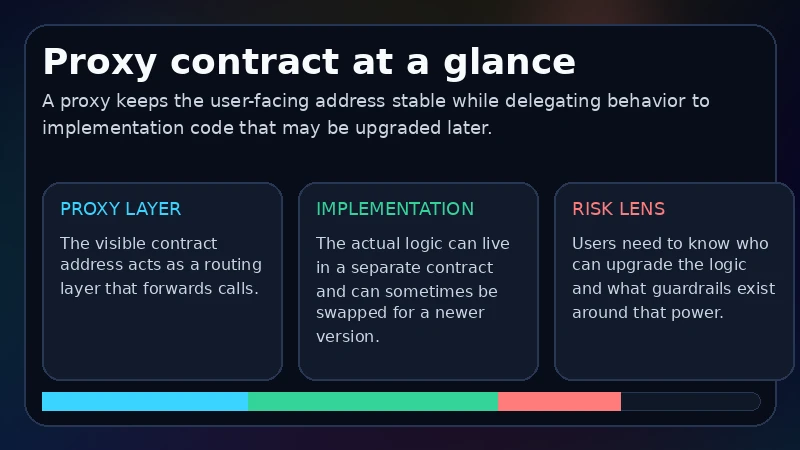
A proxy contract in crypto is a contract architecture that separates the address users interact with from the logic that actually runs the application. The visible contract can stay the same while the underlying implementation changes. That design is popular because teams want to fix bugs, add features, or evolve a protocol without forcing every user to migrate to a brand-new address.
The tradeoff is obvious once you see it clearly: upgradeability adds flexibility, but it also adds trust assumptions. If a contract can be upgraded, users need to know who controls that power, how changes are governed, and whether the protocol has guardrails like timelocks or multisigs. A proxy contract is not automatically unsafe, but it is never the same thing as a permanently immutable contract.
Quick answer
- A proxy contract lets a project change logic without changing the main address.
- That flexibility can help with bug fixes, feature upgrades, and migration simplicity.
- The main user risk is who controls upgrades and how much trust the upgrade path requires.
Intent split
- This page is the upgradeable-contract guide: how proxy architecture works and what trust assumptions it introduces.
- For the question of who controls a contract today, read What Is an Owner Wallet in Crypto?.
- For the myth that renounced automatically means safe, read What Is a Renounced Contract in Crypto?.
What a Proxy Contract Actually Is
At a high level, proxy architecture separates storage and interface from executable logic. The user continues to interact with one familiar address, but that address can delegate calls to a different implementation contract. When the project upgrades, it may update the implementation target while preserving the same surface address for users and integrations.
That design can be useful. Protocols that hold serious value often need the ability to patch mistakes or add functionality without breaking every integration. But for security analysis, the consequence is that the code you trust today may not be the code you interact with tomorrow. The address remains constant while the trust story stays dynamic.
Why users should care about proxy architecture
How This Topic Differs From Owner-Wallet and Renounced-Contract Pages
Proxy-contract content can cannibalize badly if it becomes a general article about every contract-control concept at once. The clean way to avoid that is to keep the main question specific: can the code behind this address change? Owner-wallet pages are about who currently holds privileged control. Renounced-contract pages are about whether certain owner powers were given up. Proxy pages are about upgradeability and implementation routing.
These topics overlap in practice, but they are not the same search intent. A reader searching proxy contract usually wants to understand why a contract may still change even when the surface address looks stable. That is a more architectural question than a simple holder-permission question.
How the proxy-contract page fits the contract-control cluster
How to Inspect Upgradeability Risk Before You Trust a Contract
Start by asking whether the contract is upgradeable at all. If it is, identify the admin path. Is the upgrade power held by a single wallet, a multisig, a DAO, or a timelock-controlled process? Then look for transparency. Serious protocols tend to document upgrade frameworks and publish changes, because they know users and integrators need to understand what can move.
Then think operationally. Even if the team is honest, upgradeability adds extra moving parts. Bugs in upgrade logic, compromised admin keys, or rushed emergency changes can all create risk. The right mindset is not paranoia for its own sake. It is recognizing that upgradeability replaces some code certainty with governance and operational certainty, which must be evaluated directly.
A practical proxy-contract review flow
Common Mistakes When Reading Upgradeable Contracts
The most common mistake is over-indexing on the address. Users get comfortable because the contract address is well known, integrated, or old. But a proxy architecture means the address can stay familiar while the implementation shifts underneath it. That is why static trust can be misleading in a dynamic system.
Mistakes worth avoiding
Frequently Asked Questions
Is a proxy contract automatically unsafe?
No. Proxy contracts are common and can be managed responsibly. The real question is whether the upgrade path is transparent, governed, and appropriately secured.
Why do teams use proxy contracts?
They use them to fix bugs, add features, and avoid forcing users to migrate to a new address after every major change.
What is the biggest user risk with upgradeable contracts?
The biggest risk is that privileged actors or compromised keys can change logic in ways the user did not expect.
How is a proxy contract different from a renounced contract?
Renounced-contract discussions focus on owner rights being given up. Proxy discussions focus on whether the logic behind the address can still change.
What should I inspect first on an upgradeable protocol?
Inspect whether it uses a proxy pattern, who controls upgrades, and whether there are timelocks, multisigs, or other public guardrails.
Related reading
Disclaimer: This article is for educational purposes only and not legal, tax, or financial advice. Smart-contract architecture and admin permissions should always be verified on the live deployment before any decision.
Related Guides
- What Is Tenderly: Smart Contract Simulation, Debugging and Web3 Monitoring (2026)
- What Is Tenderly: Smart Contract Monitoring, Simulation and Debugging (2026)
- What Is OpenZeppelin: Smart Contract Libraries, Security and Access Control (2026)
- What Is Foundry: Smart Contract Testing, Fuzzing and Solidity Tooling (2026)
- What Is ethers.js: Ethereum JavaScript Library, Providers and Contract Calls (2026)