Liquid Bank: Solana Token Pays SOL Rewards to Holders (2026)
— By Tony Rabbit in news
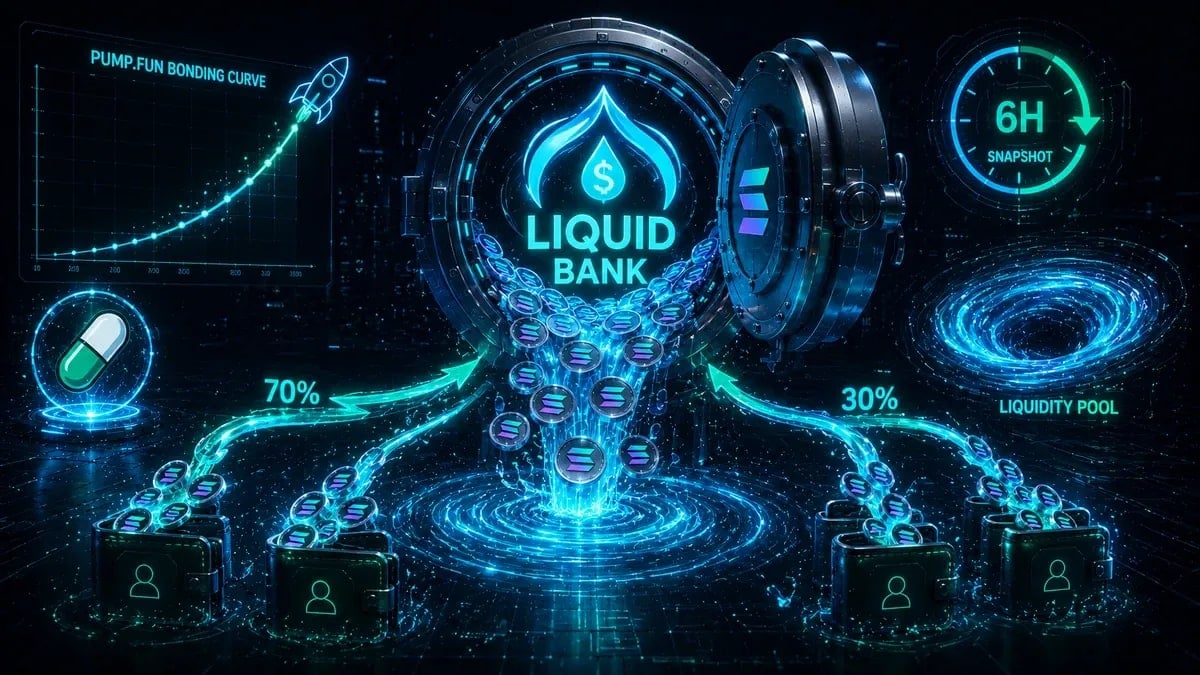
Liquid Bank is a Solana protocol on pump.fun where holders of 1M+ $Liquid earn SOL rewards via random 6-hour snapshots. 70% of creator fees compound the liquidity pool, 30% pay SOL interest to qualified holders. Here is how the bank token model works and why it is novel.
A new experimental protocol called Liquid Bank has appeared on Solana, and its design has caught the attention of yield seekers across the pump.fun ecosystem. The project markets itself as "the bank that pays you in SOL", distributing native Solana rewards to qualifying $Liquid token holders through random, unannounced snapshots that occur every six hours. Unlike traditional liquid staking derivatives or revshare meme tokens, Liquid Bank ties payouts directly to bag size and continuous holding, attempting to discourage snapshot farming while compounding its own liquidity pool over time.
The protocol launched through pump.fun, Solana's permissionless token launcher, and trades under the contract Dzqeg46fpj5XFTtUGpoDmhUAzxstdWLs2SwbFjbRpump. The trailing "pump" suffix confirms its origin as a bonding-curve launch rather than a venture-backed protocol, which immediately frames the risk profile for any potential participant.
How the Liquid Bank protocol works
At its core, Liquid Bank is a fee-redistribution mechanism wrapped around a standard pump.fun bonding curve token. The protocol's distinguishing feature is its snapshot lottery, which determines who receives SOL payouts and in what proportion.
Every six hours, the protocol records a snapshot of the $Liquid holder set. The exact timing within each window is randomized and never announced in advance, which the team frames as an anti-gaming measure. To be eligible at any given snapshot, a wallet must hold at least 1,000,000 $Liquid tokens. Wallets below that floor are excluded from the round entirely, regardless of how long they have been holding.
For wallets that clear the threshold, rewards are distributed proportionally to bag size. A wallet holding 5,000,000 tokens receives roughly five times the SOL allocation of a wallet holding the 1,000,000 minimum, scaled against the total qualifying supply. The model favors larger continuous holders, which the protocol explicitly encourages with its motto: "hold the bag, grow the pool, get paid in SOL."
- Frequency: Every 6 hours, exact timing randomized
- Minimum holding: 1,000,000 $Liquid per wallet
- Reward asset: Native SOL, not wrapped or synthetic
- Scaling: Linear with bag size above threshold
- Holding requirement: Continuous, no last-minute buys
Pre-bonding versus post-migration: the fee evolution
Liquid Bank's economic model shifts depending on whether the token has completed its pump.fun bonding curve and migrated to a permanent liquidity pool. This two-phase design has direct implications for what holders should expect during the early hours of the project versus after it graduates.
Phase 1: Pre-bonding
While $Liquid is still trading on the pump.fun bonding curve, all creator fees generated by trading activity are used to buy back and burn $Liquid tokens. This phase does not pay SOL to holders. Instead, it reduces circulating supply and applies upward pressure on price by removing tokens from the market. For holders, the pre-bonding phase functions as a deflationary period where the protocol is effectively front-loading scarcity before it begins paying interest.
Phase 2: Post-migration
Once $Liquid completes its bonding curve and migrates to a permanent AMM pool, the creator fee logic flips. From that point onward:
- 70% of creator fees are routed back into the liquidity pool, deepening market depth and reducing slippage for future trades.
- 30% of creator fees are accumulated and distributed as SOL interest to qualifying holders at each 6-hour snapshot.
This split is the heart of the "bank" branding. The pool grows organically with trading volume, while a slice of every transaction is set aside as yield for those who maintain the minimum holding. There is no manual claim function described in the protocol's public material, no staking action required beyond holding the token in a self-custodied Solana wallet.
Why the anti-gaming design matters
Snapshot-based reward systems have a long history of being exploited. The most common attack is snapshot sniping, where opportunistic wallets accumulate the minimum threshold just before a known snapshot and dump immediately afterward. This pattern extracts yield without contributing to long-term holder stability and tends to degrade the token's price action over time.
Liquid Bank attempts to neutralize this in two ways. First, the snapshot timing is randomized within each 6-hour window, so there is no predictable target to front-run. Second, the protocol emphasizes continuous holdings as a requirement, which suggests the snapshot system may detect or penalize wallets that show signs of intra-window churn. The public materials are not explicit about exactly how this is enforced on-chain, which is a transparency gap worth flagging.
The combination of random timing and continuity scoring is meant to push participants toward the protocol's stated ideal: large bags held over long periods, rewarded with a proportional share of trading-fee-derived SOL. Whether this works in practice depends entirely on adoption, sustained trading volume, and the team's ability to defend the snapshot logic from sophisticated farmers.
Liquid Bank vs liquid staking vs revshare tokens
To contextualize where Liquid Bank sits in the broader Solana yield landscape, it is worth comparing it against the two most common SOL-denominated yield categories: liquid staking derivatives like Jito and Marinade, and revshare meme tokens that distribute a portion of trading fees.
| Feature | Liquid Bank ($Liquid) | Liquid Staking (JitoSOL, mSOL) | Revshare Tokens |
|---|---|---|---|
| Yield source | Creator fees from trading | Validator staking rewards + MEV | Trading fees or platform revenue |
| Payout asset | Native SOL | SOL (via token appreciation) | Usually SOL or USDC |
| Eligibility | 1,000,000+ $Liquid, continuous | Any LST balance | Varies, often any holding |
| Distribution method | Random 6-hour snapshots | Continuous, baked into LST price | Scheduled or per-trade |
| Risk profile | Very high (pump.fun launch) | Low to moderate | High (volume-dependent) |
| Team transparency | Anonymous | Doxxed, audited | Mixed |
The table makes clear that Liquid Bank does not compete with Jito or Marinade in terms of safety or institutional credibility. It is closer in spirit to revshare meme tokens, but with a more structured eligibility model and a deflationary pre-bonding phase that most pump.fun revshare experiments lack.
Risk factors holders should weigh
Liquid Bank is novel, but it is also exposed to the full set of risks that come with any pump.fun launch. Before allocating any meaningful capital, holders should consider the following:
- Anonymous team: No public identities, no track record, no audited contracts disclosed.
- pump.fun origin: The vast majority of pump.fun tokens fail to migrate or sustain liquidity post-migration.
- Snapshot dependency: If the snapshot oracle or distribution logic breaks, yield stops. There is no clear public dispute mechanism.
- Volume risk: The 30% SOL distribution scales directly with creator fees, which scale with trading volume. Low volume equals minimal yield.
- Threshold concentration: The 1,000,000 token floor may favor whales and discourage smaller participants from joining the holder set.
- Smart contract risk: No audit information has been published at the time of writing.
None of these flags are unique to Liquid Bank. They are the standard risks attached to any early-stage Solana token launched through a permissionless platform. The novelty of the bank token model does not exempt $Liquid from the same failure modes that have claimed thousands of similar projects.
Where to track $Liquid on-chain
For anyone monitoring the project, the following resources cover the essential data points: live price action, holder distribution, contract activity, and pool depth.
- DexTools pair explorer: View $Liquid on DexTools for live charts, transaction history, and pool composition.
- Solscan: Token page on Solscan for holder distribution, top wallets, and on-chain transfers.
- pump.fun: Token page on pump.fun to confirm bonding curve status and migration progress.
- Official site: liquidbank.tech for the protocol's primary description and any official announcements.
The most important on-chain metric for prospective holders is whether the token has migrated off the bonding curve. Pre-migration, the SOL distribution mechanic is not yet active. Post-migration, the 70/30 fee split begins, and the first snapshot rewards become claimable.
Outlook: what to watch next
Liquid Bank's success depends on three measurable signals. First, the token needs to complete its bonding curve and migrate; without migration, the headline yield mechanic never activates. Second, sustained trading volume after migration is essential, because the 30% SOL payout is a direct function of creator fees, which are themselves a function of volume. A protocol with low post-migration volume will pay trivial yield regardless of how clever the snapshot design is.
Third, holders should watch for independent verification of the snapshot logic. The anti-gaming claims rest on randomized timing and continuity scoring, but those properties are only credible if they can be observed and audited on-chain. If the snapshot mechanism turns out to be off-chain or operated by the team, the protocol's trust assumptions collapse into "trust the anonymous creator."
The model is novel enough that, if it works, it may inspire a wave of similar bank token launches on Solana. If it fails, it will join the long list of pump.fun experiments that produced an interesting design and nothing else. Either outcome is informative, but only one of them pays in SOL.
Frequently asked questions
Q: How many $Liquid tokens do I need to earn SOL rewards?
You need to hold at least 1,000,000 $Liquid tokens continuously to qualify at any 6-hour snapshot. Wallets below that threshold receive no SOL distribution.
Q: When are the snapshots taken?
Every six hours, but the exact timing within each window is randomized and never announced in advance, which is intended to prevent snapshot sniping.
Q: Where do the SOL rewards come from?
After the token migrates from the pump.fun bonding curve, 30% of creator fees generated by trading activity are distributed as SOL to qualifying holders. The other 70% compounds into the liquidity pool.
Q: Is Liquid Bank audited?
No public audit has been disclosed at the time of writing. The team is anonymous and the token was launched permissionlessly through pump.fun, so holders should treat it as unaudited until proven otherwise.
Q: How is Liquid Bank different from JitoSOL or mSOL?
JitoSOL and mSOL are liquid staking derivatives backed by validator rewards on the Solana network. Liquid Bank is a meme-grade fee-redistribution token where yield comes from trading activity on the $Liquid token itself, not from staking SOL with validators. The risk profile is significantly higher.